
You send a text. Your friend replies, “uk?” Now you’re stuck staring at your phone. Is it about a country? Or something else?
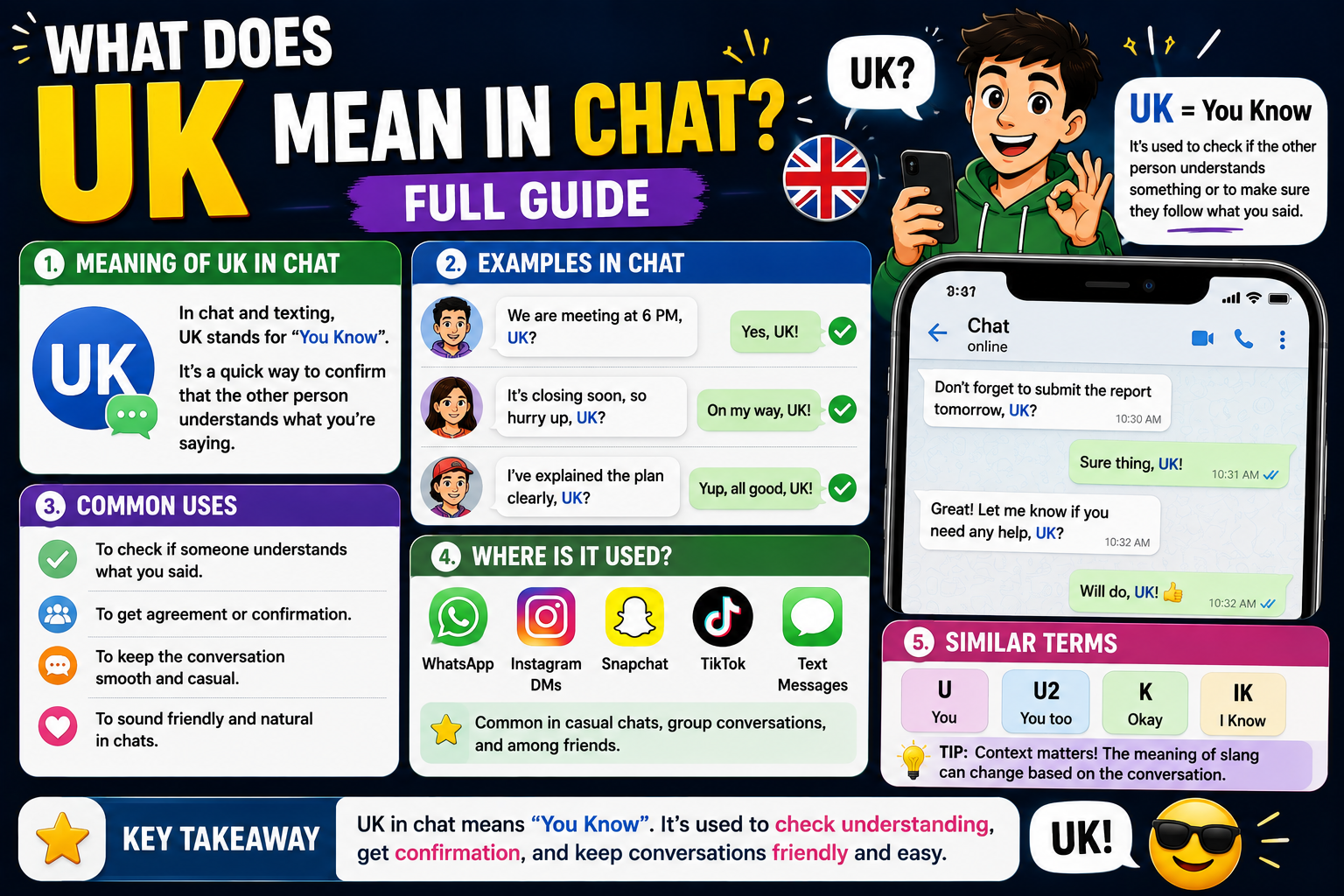
Relax. It’s not that hard. UK usually just means “you know.” People use it all the time in texts and DMs. This guide breaks down exactly what it means and how to use it.
What Does UK Mean in Chat?
In everyday texting and DMs, UK is short for “you know.” People drop it into a sentence the same way they’d use “y’know” in speech — as a filler that signals shared understanding, or as a tag question at the end of a statement.
- “That movie was so mid uk”
- “I’ve been super busy lately uk”
- “He’s kind of extra uk?”
It’s casual, low-effort, and usually doesn’t need a direct reply. Think of it as texting’s version of a verbal habit.
UK Meaning in Text Messages
Outside of “you know,” UK can occasionally stand in for “you okay?” — especially when it appears as a standalone question, often written as “u ok” or “uk?” after someone shares something worrying or goes quiet in a conversation.
- “You good? uk?”
- “That sounded rough… uk?”
Context is everything here. If UK follows bad news, silence, or something emotional, it’s more likely “you okay.” If it’s tacked onto a casual observation, it’s “you know.”
Is UK a Slang Term?
Yes. UK is internet and texting slang — an informal abbreviation, not a word with a fixed dictionary definition. Like most chat slang, its meaning is decided by context rather than spelling rules, which is exactly why it confuses people who see it out of nowhere.
What Does UK Mean on Snapchat?
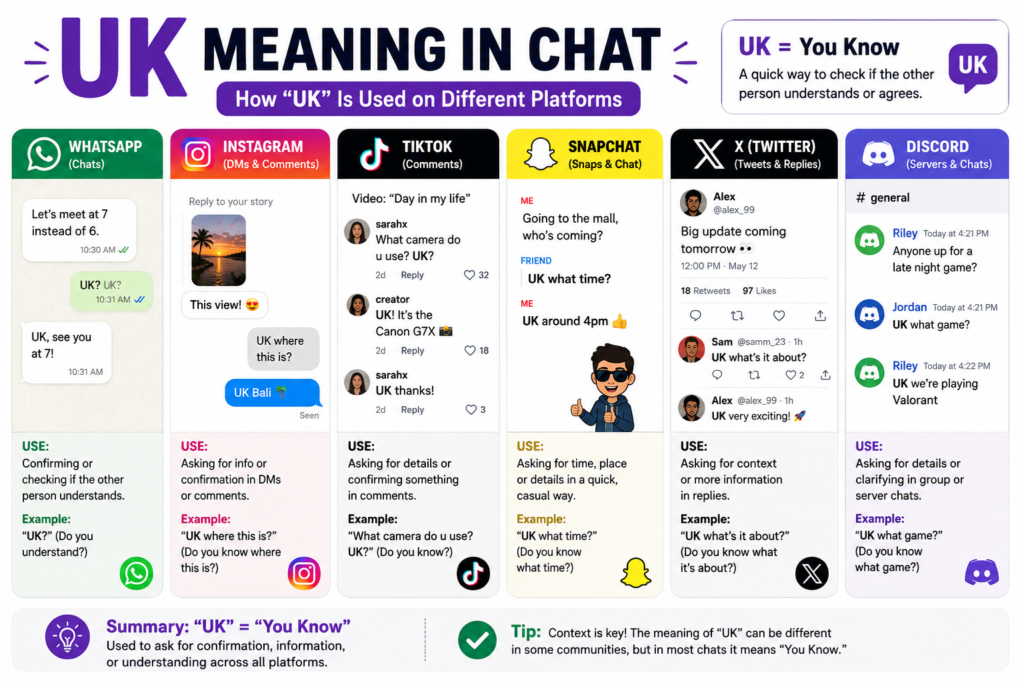
On Snapchat, UK keeps its “you know” meaning, but it shows up a lot in captions and quick replies to snaps because Snapchat conversations tend to be short and reactive.
Example 1: Snap caption: “Rainy days like this uk”
Example 2: Reply to a snap: “lol uk how it is”
Example 3: Chat message: “ngl uk I’ve been thinking about that a lot”
SEE OUR GUIDE OF CMP FOR A STRONGER EXPRESSION
UK Meaning on Instagram
On Instagram, UK pops up most in comments and DMs, often paired with other abbreviations like “ngl” (not gonna lie) or “fr” (for real). It’s used the same way — as a casual verbal tic, not a formal statement.
- Comment: “this fit is fire uk”
- DM: “uk I don’t usually post like this”
UK Meaning on TikTok
TikTok comment sections move fast, and UK fits right into that rhythm. It’s common in captions and comments where someone’s making an observation and assumes the audience already agrees.
- “the way this trend just gets funnier uk”
- Comment: “uk exactly what I mean 😭”
UK Meaning on WhatsApp
WhatsApp conversations tend to be longer and more personal than Instagram or TikTok comments, so UK here often leans toward “you know” used as a genuine connector between thoughts, similar to how it’s used in texting.
- “I’ve been meaning to call you, uk, just been busy”
Is UK an Acronym, Abbreviation, or Slang?
People often mix these terms up, so here’s where UK actually fits.
Acronym?
Not really. An acronym is pronounced as a word (like “NASA”). UK in chat is read letter by letter or simply understood as the phrase it stands for — it’s not spoken as a single sound.
Short Form?
Yes. It’s a shortened form of “you know,” created by dropping the vowel sounds and keeping the consonant-like letters, similar to how “ur” replaces “your.”
Phonetic Spelling?
Not quite phonetic in the traditional sense, but it follows the same logic as other texting shorthand — stripping words down to their fastest-typed version.
Typo Turned Slang?
Not typically. Unlike some slang that started as autocorrect mistakes, “uk” for “you know” developed intentionally as a shortcut, the same way “u” replaced “you” years ago.
Why Do People Search “UK Meaning in Chat”?
A few recurring reasons show up again and again:
1. Many Abbreviations Have Slang Meanings
Two-letter combos like UK, IK, and YK all look similar, and it’s easy to lose track of which one means what.
2. Social Media Uses Abbreviations Constantly
Platforms with character limits or fast-scroll culture (Twitter/X, TikTok, Snapchat) push people toward shorthand, so unfamiliar abbreviations show up often.
3. Confusion With YK
“YK” (you know) and “UK” are used almost interchangeably by some texters, which adds to the mix-up. Some people type “uk” simply because it’s faster than “yk” on a phone keyboard.
4. International Conversations
Because UK is also the standard abbreviation for the United Kingdom, people texting internationally sometimes genuinely aren’t sure which meaning is intended.
IK Meaning in Chat
Worth clarifying since it’s easy to confuse: IK means “I know.” It’s a response, not a filler — usually used to agree with something someone just said.
- “That test was brutal.” → “ik, I barely finished”
UK and IK look alike but function differently: UK is dropped mid-sentence or at the end as a tag; IK is typically a standalone reply.
UK Meaning Which Country
When “UK” appears in a normal sentence with capital letters, referencing travel, news, sports, or geography, it means exactly what it looks like: the United Kingdom (England, Scotland, Wales, and Northern Ireland). Context makes this obvious — “I’m visiting the UK next month” isn’t chat slang, it’s just the country.
Other Possible Meanings of UK
Less commonly, UK can also mean:
- “You’re kidding” — used sarcastically in reaction to surprising news, though this is far less common than “you know.”
- “Unknown” — occasionally used in gaming or group chats when someone’s identity or status isn’t confirmed.
If a meaning doesn’t make sense in context, it’s worth checking the sentence around it — chat abbreviations are almost always context-dependent.
Tone and Context Variations
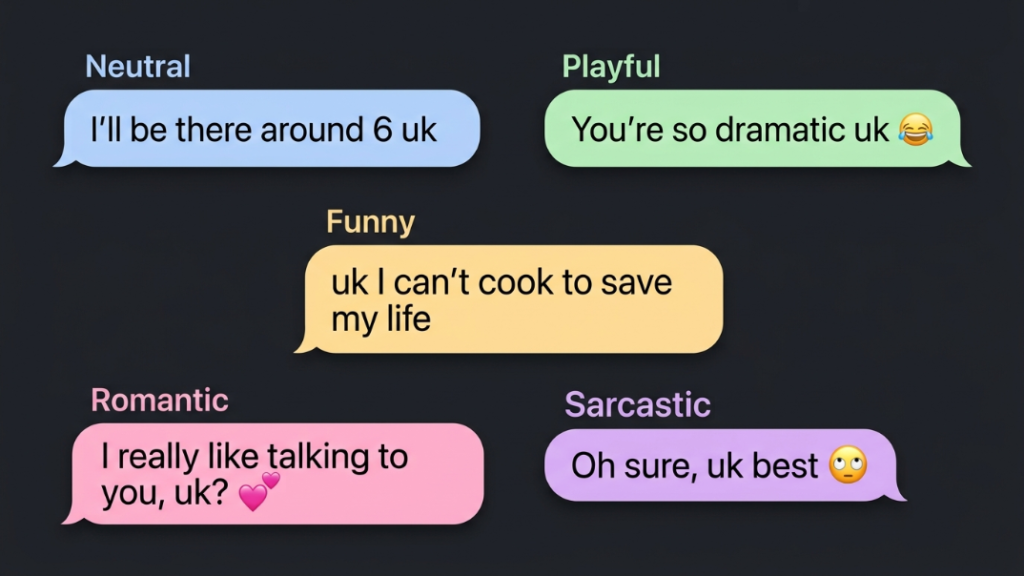
The same two letters can land very differently depending on tone.
Neutral Tone
“I’ll be there around 6 uk” — simple filler, no emotional weight.
Playful Tone
“You’re so dramatic uk 😂” — lighthearted teasing.
Funny Tone
“uk I can’t cook to save my life” — self-deprecating humor.
Romantic Tone
“I really like talking to you, uk?” — softening a vulnerable statement.
Sarcastic Tone
“Oh sure, uk best” — used ironically, often paired with an eye-roll emoji.
YOU MAY ALSO WANT TO KNOW ABOUT YFM MEANS ONLINE
Real Chat Examples Using UK
- “uk what I mean tho”
- “he’s always late uk”
- “I don’t wanna go out tonight, uk?”
- “that was so random uk 😂”
- “uk I’ve been stressed lately”
- “she’s just like that uk”
- “uk it’s not that deep”
- “I miss the old days uk”
- “uk how group projects go”
- “uk I’m not even mad”
- “that show got weird fast uk”
- “uk sometimes it’s better to just say nothing”
- “uk I hate mornings”
- “we should hang out more uk?”
- “uk life’s been a lot lately”
Grammar and Language Role of UK
Part of Speech
UK doesn’t function as a traditional part of speech. It behaves like a discourse marker — a phrase that shapes tone and flow rather than adding new information.
Sentence Position
It usually appears at the end of a sentence as a soft tag (“…uk?”) or mid-sentence as a natural pause (“I was, uk, kind of upset”).
Does UK Replace a Full Sentence?
Rarely on its own. It’s almost always attached to a longer thought rather than standing completely alone, unlike “IK” or “OK,” which can be full responses by themselves.
Tone Impact
Adding UK softens a statement, making it feel more conversational and less blunt — similar to saying “you know what I mean?” out loud.
Formal vs Informal Use
UK is strictly informal. It belongs in texts, DMs, and casual chats — not emails, cover letters, or professional messages.
How to Reply When Someone Says UK
Neutral Reply
“Yeah, I get it.”
Friendly Reply
“Haha yeah totally uk”
Funny Reply
“uk fr fr 😂”
Serious Reply
“I understand, thanks for sharing that.”
Flirty Reply
“uk you always know what to say 👀”
Comparison Table
| Abbreviation | Meaning | Typical Use |
| UK | You know | Filler / tag question |
| IK | I know | Direct agreement |
| YK | You know | Alternate spelling of UK |
| IKR | I know, right? | Enthusiastic agreement |
| UK (capitalized, in context) | United Kingdom | Geography / travel / news |
Who Uses the Term UK?
Age Groups
UK as “you know” is used most by teens and young adults, though anyone active on texting-heavy platforms can pick it up.
Gen Z vs Millennials
Gen Z: Uses UK casually and frequently, often stacked with other shorthand like “ngl,” “fr,” and “ik” in the same message.
Millennials: Tend to use the fuller “yk” or spell out “you know,” though many have adopted UK as well through social media exposure.
Regional Usage
This slang usage isn’t tied to any specific country — it’s used by English-speaking texters generally, which ironically has nothing to do with the United Kingdom as a place.
Platforms Where UK Is Common
- Snapchat
- Instagram DMs and comments
- TikTok comments
- Text messages (SMS/iMessage)
- Twitter/X replies
Origin and Internet Culture Insight
UK as slang grew out of the broader trend of vowel-dropping in texting culture, the same pattern that gave us “ur,” “thx,” and “btw.” As phone keyboards and character limits pushed people toward faster typing, “you know” naturally compressed into “uk.” It’s not tied to a single viral moment or platform — it evolved gradually alongside other texting shorthand throughout the 2010s and into the 2020s.
Why People Say UK on TikTok
TikTok comment culture rewards fast, casual reactions. UK fits that pace, letting commenters add a conversational tag without breaking the quick, informal rhythm of the platform.
ANOTHER COMMON TEXTING ABBREVIATION IS GREEN
Is UK Rude?
No. UK isn’t inherently rude — it’s simply casual. However, tone still matters: paired with sarcasm or dismissiveness (“uk whatever”), it can come across as curt, but that’s a function of the surrounding words, not the abbreviation itself.
Is UK a Bad Word?
No. UK carries no offensive meaning. It’s neutral slang, safe to use in casual conversations with friends and family.
Should You Use UK in School or Office?
Generally, no. UK is texting shorthand meant for casual conversations. In school assignments, professional emails, or workplace chats, it’s better to write out “you know” or avoid the filler altogether for a more polished tone.
Experience-Based Insight
Anyone who’s spent time in group chats or comment sections has likely seen UK used dozens of times without a second thought — it blends in so naturally that it barely registers as an abbreviation anymore. That’s a useful signal for figuring it out in real time: if a two-letter word doesn’t fit “United Kingdom,” swapping in “you know” almost always makes the sentence make sense instantly.
Clear Summary
In casual texting and social media, UK almost always means “you know.” It’s a soft, conversational filler used to signal shared understanding — not a reference to the United Kingdom unless the surrounding sentence is clearly about geography, travel, or news.
Usage Tips
- Use it the way you’d use “y’know” out loud — casually, not in every sentence.
- Check the context before assuming which meaning applies.
- Save it for texts and DMs, not formal writing.
Common Mistakes
- Confusing UK with IK (they mean different things: “you know” vs. “I know”).
- Assuming it always refers to the country.
- Overusing it in professional messages where it feels out of place.
When to Use UK
In casual texts, comments, and DMs with friends, when you want to add a relaxed, conversational tone to a message.
When to Avoid UK
In schoolwork, job applications, professional emails, or any message where clarity and formality matter more than casual tone.
Conclusion
So that’s the deal with UK in chat. Most times, it just means “you know.” It’s casual. It’s simple. And now you won’t get confused when you see it.
Next time a friend texts “uk?”, you’ll know exactly what’s up. Use it in your own texts too, if you like. Just save it for casual chats, not schoolwork or emails. That’s really all there is to it.
FAQ
What does UK mean in text?
UK usually means “you know.” It’s used as a casual filler in texts and DMs.
What does “uk slang” mean?
It refers to shorthand texting language, where “uk” stands for “you know,” used to sound casual and relatable.
What does “if UK UK” mean in chat?
This phrase means “if you know, you know” — implying an inside joke, reference, or detail that only certain people will understand. It’s often used with a wink emoji or paired with niche content.
Is there an “UK meaning in chat” entry on Urban Dictionary?
Urban Dictionary has multiple user-submitted entries for “UK,” with “you know” being one of the most common slang definitions listed there, alongside joke entries about the country.
Does UK always mean “you know”?
No — context decides. Capitalized “UK” in a sentence about travel or news almost always means the United Kingdom.
Is UK the same as YK?
Functionally, yes. Both are shorthand for “you know,” just spelled slightly differently by different texters.
Is UK short for something rude?
No, UK isn’t rude. It’s just casual slang for “you know.”
What’s the difference between UK and IK in texting?
UK means “you know,” while IK means “I know.” They’re used in different ways.
1 thought on “What Does UK Meaning in Chat? Full Guide”