
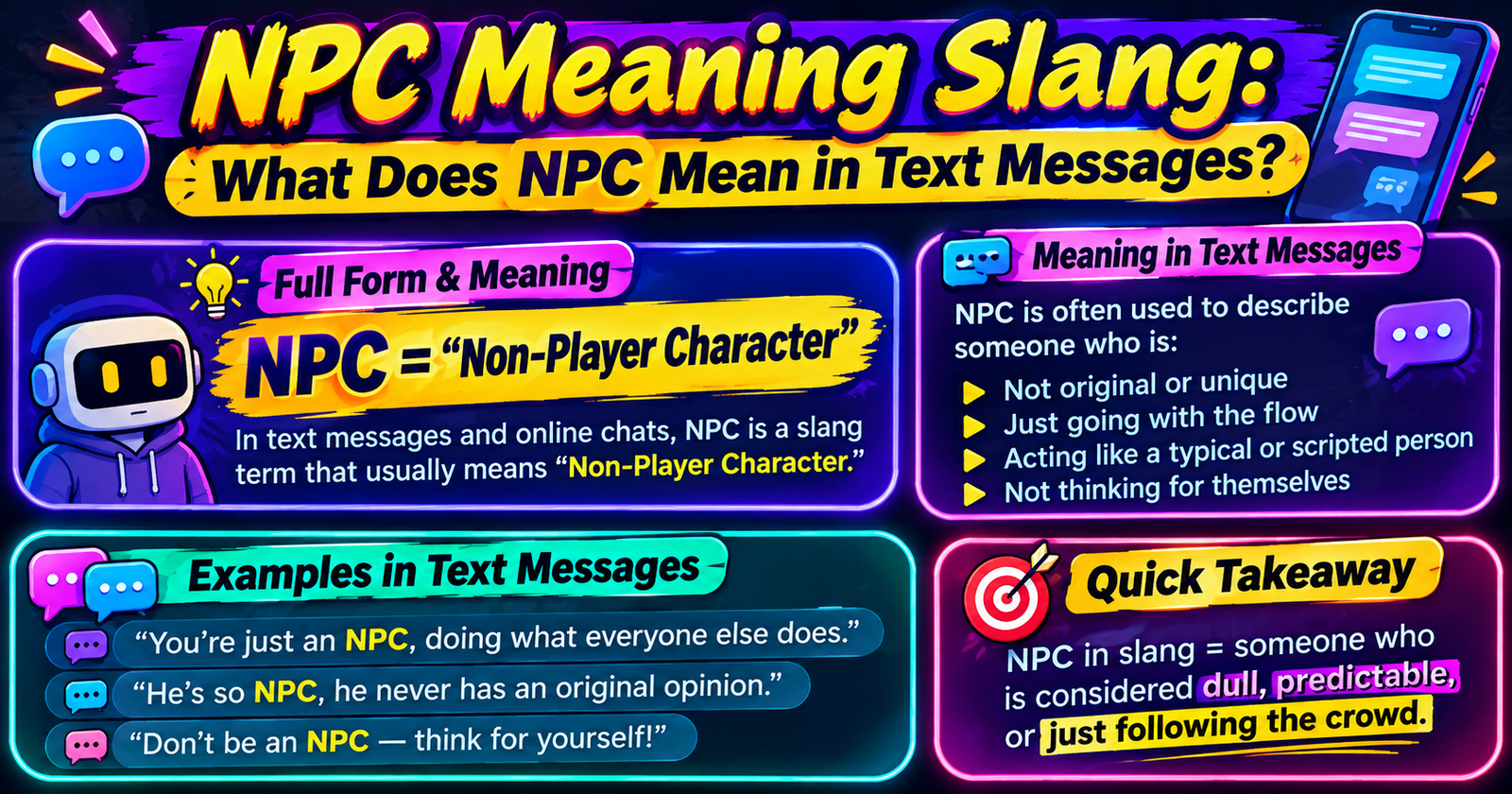
NPC meaning slang refers to calling someone a “non-player character” — internet slang for a person who seems to act on autopilot, has no original opinions, or just follows the crowd instead of thinking for themselves.
You’ve probably seen someone get called an NPC in a text or comment and wondered what it means. NPC meaning slang comes from video games, where NPC stands for “Non-Playable Character.” Online, people use it to describe someone who acts predictable, robotic, or like they have no real opinions of their own.
This slang term has taken over TikTok, Instagram, and everyday group chats. Sometimes it’s a lighthearted joke between friends, and sometimes it’s a sharper insult depending on the tone. Understanding the real NPC meaning slang helps you use it correctly and know exactly what someone means when they call you or a friend an NPC.
Meaning & Explanation
What does “NPC” mean in text?
In text messages, NPC means someone is being called boring, predictable, or mindless — like a background character in a video game who has no real personality. It’s almost always used casually between friends, not as a formal term.
“NPC” slang meaning
The NPC meaning slang comes directly from gaming, where NPC stands for “Non-Playable Character.” These are characters controlled by the game, not a real player. Online, it got flipped into an insult (or a joke) for real people who seem to lack independent thought.
What does “NPC” mean in chat?
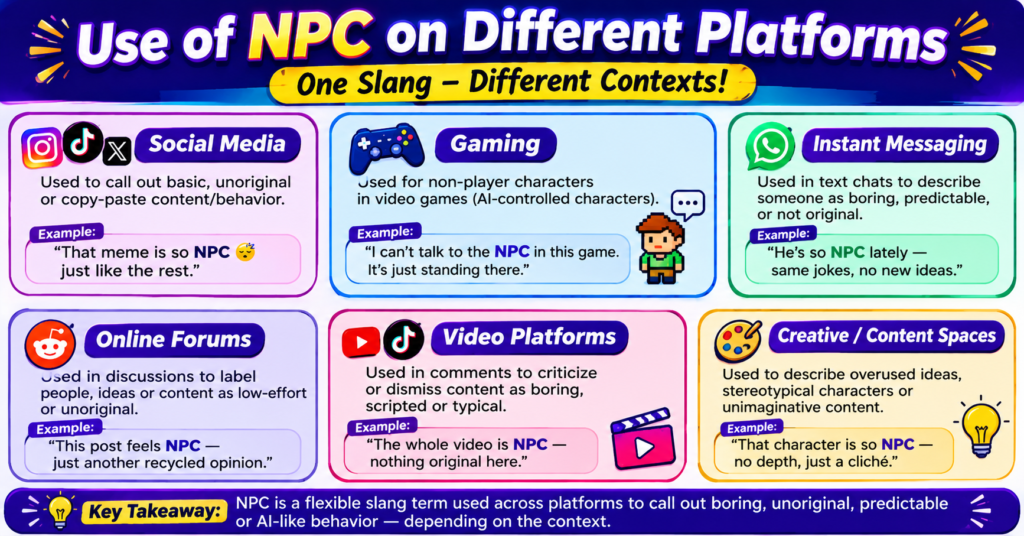
In group chats or DMs, “NPC” usually pops up when someone gives a generic response, agrees with everything, or has zero reaction to anything. Example: “Bro just said ‘ok cool’ to literally everything, he’s an NPC.”
“NPC” meaning on Snapchat
On Snapchat, NPC is typically used in captions or replies to poke fun at someone’s dull or repetitive Snap story. Example: “POV: you’re the NPC of the group chat 😭”
“NPC” meaning on Instagram, TikTok, WhatsApp
- Instagram: Often used in comments as a joke — “npc behavior fr” under a bland post.
- TikTok: The term exploded here through “NPC live streaming,” where creators act like video game characters, repeating scripted phrases and reactions for viewers who send gifts to trigger responses. This trend is one of the biggest reasons NPC slang went mainstream.
- WhatsApp: Less common, but used the same way — teasing someone for a flat, unoriginal reply.
KNOW ABOUT UK? READ THIS ONE ALSO
Is “NPC” an acronym, short form, or something else?
NPC is an acronym. It originally stood for “Non-Player Character” in gaming and tabletop RPGs (Dungeons & Dragons popularized the term decades before it hit social media). The slang usage borrows the letters but shifts the meaning toward personality, not game mechanics.
Tone & Context Variations
Funny Tone
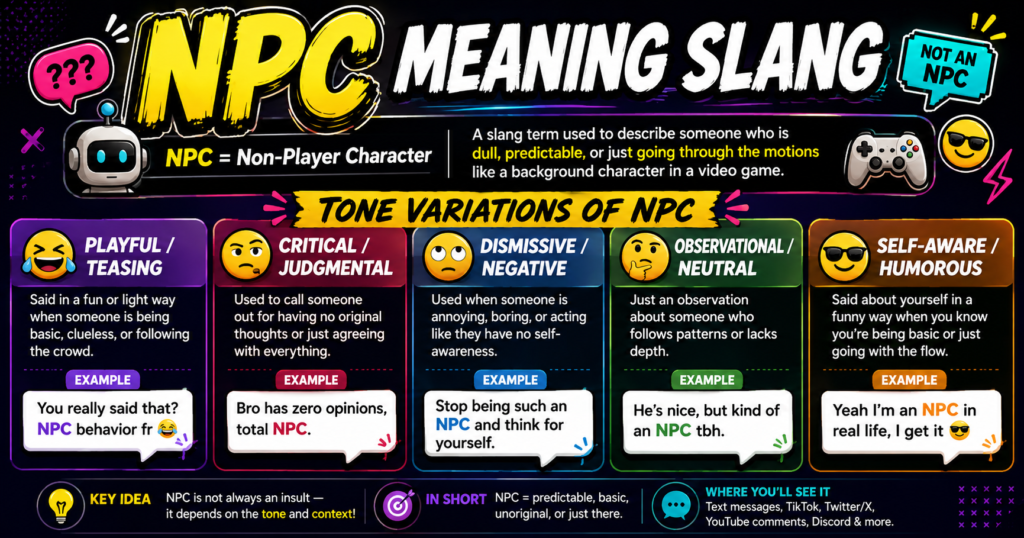
“You just repeated exactly what I said 😂 certified NPC.”
Sarcastic Tone
“Wow, such an original opinion. Never would’ve guessed, NPC.”
Romantic Tone
NPC almost never appears in genuinely romantic contexts. If it does, it’s playful teasing, not affection — “You only text ‘lol’ back, are you an NPC or what 😘”
Angry Tone
“I’m so done, you’re acting like a straight up NPC right now, no real answers ever.”
Playful Tone
“Ok NPC, say something that isn’t ‘idk’ for once lol.”
Real Chat Examples
- Casual: “lol you’re such an npc for liking every single post she makes”
- Safe for work: “The intern just says ‘noted’ to every email, total NPC energy.”
- Offensive (context matters): “Why do you even talk, you’re an NPC” — this crosses into bullying territory and should be avoided in serious conversations.
- Group chat banter: “New rule: no NPC replies allowed, actually say something 💀”
- TikTok comment: “the npc live girl just said ‘ice cream so good’ for the 50th time”
Grammar & Language Role
Part of speech
NPC functions as a noun, though it’s frequently used as an adjective-like descriptor: “NPC behavior,” “NPC energy,” “NPC vibes.”
Sentence position
It usually appears at the end of a sentence as a label (“you’re an NPC”) or as a standalone reaction (“NPC.”).
Can it replace a full sentence?
Yes. On its own, “NPC” or “npc.” sent as a single-word reply implies “that was a boring/predictable/mindless response.”
Tone impact
The word itself is neutral, but tone comes from context and punctuation. “NPC 😂” reads as playful; “NPC.” with a period that reads as dismissive or cold.
Formal vs informal use
This is strictly informal slang. It has no place in professional emails, academic writing, or formal speech.
How to Reply When Someone Says “NPC”
Funny Replies
- “Beep boop, loading personality update.”
- “At least I’m a well-optimized NPC.”
Serious Replies
- “That’s a bit harsh, I just didn’t have much to say.”
- “I hear you, I’ll try to add more to the conversation.”
Flirty Replies
- “Maybe I’m just saving my best lines for you.”
- “Guess you’ll have to unlock my full character arc.”
Neutral Replies
- “Fair enough lol.”
- “Noted.”
YOU MAY ALSO WANT TO KNOW ABOUT CMP MEANS ONLINE
Comparison Table
| Term | Meaning | Tone | Example |
| NPC | No personality, robotic behavior | Playful to insulting | “You’re such an NPC today” |
| Basic | Predictable taste or style | Mildly negative | “That outfit is so basic” |
| Bot | Repetitive, automated-sounding replies | Neutral to negative | “He talks like a bot” |
| Sheep | Blindly follows trends | Negative | “Don’t be a sheep, think for yourself” |
| Main character | Confident, unique, stands out | Positive | “She’s got main character energy” |
Who Uses This Term?
Age Group
Mostly teens and young adults, roughly ages 13–27.
Gen Z vs Millennials
Gen Z uses NPC constantly in everyday texting and TikTok comments. Millennials know the term mainly from gaming and use it less in casual chat.
Region
Most common in the United States, but it’s spread globally through TikTok and gaming communities.
Platforms
TikTok, Instagram, Discord, and group texts are where it shows up most.
Origin & Internet Culture Insight
How it became slang
NPC started in video games and tabletop RPGs like Dungeons & Dragons, referring to characters not controlled by a real player. Gamers began using it to describe real people who acted predictably or without independent thought, and the term spread from gaming forums into wider internet slang.
Why it went viral
The term exploded further in 2023 when creators started “NPC streaming” on TikTok — acting like literal video game characters, repeating phrases and gestures triggered by viewer gifts. This trend pushed NPC meaning slang far beyond gaming circles and into mainstream text and social media language.
Safety & Appropriateness
Is “NPC” rude?
It can be. Used between friends as a joke, it’s harmless. Aimed at a stranger or used repeatedly at someone, it can feel demeaning.
Is it a bad word?
No, it’s not profanity or a slur. It’s slang, so appropriateness depends entirely on tone and relationship.
Should you use it in school or office?
Avoid it in classrooms, workplaces, or any formal setting. It reads as unprofessional and can be taken as an insult by people unfamiliar with the joke.
Experience-Based Insight
People who spend time in gaming communities or on TikTok will recognize NPC instantly, while others may need context. If you’re using it with someone outside Gen Z or gaming circles, a quick explanation avoids confusion or hurt feelings.
Final Summary
NPC meaning slang describes someone who comes across as robotic, predictable, or without a real personality, borrowed from the gaming term for computer-controlled characters. It ranges from a lighthearted joke to a genuine insult depending on tone, platform, and relationship.
ALSO READ OUR OTHER BLOGS, CYA
Usage Tips
- Use it with people who already know internet slang.
- Keep it light and joking, not repeated or targeted.
- Pair with emojis (😂💀) to soften the tone in text.
Common Mistakes
- Using it in professional or formal settings.
- Assuming everyone knows the reference — older audiences may not.
- Using it repeatedly at one person, which can tip into bullying.
When to Use & Avoid
Use it:
- Joking with close friends
- Commenting on TikTok or Instagram casually
- Describing a scripted or robotic interaction
Avoid it:
- School or workplace conversations
- Talking to someone unfamiliar with the slang
- Repeated use aimed at one person’s personality
Conclusion
Now you know exactly what NPC meaning slang stands for and how people use it in everyday texts. It started in gaming but grew into a common way to describe someone who seems robotic, predictable, or short on original thoughts. Whether it’s a joke among friends or a real jab, the tone and context always decide how it lands.
Next time you see “NPC” in a chat or comment, you’ll understand the reference right away. Use it casually with people who get the joke, and skip it in serious or professional settings. Like most internet slang, NPC meaning slang works best when it stays light, playful, and easy to laugh off.
SEO FAQ Section
What does NPC mean in a text message?
It means someone is being called predictable, boring, or lacking their own opinions — like a background game character.
What does it mean to call someone an NPC?
It means you’re saying they act predictable, robotic, or like they have no personality of their own — like a background character in a video game.
What does NPC mean in Gen Z slang?
For Gen Z, NPC describes someone who follows the crowd, gives generic reactions, or seems to lack independent thought or opinions.
What does it mean to call people NPCs?
It suggests they’re going through life on autopilot, reacting the same way everyone else does instead of thinking or acting for themselves.
Is NPC an insult?
It can be teasing among friends or genuinely insulting depending on tone and context.
What does NPC mean on TikTok?
On TikTok, it refers both to the slang insult and to “NPC live streams,” where creators act like scripted game characters.
What’s the opposite of NPC?
“Main character energy” — someone confident, original, and memorable.
Is NPC dating slang?
In dating contexts, calling someone an NPC usually means they seem emotionally flat or give generic, low-effort responses.
3 thoughts on “NPC Meaning Slang: What Does NPC Mean in Text Messages?”