
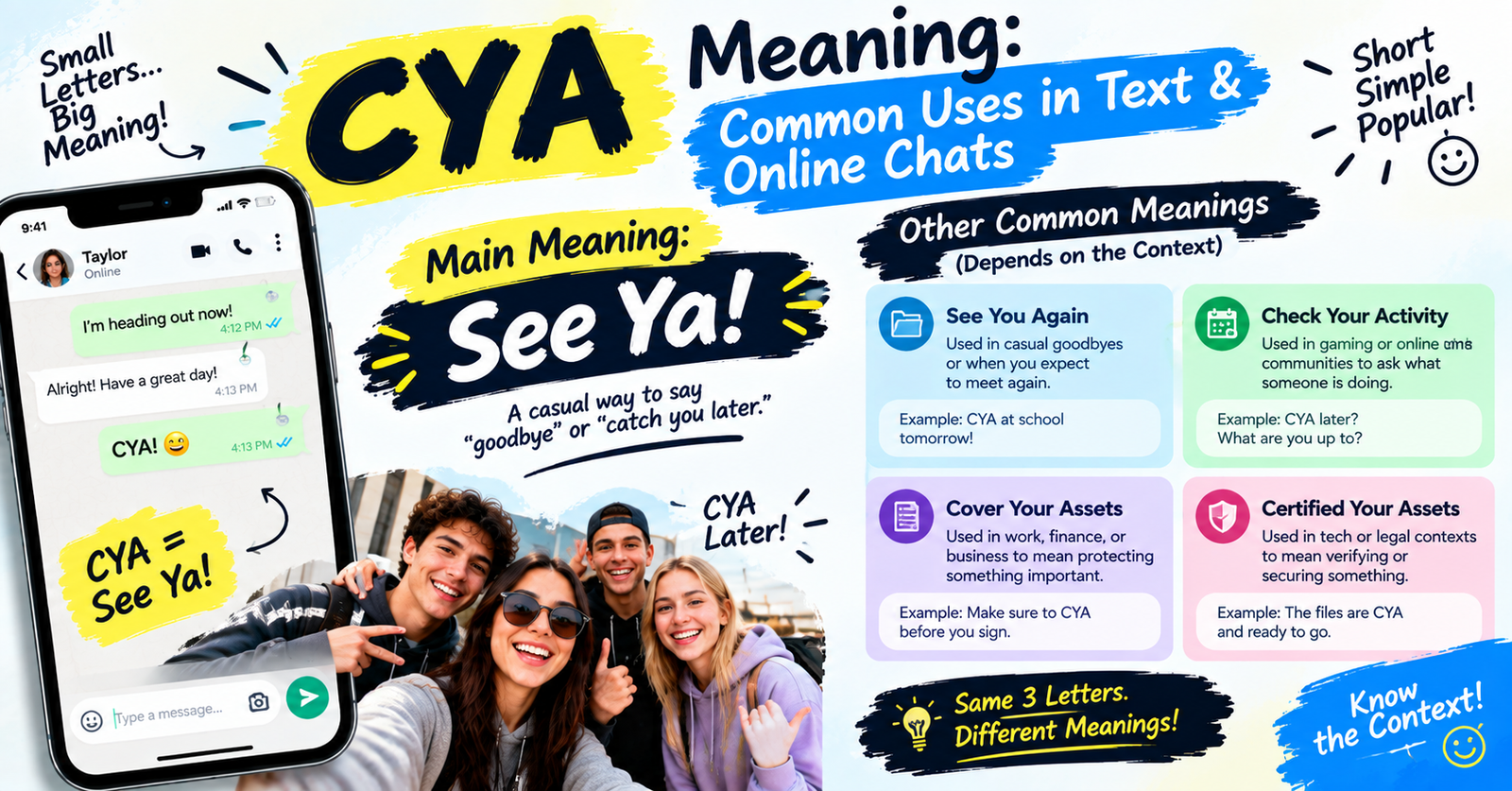
Ever seen “CYA” pop up in a text and wondered what it means? The CYA meaning actually changes depending on where you see it. In casual chats, it’s a quick, friendly way to say “see ya” before signing off.
But CYA has a second life too. In emails, work chats, and online debates, it often stands for “cover your ass” (or the politer “cover yourself”). This version means protecting yourself from blame if something goes wrong. So next time you spot CYA, check the context—it makes all the difference!
Why Do People Search for CYA Meaning?
Most people land here for one of a few reasons:
- They received a text or DM ending in “cya” and want to know if it’s just a goodbye or something more.
- They saw it in a professional email or meeting and it felt oddly loaded — like there’s a second meaning they’re missing.
- They’re decoding a message from someone they’re interested in and are trying to read tone into a short sign-off.
- They saw it on Instagram, Snapchat, or TikTok and want to confirm it’s normal, common slang — not something niche or platform-specific.
- They’re not native English speakers (including Urdu-speaking readers) looking for a clear, accurate translation and explanation.
Every one of those intents gets covered below.
CYA Meaning & Explanation
At its core, CYA is a shorthand spelling that represents how “see ya” sounds when said quickly. It’s not a formal acronym in the traditional sense — it’s closer to a phonetic shortcut. The letters C-Y-A mimic the sound of the words, similar to how “gr8” represents “great.”
CYA Meaning in Text
In texting, CYA is almost always a farewell. It signals that the conversation is wrapping up and the sender expects to talk or see the other person again, even if no specific time is mentioned. It’s lighter than a formal goodbye and works well at the end of a casual thread.
CYA Slang Meaning
As a slang term, CYA carries an informal, breezy tone. It belongs to the same family as other texting shorthand — quick, lowercase, punctuation-optional. Slang dictionaries and crowd-sourced sites list CYA under two headline definitions: “see ya” (the dominant, everyday meaning) and “cover your a**” (the secondary, context-specific meaning used mostly in professional or cautionary situations).
What Does CYA Mean in Chat?
In live chat environments — Discord servers, gaming lobbies, group chats — CYA functions as a quick, low-effort way to exit a conversation without it feeling abrupt. It’s commonly paired with other shorthand like “gtg” (got to go) or “brb” (be right back) right before it.
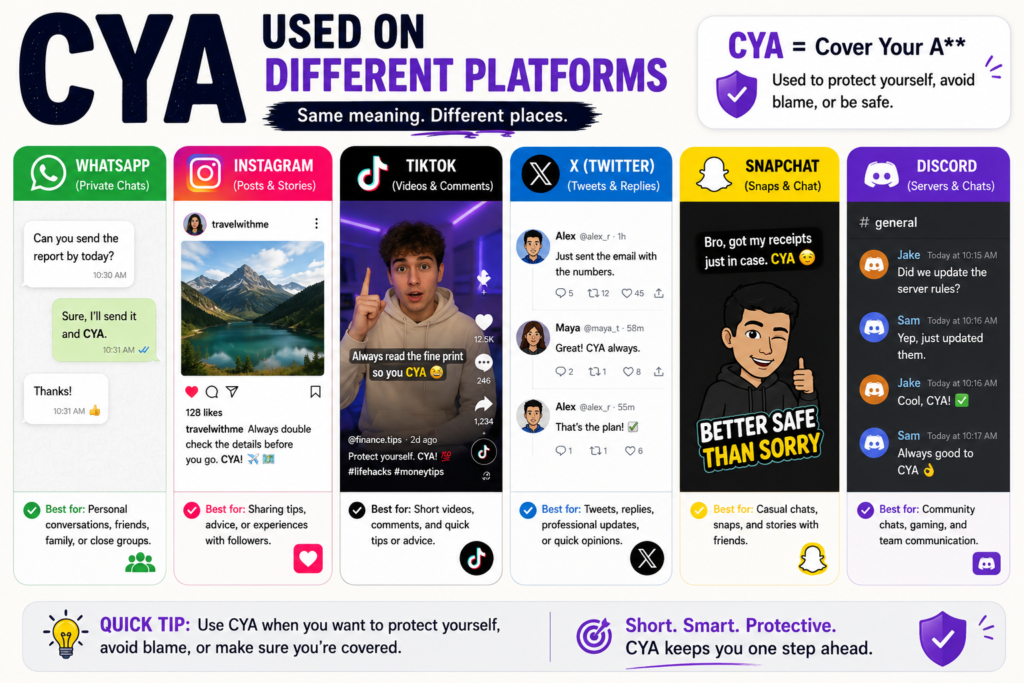
CYA Meaning on Snapchat
On Snapchat, CYA is used the same way it’s used in regular texting: a casual sign-off. Because Snapchat conversations tend to be quick, back-and-forth, and disappearing by design, short exits like “cya” fit the platform’s fast pace naturally.
CYA Meaning on Instagram
On Instagram — in DMs, comments, or captions — CYA still means “see ya,” but it shows up in a few extra formats:
- Comment sign-offs: “Cya at the concert!”
- Caption farewells: “Cya, 2025 👋” (saying goodbye to a year, season, or era)
- Story reply closers: ending a quick back-and-forth exchange
CYA Meaning on TikTok
TikTok comments and captions use CYA the same way — a playful, low-stakes goodbye. It’s especially common in comment sections under “storytime” or vlog-style videos, where a creator ends a video and viewers respond with “cya” as a lighthearted sign-off, or creators themselves close a video with it.
CYA Meaning on WhatsApp
WhatsApp usage mirrors texting culture closely, since it’s used heavily for both casual and semi-formal conversations. In personal chats, CYA works exactly like a text message goodbye. In family or work-adjacent WhatsApp groups, it’s best used carefully, since WhatsApp often bridges casual and professional relationships more than Instagram or Snapchat do.
YOU MAY ALSO WANT TO KNOW ABOUT NFW MEANS ONLINE
Is CYA an Acronym, Short Form, Phonetic Spelling, or Typo?
This is worth clarifying because CYA behaves differently depending on which meaning is intended:
| Meaning | Classification | Why |
| “See ya” | Phonetic spelling / short form | The letters represent sounds, not separate words |
| “Cover Your A**” | True acronym | Each letter stands for the first letter of an actual word |
It is not a typo in either case — it’s intentional shorthand, even though it can look like a truncated version of “you” or “your” at first glance.
The Most Common Meaning: “See Ya”
Across texting, DMs, and social comments, “see ya” is overwhelmingly the meaning people intend. It’s friendly, open-ended, and doesn’t require any explanation or follow-up.
Why People Use CYA Instead of “See You”?
- Speed. Three letters versus six or seven.
- Habit. It’s been standard texting shorthand since the early SMS era, so it’s typed automatically.
- Tone. “Cya” reads more casual and warm than the fully spelled-out “see you,” which can feel slightly stiff in a text.
- Platform norms. Shortened language fits the visual style of chat apps and comment sections better than full sentences.
Examples of “See Ya”
- “Heading out now, cya tomorrow!”
- “Cya at practice 🙌”
- “Alright, gtg, cya”
- “Cya this weekend, can’t wait”
Secondary Meaning: “Cover Your Ass“
This is the meaning most people encounter later — usually at work, in the news, or in a legal or bureaucratic context, rather than in personal messaging.
What Does “Cover Your Ass” Mean?
The phrase describes protecting yourself from blame, criticism, or consequences — usually by documenting decisions, getting approvals in writing, or making sure there’s a clear record if something goes wrong later. It can describe genuinely smart self-protection (like keeping proof of an agreement) or, more critically, deflecting responsibility in advance instead of taking ownership of a mistake.
Is “Cover Your Ass” Offensive?
The phrase contains mild profanity, which is why it’s often softened in professional writing to “cover your assets” or “CYA” without spelling it out. It’s not aggressive or targeted at anyone, so it isn’t considered offensive in the way slurs or insults are — but it’s still informal enough that most people avoid saying it in front of clients, in official documents, or in front of children.
Tone & Context Variations
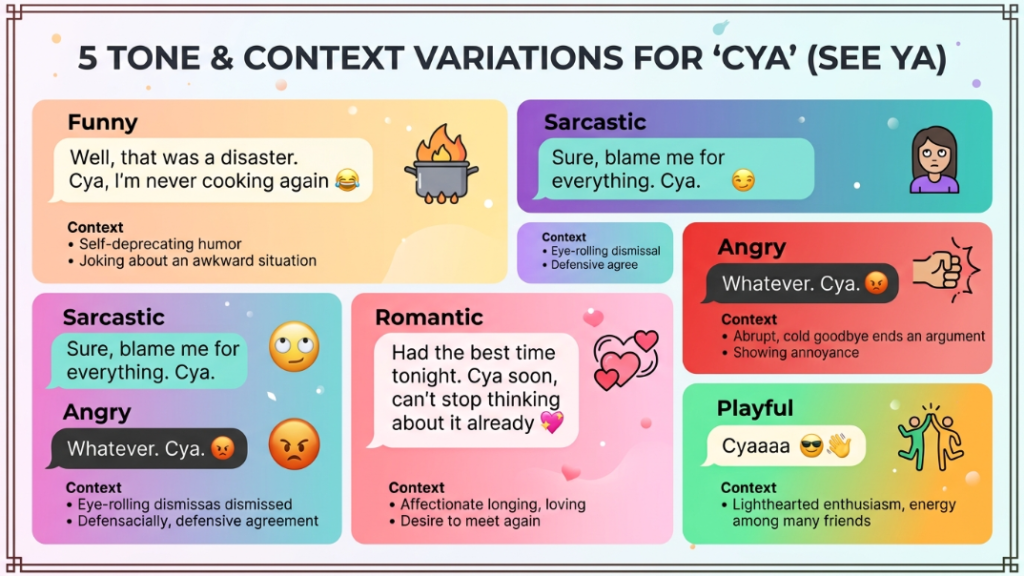
The exact same three letters can land completely differently depending on tone. Here’s how CYA shifts across common moods.
Funny Tone
“Well, that was a disaster. Cya, I’m never cooking again 😂” — used to close out a joke or self-deprecating story.
Sarcastic Tone
“Sure, blame me for everything. Cya.” — a clipped, slightly cold goodbye that signals annoyance without escalating into a full argument.
Romantic Tone
“Had the best time tonight. Cya soon, can’t stop thinking about it already 💕” — softened and warm, often paired with an emoji or a follow-up compliment.
Angry Tone
“Whatever. Cya.” — short, flat, and intentionally distant. In this context, the brevity itself is the message.
Playful Tone
“Cyaaaa 😎👋” — stretched-out spelling and emojis turn a plain goodbye into something upbeat and fun.
Real Chat Examples
- “Cya at 6, don’t be late!”
- “Gtg, family’s calling me. Cya later”
- “Cya tomorrow, good luck on the exam”
- “That meeting ran long lol, cya”
- “Cya, this was fun, let’s do it again”
- “Make sure you get that in writing — always CYA at this job”
- “Cya around campus!”
- “Ugh fine, cya” (annoyed tone)
- “Cya, love you, drive safe”
- “Just documenting this email thread to CYA in case HR asks”
- “Cya 👋 heading to bed”
- “Cya later, alligator” (playful callback to the classic rhyme)
- “Wrap it up and send me a copy — CYA before the audit”
- “Cya, I’m logging off Discord”
- “See you Monday, cya!”
ANOTHER COMMON TEXTING ABBREVIATION IS ATE
Grammar and Language Role
What Part of Speech Is CYA?
Functionally, CYA acts as an interjection — a standalone expression, much like “bye” or “hey.” In its “cover your a**” sense, it behaves more like a shorthand verb phrase or command (“CYA on this one”).
Sentence Position
As a farewell, CYA almost always appears at the end of a message. As workplace advice, it can appear anywhere — at the start (“CYA, get it in writing”), middle, or end of a sentence.
Does CYA Replace a Full Sentence?
Yes, in its “see ya” form, it functions as a complete thought on its own — no subject or verb needed, similar to “bye” or “later.”
Tone Impact
Because it’s so short, CYA can feel abrupt if sent without any context, especially as a reply to a longer, more emotionally invested message. Pairing it with an emoji, a follow-up plan, or a compliment softens that effect.
Formal vs Informal Use
CYA is informal in both meanings. Even the workplace version — while describing a legitimate professional habit — is rarely typed out as “CYA” in an actual formal document. People describe the behavior formally (“for documentation purposes”) while reserving the literal term for casual conversation about that behavior.
How to Reply When Someone Says CYA
Funny Replies
- “Cya, don’t get lost on the way home 😂”
- “Peace out ✌️”
Serious Replies
- “Sounds good, talk soon.”
- “Okay, take care.”
Flirty Replies
- “Cya 😘 text me when you’re home”
- “Already counting down to next time”
Neutral Replies
- “Cya”
- “Bye, see you later”
Comparison Table
CYA vs TTYL
| CYA | TTYL | |
| Full meaning | See ya | Talk to you later |
| Implies future contact | Loosely | More directly |
| Common on | Texting, Instagram, Snapchat | Texting, older chat platforms (AIM-era origin) |
| Tone | Casual, open-ended | Casual, slightly more specific |
CYA vs GTG
| CYA | GTG | |
| Full meaning | See ya | Got to go |
| Focus | The goodbye itself | The reason for leaving |
| Typical pairing | Used alone or after GTG | Often followed by CYA (“gtg, cya”) |
| Tone | Farewell | Explanation for exiting |
Who Uses This Term?
Age Groups
CYA spans a wide age range because it’s been part of texting culture since SMS first became mainstream. Teens, young adults, and even older millennials use it comfortably.
Gen Z vs Millennials
Gen Z
Gen Z tends to stretch, stylize, or exaggerate it — “cyaaa,” paired with emojis, GIFs, or stickers on Snapchat and TikTok. It’s used heavily in comment sections and DMs.
Millennials
Millennials, who grew up during CYA’s rise in early-2000s texting and AIM culture, tend to use it in a more standard, unmodified form — closer to how it originally appeared in flip-phone texting.
Regional Usage
CYA is widely understood across English-speaking countries, including the U.S., U.K., Canada, and Australia. It also appears frequently in translated or non-native English contexts — for example, Urdu-language slang dictionaries commonly define CYA straightforwardly as a goodbye, often translating it close to “khuda hafiz” (goodbye) for readers learning English internet slang.
Platforms Where CYA Is Most Common
- Text messaging (SMS/iMessage)
- Instagram comments and DMs
- Snapchat chats
- TikTok comments
- WhatsApp casual chats
- Gaming voice/text chat (Discord, Xbox/PlayStation party chat)
Origin & Internet Culture Insight
Where Did CYA Come From?
The “see ya” version of CYA rose alongside early SMS texting and internet chatrooms in the late 1990s and early 2000s, when character limits and slow keypad typing made abbreviation genuinely useful rather than just stylistic.
The “cover your a**” version has a separate, older history rooted in military and workplace culture, where documenting decisions to avoid blame became common long before texting existed. The two meanings only share letters — they didn’t evolve from the same root.
Fast Typing Culture
T9 keypads, character limits on early SMS plans, and the general pace of chatroom conversations pushed users toward abbreviations. CYA fit perfectly: fast to type, instantly recognizable, and short enough to end a message without feeling clipped.
Meme Culture Influence
While CYA itself isn’t meme-driven the way newer slang can be, it survives because of internet culture’s ongoing appetite for shorthand. It regularly appears in caption humor, farewell memes (“cya, 2025”), and reaction GIFs used to punctuate an exit from a conversation.
Why People Say CYA on TikTok
TikTok’s comment culture rewards short, punchy language, and CYA fits that format perfectly. Creators often end videos with a quick “cya” instead of a longer sign-off, and commenters mirror that tone back. It also shows up as a lighthearted way to end a back-and-forth in the comments without the exchange feeling unfinished or awkward.
KNOW ABOUT STSU READ THIS ONE ALSO
Experience-Based Insight
A pattern worth flagging that most guides skip: the emotional weight people assign to “cya” is almost always inflated relative to the sender’s actual intent. In lived text conversations, “cya” functions closer to a verbal tic than a deliberate emotional signal — most people type it the same way they’d casually say “later” out loud, without thinking about how it reads.
The real signal isn’t the word itself; it’s the surrounding context — response time, message length, whether future plans were mentioned. Treating “cya” as a standalone clue, especially in dating or ambiguous relationship texts, is one of the most common ways people misread a conversation.
Is CYA Rude?
Not inherently. As a farewell, it’s friendly and low-pressure. It can read as slightly cold only when it’s the sole reply to a longer, more emotionally invested message, or when it’s used after a disagreement — in those cases, the shortness itself carries the tone, not the word.
Is CYA a Bad Word?
No. “See ya” carries zero profanity and is fully appropriate in casual settings. The “cover your a**” meaning contains a mild vulgarity, which is why it’s often softened in professional writing, but it isn’t classified as an offensive or inappropriate term — just an informal one.
Should You Use CYA in School or Office?
School
Fine in texts and DMs between classmates or friends. Avoid it in emails to teachers, assignment submissions, or any written work that’s graded for tone and professionalism.
Workplace
Acceptable in casual Slack or text messages with coworkers you’re close to. Avoid it in client-facing emails, official documentation, or any communication where a formal tone matters — even though the underlying “cover yourself” habit (documenting decisions, keeping records) is genuinely useful workplace practice.
Final Thoughts
CYA is simple on the surface but genuinely depends on context to interpret correctly. The good news: once you know both meanings, spotting which one applies takes seconds.
Usage Tips
- Default to “see ya” unless the conversation is about work, risk, or accountability.
- Pair it with an emoji or a follow-up line if you want to avoid sounding abrupt.
- Save the literal term “CYA” for casual conversations, not formal documents.
Common Mistakes
- Assuming every CYA is a workplace warning.
- Reading deep emotional meaning into a short, habitual sign-off.
- Using it in formal emails, cover letters, or professional documents.
When to Use CYA
Texting friends, Instagram/Snapchat/TikTok comments, casual group chats, and informal workplace messages with close coworkers.
When to Avoid CYA
Client emails, job applications, teacher or professor communication, legal or HR documentation, and any first-impression professional context.
Final Takeaway
CYA will keep showing up in your notifications no matter which platform you’re on — and now you have a reliable way to read it correctly every time: casual goodbye by default, workplace caution in context.
Conclusion
That’s the full picture on CYA. Most of the time, it just means “see ya.” It’s light, friendly, and common in texts, DMs, and comments. No hidden meaning needed.
Still, context changes things. At work, CYA can mean “cover your a**” instead. So next time you see it, check the setting first. That’s really all it takes to read it right.
Frequently Asked Questions
Does CYA mean the same thing on every platform?
Yes, for the most part. Instagram, Snapchat, TikTok, and WhatsApp all use CYA as a casual farewell.
What does CYA mean in a text?
CYA usually means “see ya.” It’s a casual way to say goodbye.
What does CYA stand for?
CYA stands for “see ya” in texting, or “cover your a**” in business settings.
Is CYA rude to say?
No, CYA isn’t rude. It’s a friendly, informal way to say bye.
What does CYA mean in business?
In business, CYA means “cover your a**.” It means protecting yourself from blame.
Is CYA the same as “bye”?
It’s similar but slightly warmer and more open-ended, implying you’ll see the person again rather than a flat, final goodbye.
How do I know which meaning of CYA someone intended?
Check the setting. Personal chats, social media, and casual conversations point to “see ya.” Discussions about documentation, blame, risk, or accountability point to “cover your a**.”
Is it okay to text “cya” to someone I’m dating?
Yes — it’s a normal, casual sign-off and doesn’t inherently signal disinterest. Read it alongside the rest of the conversation rather than in isolation.
1 thought on “CYA Meaning: Common Uses in Text & Online Chats”