
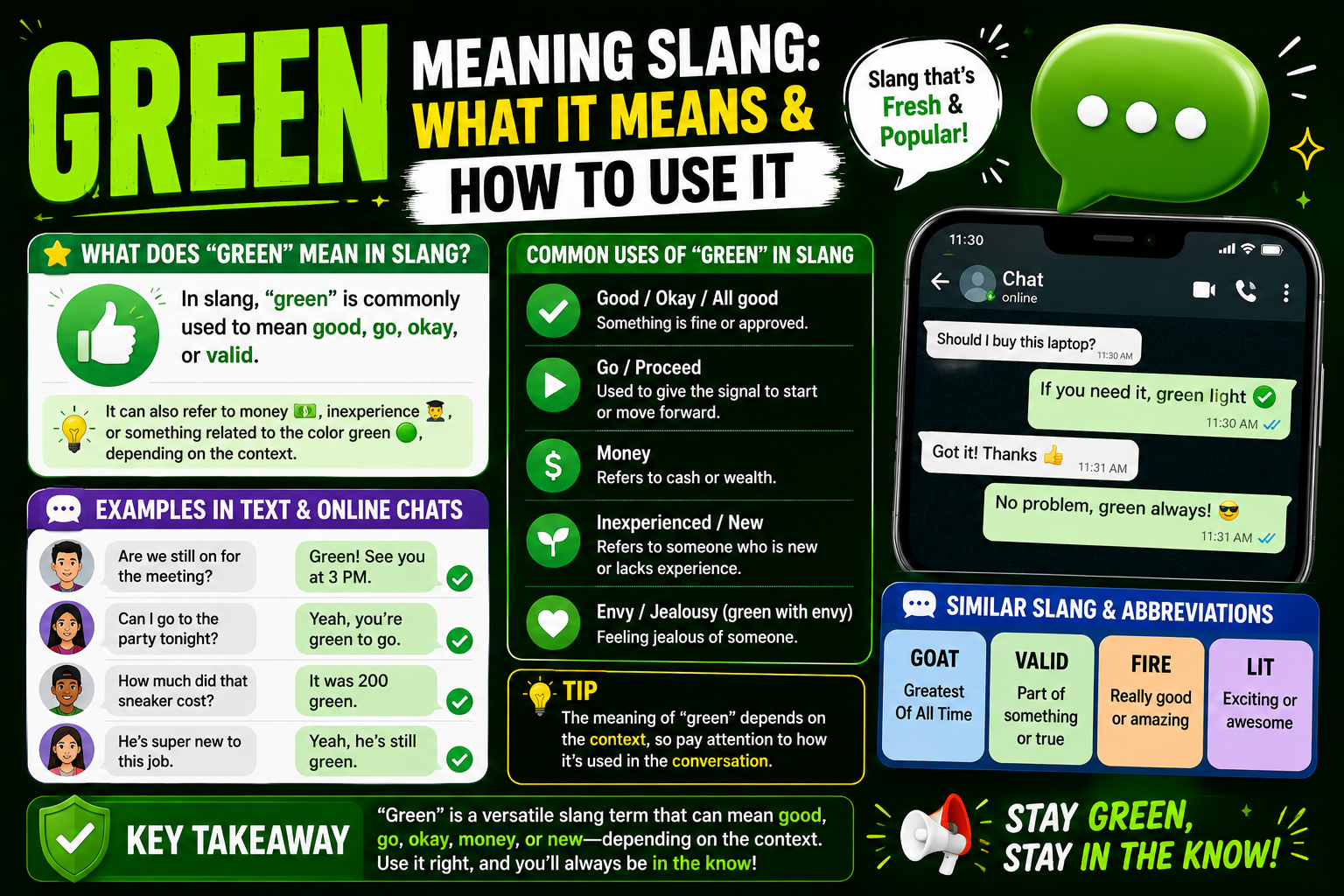
What Does It Mean to Be Green Slang Meaning in Text
You hear someone say “green” and it throws you off. Are they talking about money? A color? Something else? Turns out, “green” is one of the most flexible slang words out there.
It can mean cash, being new at something, jealousy, or even weed. The right meaning depends on the sentence around it. Once you know the patterns, it’s actually easy to spot which one someone means.
Simple Definition
In slang, “green” most often describes someone who is inexperienced or naive — like a new employee who doesn’t know the job yet. Outside of that, it commonly refers to cash (because U.S. dollar bills are green), marijuana (referencing the plant’s color), or envy, as in the phrase “green with envy.”
Is It Slang, Acronym, or Abbreviation?
“Green” isn’t an acronym or abbreviation — it’s a regular English word used figuratively. Unlike shorthand like “cya” or “brb,” there’s no letter-by-letter breakdown here. It’s closer to an idiom: the color itself became a stand-in for an idea (inexperience, money, jealousy) through cultural association, not through spelling tricks.
What It Means in Everyday Chat
In casual texting and DMs, context decides everything:
- “You’re so green at this” → inexperienced
- “I need that green” → money
- “He’s smoking green” → marijuana
- “She’s green over your new car” → jealous
Because the meanings vary so widely, “green” almost never causes confusion in real conversations — the surrounding words make the intended meaning obvious within a sentence or two.
Where People Use “Green” Slang
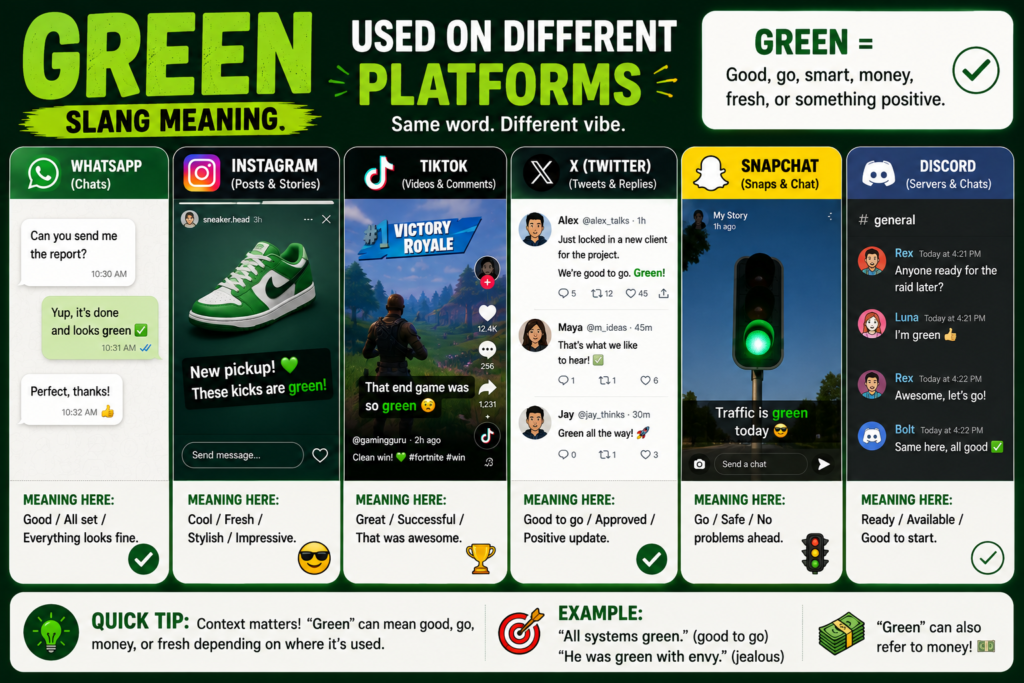
TikTok
On TikTok, “green” shows up mostly in captions and comments about money or flexing (“chasing that green”), and occasionally in comedic or gaming contexts to call someone inexperienced (“bro is still green at this game”). It’s not a term tied to a specific TikTok trend or challenge — it’s general slang that carries over from everyday speech.
Snapchat
Snapchat usage mirrors regular texting. “Green” pops up casually in captions about earning money or in jokes about someone being new to a group, activity, or inside joke.
On Instagram, “green” appears in captions and comments referencing money, luxury, or hustle culture (“all about that green 💰”), and occasionally in comments calling out someone’s inexperience in a lighthearted way.
WhatsApp conversations use “green” the same way texting does — casually, and almost always clarified by the rest of the message. It doesn’t carry any WhatsApp-specific meaning.
SMS (Text Messages)
In plain text messages, “green” is typically shorthand for money (“send me some green”) or a quick way to call someone inexperienced (“still pretty green, huh?”). Both uses are casual and friendly rather than harsh.
YOU MAY ALSO WANT TO KNOW ABOUT CYA MEANS ONLINE
Real Chat Examples
- “Bro’s still green, give him time.”
- “I need to make some green this weekend.”
- “She got so green when she saw your new phone.”
- “He’s holding some green, don’t ask questions.”
- “You’re green at this job, but you’ll catch on fast.”
- “All I do is chase that green, no days off.”
- “Don’t be green about it, just ask for help.”
How to Reply When Someone Says “Green”
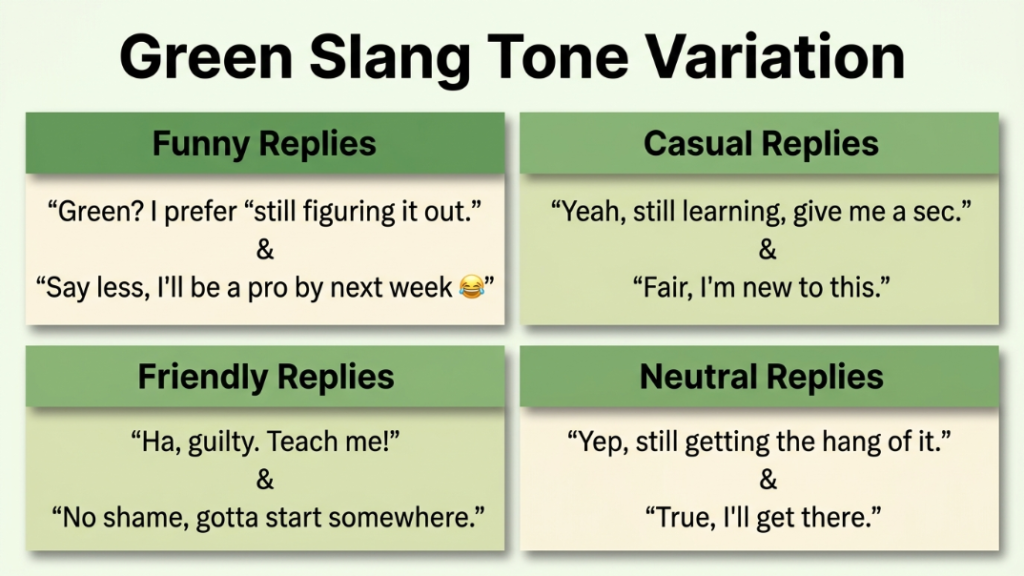
Funny Replies
- “Green? I prefer ‘still figuring it out.'”
- “Say less, I’ll be a pro by next week 😂”
Casual Replies
- “Yeah, still learning, give me a sec.”
- “Fair, I’m new to this.”
Friendly Replies
- “Ha, guilty. Teach me!”
- “No shame, gotta start somewhere.”
Neutral Replies
- “Yep, still getting the hang of it.”
- “True, I’ll get there.”
Is “Green” Rude or Offensive?
Generally, no. Calling someone “green” as in inexperienced is usually observational rather than insulting — it’s often said lightheartedly, similar to calling someone a “rookie” or “newbie.” It can sting slightly if said in a mocking tone or repeated to embarrass someone, but the word itself isn’t a slur or profanity. The money and marijuana meanings are neutral descriptors, not insults.
Is It Safe to Use?
Yes, in casual conversation. The only meaning worth being careful with is the drug-related one (“green” for marijuana), since using it in the wrong setting — around family, in a professional message, or with someone unfamiliar with the term — can create an awkward or unintended implication. Outside of that, “green” is safe, common, and widely understood.
Should You Use It in School or Work?
School
Fine among friends and classmates in casual conversation. The “inexperienced” meaning works well in group projects or sports talk (“I’m still green at this”). Avoid using the drug-related meaning around teachers or in written assignments.
Workplace
The “inexperienced” meaning is actually common in professional speech too — you’ll hear managers describe new hires as “green” without it sounding unprofessional. The money and drug meanings, however, are too casual (or risky) for workplace messaging, emails, or meetings.
ANOTHER COMMON TEXTING ABBREVIATION IS NFW
Who Uses This Term?
Age Groups
“Green” spans nearly every age group because its core meaning — inexperience — has been standard English for centuries, long before texting existed. The money and drug slang uses are more associated with younger, casual speech.
Gen Z Usage
Gen Z leans heavily on the money and jealousy meanings in captions and comments, often paired with emojis (💰, 🍃, 😒). The word rarely needs explaining within their own conversations because context does the work.
Platforms
Most common on Instagram, TikTok, and regular texting. Less common on more formal platforms like LinkedIn, where the word rarely appears outside of describing a “green,” or newly hired, employee.
Frequency
“Green” is used constantly in everyday English, arguably more than most trendy internet slang, simply because its “inexperienced” and “money” meanings have been part of the language for generations rather than invented recently online.
Origin of the Term
“Green” meaning inexperienced dates back centuries in English literature, describing anything young, unripe, or not yet fully developed — much like green fruit before it ripens. Shakespeare used similar color-based imagery for youth and naivety in his plays.
The money meaning is more recent and distinctly American, tied directly to the green ink used on U.S. dollar bills. The marijuana meaning simply describes the plant’s natural color, and the jealousy meaning (“green with envy”) also traces back to classic literature, including Shakespeare’s use of a “green-eyed monster” to represent jealousy in Othello.
Internet Culture Influence
Social media didn’t invent any of these meanings — it just accelerated how often they appear, especially the money and marijuana uses, which show up frequently in captions, song lyrics referenced in posts, and casual online bragging about finances or lifestyle.
Is the Origin Clear?
Yes, unusually so for slang. Most modern internet slang has murky or debated origins, but “green” is well-documented across dictionaries and historical texts for each of its meanings — inexperience, money, jealousy, and marijuana all have traceable roots rather than uncertain internet folklore.
Comparison Table
| Meaning | Example Sentence | Common Setting | Tone |
| Inexperienced | “He’s still green at this job.” | Work, school, sports | Neutral/friendly |
| Money | “I need that green.” | Texting, social captions | Casual, confident |
| Marijuana | “He’s got some green.” | Casual conversation | Informal, situational |
| Jealousy | “She’s green with envy.” | Everyday speech | Playful or genuine |
| Eco-friendly | “We’re going green this year.” | Environmental talk | Neutral, positive |
Real-World Usage Example
A group chat conversation might look like this:
Sam: “New guy on the team is kinda green, but he’s trying.” Alex: “Give him a few weeks, we were all green once.” Sam: “True. Anyway, you still owe me some green for lunch 😂”
Notice how the same word shifts meaning twice in one short exchange — first describing inexperience, then money — without any confusion, because the sentence structure makes each meaning obvious.
Conclusion
So “green” really does mean a lot of things. It can be money, jealousy, inexperience, or weed. The word itself never changes. Only the context around it does.
That’s really the whole trick. Read the sentence, not just the word. Once you get the hang of it, “green” is easy to understand every time.
When to Use It
Casual texts, social captions, friendly conversations about money or learning something new, and lighthearted comments about someone being a beginner.
When to Avoid It
Formal emails, professional documents, or any conversation where the drug-related meaning could be misread — especially with people who aren’t familiar with casual slang.
Frequently Asked Questions
What does green mean in slang?
It usually means inexperienced or new to something. It can also mean money, jealousy, or marijuana depending on context.
What does green mean in Gen Z?
Mostly money or flexing (“chasing that green”). It’s also used for jealousy in captions and comments.
What does green mean in TikTok slang?
Same as everywhere else — often money, sometimes calling someone inexperienced. Context makes it clear.
What does “you green” mean?
It typically means you’re being called inexperienced or naive about something. It’s usually casual, though it can come across as mocking if said in a harsh tone.
Does “green” always mean marijuana?
No. That’s only one of several meanings, and it’s the least common in general texting — inexperience and money come up far more often.
What does “dark green” mean in slang?
It’s not a separate slang term. It’s usually just a more intense version of whatever “green” already means (like stronger money talk or higher-quality weed).
What does “green” mean in Urdu or when translated for Urdu-speaking readers?
There’s no separate Urdu meaning — it’s the same English slang, just explained for readers translating or learning it.
Why do people say “chasing green” or “get that green”?
It’s slang for pursuing or earning money, popularized through hip-hop and everyday American English.