
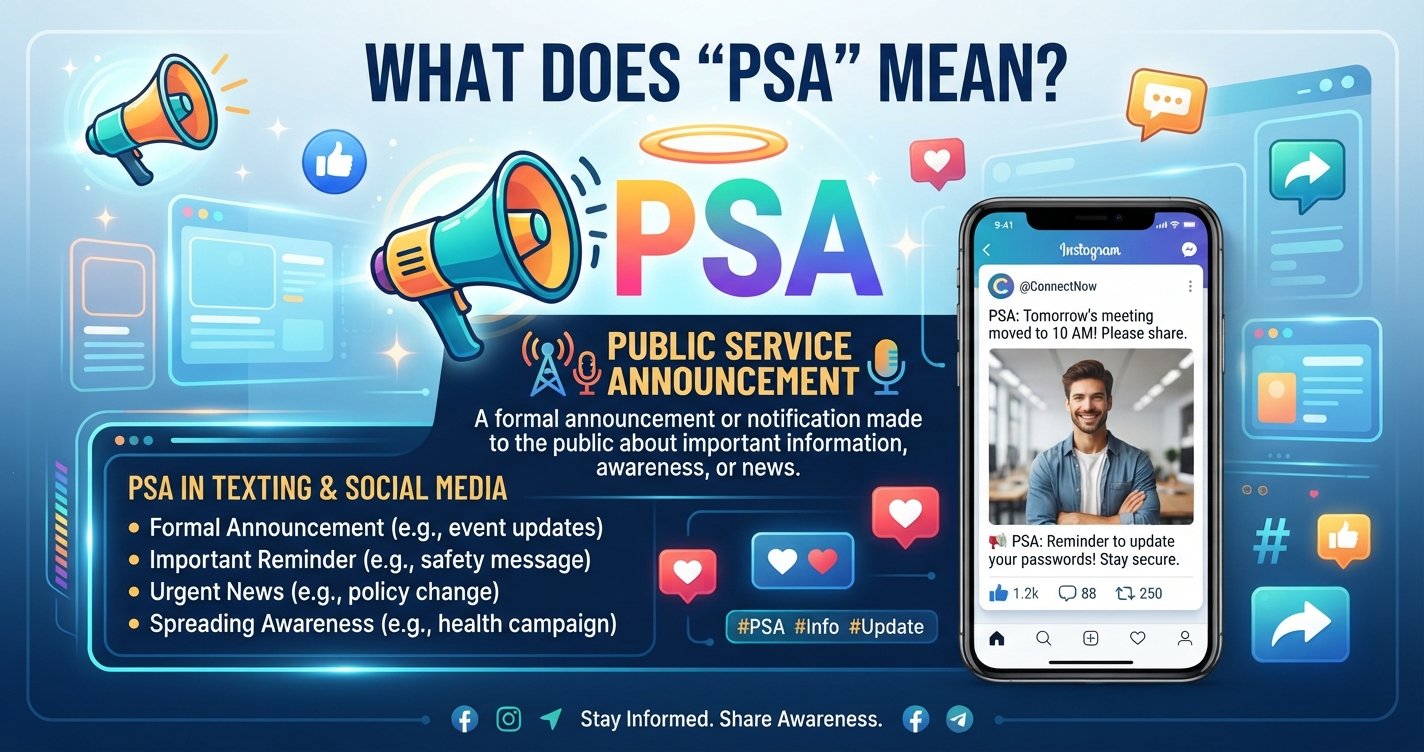
You have probably seen “PSA” at the start of a text, a TikTok caption, or a Reddit post. PSA meaning slang is simple: it stands for “public service announcement,” and it signals that something worth reading comes next. The message can be a helpful tip, a quick warning, or just a joke.
Online, the term has moved far beyond TV and radio. This guide explains what PSA means in texting and social media, shows real examples, and covers related slang. You will also learn how to use it without sounding rude or confusing
Quick Answer: Examples of PSA in Real Messages
PSA stands for “public service announcement.” In texting and online chats, it flags a message the sender thinks everyone should read. It can be serious, helpful, funny, or sarcastic.
Here are five examples. Each one shows a different tone.
- Casual: “PSA: the taco truck is back on Main Street.”
- Safe for work: “PSA: Friday’s meeting moved to 10 a.m.”
- Friendly and ironic: “PSA: that jacket looks great on you. Wear it more.”
- Passive-aggressive: “PSA to whoever keeps taking my lunch from the fridge: I know.”
- Rude (avoid at work): “PSA: nobody asked for your opinion, Kyle.”
The first two are safe anywhere. The last two can start arguments.
Related Slang You Will See Next to PSA
People often use PSA with other short terms. Here are the common ones.
- FYI: “for your information.” Softer and more casual than PSA. Example: “FYI, the store closes early today.”
- Heads up: a friendly warning. Example: “Heads up, the bridge is closed.”
- ICYMI: “in case you missed it.” Example: “ICYMI, the finale airs tonight.”
- TIL: “today I learned.” Example: “TIL octopuses have three hearts.”
- NGL: “not gonna lie.” Example: “NGL, that PSA was needed.”
- FWIW: “for what it’s worth.” Example: “FWIW, I’d skip that restaurant.”
- Not a drill: adds urgency. Example: “Pay your bills, not a drill.”
Quick Table
| Item | Details |
| Full form | Public service announcement |
| Type | Acronym, internet slang |
| Main use | Sharing useful, urgent, or funny info |
| Tone | Serious, casual, ironic, or sarcastic |
| Common platforms | TikTok, Reddit, X, Instagram, Discord, text chats |
| Where it sits in a post | Usually the first word, often followed by a colon |
| Safe for work? | Yes, in most cases |
| Other meaning | PSA is also a trading card grading company |
Meaning of PSA in Text and Social Media
In a text, PSA means “listen up, this matters.” The sender wants attention. They are about to say something useful.
The topic can be big or tiny. One person warns about a scam. Another points out that oat milk is on sale.
That range is why PSA meaning slang is so flexible. The word itself is neutral. The message that follows sets the mood.
The usual format is simple. Type PSA, add a colon, then give the message. Many people write it in capitals. Some add an emoji to grab the eye.
The Evolution of PSA from Formal to Slang
The term began in the world of media and government. Public service announcements are short messages made for the public good. Radio, TV, and print carried them for decades.
In the US, many classic campaigns came through the Ad Council. Its roots go back to the 1940s. Famous examples include the Smokey Bear wildfire message.
Online culture then borrowed the format. Social platforms let anyone act like a broadcaster. A person with a phone could now “announce” something to a crowd.
At first, people used it sincerely. Later, users started using it as a joke. Today you will see both styles daily.
Primary PSA Meaning: Public Service Announcement
This is the meaning you should assume first. If someone texts “PSA: the gym is closed Monday,” they mean a public service announcement.
It is also the main entry on Urban Dictionary. Keep in mind that site is user-written. It reflects how people use slang, not official definitions.
If you wonder about PSA meaning slang Urban Dictionary style, the answer is the same. The top meaning is a public service announcement. Some entries add jokes or sarcasm on top.
YOU MAY ALSO WANT TO KNOW ABOUT OPPO MEANS ONLINE
Alternative PSA Meanings in Slang Context
PSA can mean other things. Context tells you which one.
| Meaning | Where you will see it |
| Professional Sports Authenticator | Trading cards, especially Pokémon and sports cards |
| Prostate-specific antigen | Medical talk and health tests |
| PSA Airlines | Travel and aviation, a US regional airline |
| PSA Group | Car industry, the former French automaker group |
| Professional Squash Association | Squash sports news |
In texting and social media, the “public service announcement” meaning wins nearly every time. Other meanings appear in niche communities.
PSA Usage on Different Social Media Platforms
Each platform has its own style. Here is how PSA usually looks on each one.
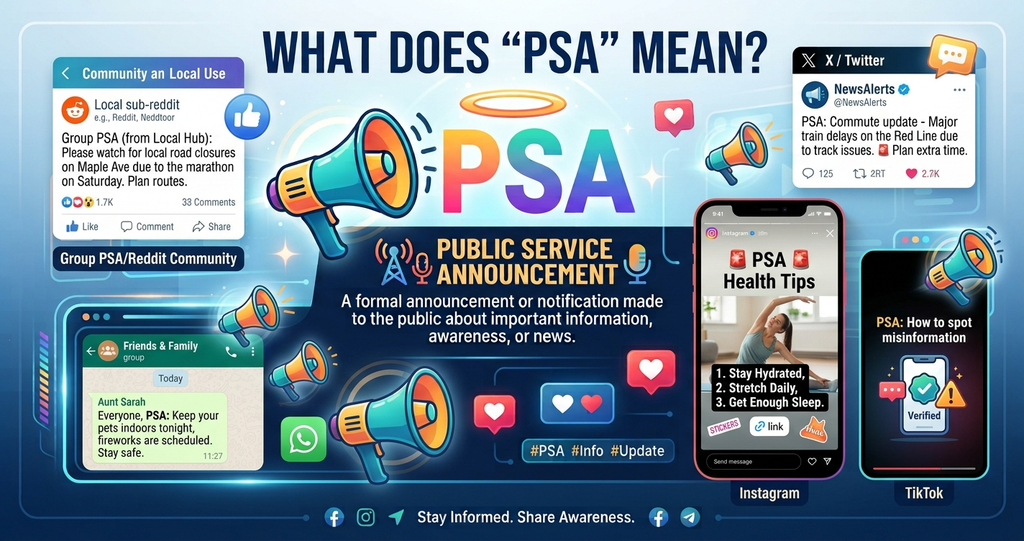
TikTok.
This is where PSA meaning slang TikTok searches usually start. Creators say “this is a PSA” in a voiceover or add it as on-screen text. It is often a joke. A person might warn viewers that cold pizza is the best pizza.
Instagram.
Users put PSA in captions and Stories. It often shares quick tips, event news, or reminders.
X (formerly Twitter).
PSA starts a post and sets the tone. It may be useful, or it may be a vague dig at someone.
Reddit.
Many subreddits use PSA as a post flair or tag. That gives you the PSA meaning slang Reddit answer. The tag marks a post that shares important info, such as a safety issue, a rule change, or a known bug. Check each community’s rules, because flairs vary.
Facebook.
Older users often post longer PSAs here. Some are helpful. Some are chain-style warnings that need fact-checking.
Discord and group chats.
PSA is a fast way to flag announcements for a server or friend group.
In short, PSA meaning social media posts all share one goal. They want you to stop scrolling and read.
When to Use PSA in Text Messages and Chats
Use PSA when the message helps the reader. That is the rule that works best.
Good times to use it:
- You are sharing a change of plans.
- You want to warn friends about a scam or problem.
- You have a useful tip worth passing along.
- You want to joke in a playful way.
Times to skip it:
- The message is only about you and not useful to others.
- You are venting at a person who will see it.
- The topic is sensitive and needs a private talk.
ANOTHER COMMON TEXTING ABBREVIATION IS IG
The Tone Spectrum: Serious to Ironic PSA Usage
PSA can sit anywhere on a tone scale.
- Serious: “PSA: Boil-water notice in effect until Thursday.”
- Helpful: “PSA: your phone has a built-in scanner. Use it.”
- Playful: “PSA: socks with sandals is a lifestyle.”
- Ironic: “PSA: water is wet.”
- Sarcastic: “PSA: some of us have to work on Saturdays.”
Tone is shown through punctuation, emojis, and the topic. A siren emoji with a silly topic usually signals a joke.
Common PSA Mistakes and Misuses
These errors come up a lot.
- Using it for trivial opinions. If the PSA is just a hot take, readers may roll their eyes.
- Using it to call someone out. Posting a vague PSA about one person looks petty.
- Overusing it. If every post is a PSA, readers stop paying attention.
- Sharing unverified claims. A PSA with false info can spread fast.
- Writing it in a long block of capitals. It is hard to read and feels like shouting.
- Missing the tone. A joke PSA in a serious thread can land badly.
PSA and Generational Communication Differences
Generations often hear the term differently.
Older adults know PSA from TV and radio. To them, it sounds formal and serious. They tend to use it in a straightforward way.
Younger users grew up with memes. They often use PSA as a joke setup. The punchline may be small or silly.
This can cause mix-ups. A parent might read a joke PSA as a real warning. A teen might find a serious PSA overly dramatic. These are general patterns, not rules. People of every age use the term in both ways.
If you are texting someone from another generation, add a clue. A “just kidding” or a laughing emoji helps.
PSA in Professional vs. Personal Contexts
At work, PSA can sound a bit loud. Some teams use it in chat apps for quick notices. Many managers prefer plainer wording in emails.
Safer work alternatives include:
- “Quick reminder:”
- “Heads up:”
- “For visibility:”
- “Please note:”
With friends and family, PSA is relaxed. It fits group chats well. It is also fine for jokes you know the group will enjoy.
A good test is simple. Would you say “attention, everyone” in this setting? If yes, PSA likely works.
The Psychology Behind PSA Effectiveness
PSA works because it does three small jobs at once.
- It signals importance. The first word tells the brain to focus.
- It sets a clear frame. Readers know a tip or warning is coming.
- It feels generous. The sender seems to be helping, not bragging.
There is a catch. If people see too many PSAs, they tune them out. The label only works when the message earns it.
This section reflects common communication principles. It is not based on one single study.
Regional Variations in PSA Slang Usage
PSA is understood across the English-speaking world. In the US, the term is rooted in decades of broadcast announcements, so many Americans use it naturally.
Usage in other regions may differ in style. Some people may prefer “heads up” or “FYI.” In some communities, PSA may also appear in the local meaning of a company or group name.
There is no strong evidence of region-specific slang meanings for PSA. The core meaning stays the same. What changes is how often people use it and how playful the tone is.
PSA Alternatives and Similar Acronyms
Sometimes another term fits better.
| Term | Best for |
| FYI | Casual info |
| Heads up | Friendly warnings |
| ICYMI | Sharing missed news |
| Reminder | Polite nudges |
| Notice | Formal or official info |
| Unpopular opinion | Opinions, not facts |
| Hot take | Bold opinions |
| TIL | Fun facts you just learned |
Pick PSA when the message is for a group. Pick FYI when it is just for one or two people.
Cultural Context: Why PSA Became Popular Slang
There are a few reasons PSA stuck.
First, it is short. Three letters work well on a small screen.
Second, it is familiar. Many people already knew what it meant before social media.
Third, it is flexible. It can be serious or silly, so it suits meme culture.
Finally, it fits how people share online. Feeds move fast. A clear label helps a post stand out.
SEE OUR GUIDE OF SELLING FOR A STRONGER EXPRESSION
PSA in Influencer and Creator Content
Creators use PSA to open a clip or caption. It signals a quick tip, a warning, or a mini rant.
Common patterns include:
- Product warnings, such as “PSA: check the expiry date.”
- Money tips, such as “PSA: cancel unused subscriptions.”
- Beauty and wellness reminders.
- Humorous life advice.
One thing matters here. When a creator shares health, money, or legal advice, trust drops if they do not back it up. Good creators link to a source or say what they are unsure about.
Paid content also needs clear labels. A sponsored post dressed up as a PSA can mislead people.
Gaming Communities and PSA Usage
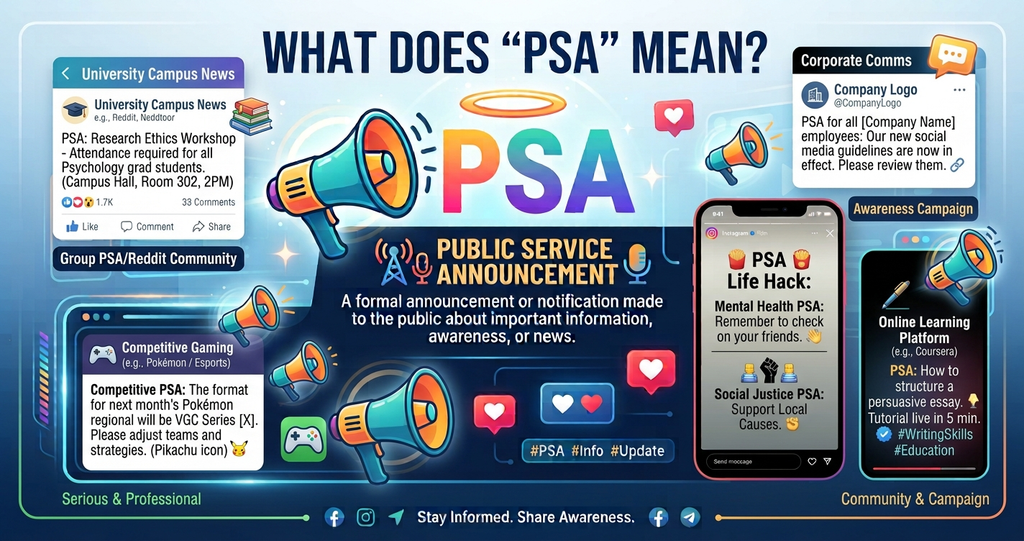
Gamers use PSA often. It appears in Discord servers, forums, and game subreddits.
Typical examples:
- “PSA: servers will be down for maintenance tonight.”
- “PSA: don’t click the link in that DM. It’s a scam.”
- “PSA: the new patch changes how crafting works.”
- “PSA: save before the boss fight.”
In these spaces, a PSA is usually practical. It protects players from lost progress, bugs, and fake giveaways.
PSA Meaning Slang Pokémon
This is the one that confuses people most. In the Pokémon community, PSA has two common uses.
The first is the standard one. A trader might post “PSA: new set releases Friday.”
The second is about card grading. PSA is also the name of a grading company, Professional Sports Authenticator. Collectors send cards in to get a grade, usually on a scale of 1 to 10. A card rated “PSA 10” is in top condition.
So what does it mean when someone says “PSA 10 Charizard”? They mean a Charizard card graded 10 by PSA. It has nothing to do with an announcement.
Check the context. If a number follows PSA, it likely means a grade.
ANOTHER COMMON TEXTING ABBREVIATION IS POV
Academic and Educational Settings
In school, PSA still keeps its original meaning.
Students may create PSA videos as class projects. Topics include bullying, recycling, and road safety. Schools also run PSA campaigns through posters and morning announcements.
On learning platforms and group chats, students use PSA more casually. Example: “PSA: the quiz is open-book.”
For teachers, PSA projects can build media literacy. Students learn how to be clear, brief, and persuasive.
Mental Health and Support Communities
PSA is common in mental health spaces, but it needs care.
Good uses include:
- “PSA: it’s okay to take a mental health day.”
- “PSA: therapy is not only for crises.”
- “PSA: check in on your friends.”
These posts can reduce stigma. They remind people they are not alone.
However, a PSA is not medical advice. Posts should not tell people to stop medication or avoid treatment. When someone may be in danger, point to professional help. In the US, people can call or text 988 to reach the Suicide & Crisis Lifeline.
If you share a mental health PSA, keep the tone kind and avoid graphic details.
KNOW ABOUT OBO READ THIS ONE ALSO
Political and Social Justice Usage
PSA is common in civic posts too. People use it to share voting deadlines, protest safety tips, and community resources.
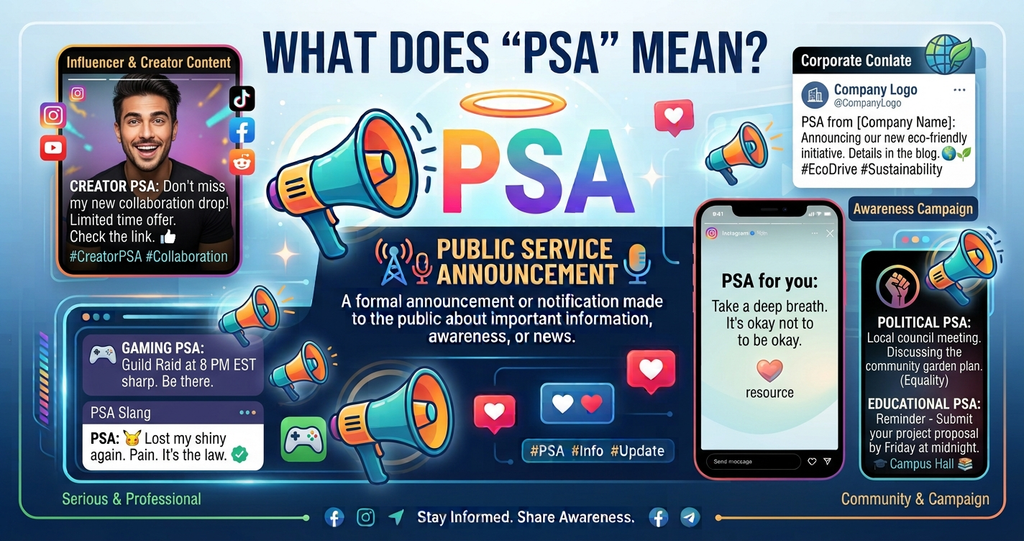
Examples include:
- “PSA: voter registration closes next week.”
- “PSA: know your rights at a public protest.”
- “PSA: check your polling place before you go.”
This is where accuracy matters most. Deadlines and rules vary by state and can change. Link to an official source such as your state election office.
Some posts also use PSA to push an opinion as if it were a fact. Readers should watch for that. A real PSA gives information. An opinion post gives a view.
Brand and Corporate PSA Adoption
Brands have picked up the format too. Companies use PSA-style posts to announce outages, recalls, new features, or safety tips.
When it works, it feels honest and quick. A brand might write: “PSA: our app is down. We’re fixing it now.”
When it fails, it feels forced. Using PSA for a basic sales message can seem fake. Users notice quickly.
Brand teams should follow a few rules:
- Use PSA only for useful news.
- Keep humor in check during serious events.
- Give a clear next step.
- Update the post when the issue is fixed.
The Dark Side: PSA in Misinformation
The PSA label can make false info look official. That is a real risk.
Hoaxes often start with “PSA” or a siren emoji. Common examples are fake kidnapping warnings, fake privacy notices, and made-up health scares. Many of these spread through copy-and-paste posts.
Before sharing a PSA, do these checks:
- Look for the original source.
- Check the date.
- Search the claim on a fact-checking site.
- Ask whether it plays on fear.
- Wait before you repost.
If a PSA says “share this with everyone now,” slow down. Urgency is a common sign of a hoax.
Future of PSA Slang
No one can predict slang perfectly. Still, a few trends look likely.
PSA will probably stay popular because it is short and useful. Ironic use may keep growing. Short video platforms may also push new spins on it.
It may become even more of a joke setup, like “PSA: you are doing better than you think.” Serious use will likely continue in safety, health, and civic posts.
Treat these as informed guesses, not facts.
YOU MAY ALSO WANT TO KNOW ABOUT HMU MEANS ONLINE
PSA in Video Content and Live Streaming
In video, PSA works as a quick hook. A creator says it in the first few seconds. That tells viewers a useful point is coming.
On live streams, moderators and streamers use PSA in chat. They remind viewers of rules, giveaways, or schedule changes.
Tips for video PSAs:
- Say the main point early.
- Add on-screen text.
- Keep it short.
- Add captions so viewers can follow without sound.
Emoji and Symbol Combinations with PSA
Emojis change how a PSA feels. Here are common pairings.
| Emoji | What it signals |
| 🚨 | Urgent or dramatic |
| 📢 | Announcement |
| ⚠️ | Warning |
| 📌 | Important, worth saving |
| 🧵 | A thread follows |
| 👇 | Details below |
| 😂 | Joke or light tone |
One or two emojis are plenty. Too many make a post look spammy and can hide the message.
Cross-Platform PSA Etiquette
A PSA that works on one app may not work on another.
A few simple habits help:
- Match the platform. A casual tone suits TikTok. A plain tone suits LinkedIn.
- Keep it brief. Short PSAs get read.
- Credit sources. Link or name where the info came from.
- Correct mistakes. If you shared wrong info, post an update.
- Respect privacy. Do not name or shame private people.
- Avoid spamming. Do not post the same PSA in every group.
If you are unsure, ask this: Does this help the reader? If not, skip the PSA.
Teaching Kids About PSA Slang
Kids pick up slang from videos and friends. Explaining PSA is a good chance to talk about online safety.
Try these steps:
- Explain that PSA means public service announcement.
- Show a safe example, like “PSA: wear a helmet.”
- Talk about how anyone can post a PSA, even if it is wrong.
- Teach them to ask, “Who said this? Is it true?”
- Encourage them to check with a trusted adult.
This builds critical thinking. It also helps kids spot scams and hoaxes.
International PSA Usage Patterns
English-language internet culture spreads fast, so PSA shows up worldwide. Users in many countries understand it from global platforms.
As a result, you may see PSA mixed into posts in other languages. People often keep the English term because it is short and recognizable.
Still, local words may be more natural in everyday talk. If you are chatting with someone who is learning English, spell it out. Say “public service announcement” or use “heads up.”
PSA and Accessibility Considerations
A good PSA should be readable by everyone.
Here are some helpful practices:
- Avoid long all-caps text. Screen readers and some readers struggle with it.
- Do not rely on emojis alone. Screen readers read each emoji name aloud.
- Use plain language. Short sentences help everyone, including non-native speakers.
- Add captions to video. This helps deaf and hard-of-hearing viewers.
- Add alt text to images. Describe key info in the image.
- Write hashtags in CamelCase. For example, #PublicServiceAnnouncement.
- Keep color contrast strong. Pale text on a light background is hard to read.
Accessible PSAs reach more people. That is the whole point of the format.
PSA Meaning in Relationships and From a Girl
These two searches are common, so here is the short version.
PSA Meaning Relationship
In relationship talk, PSA works like any other PSA. It flags advice or a warning about dating.
Examples:
- “PSA: if they want to see you, they will make time.”
- “PSA: communicate before you assume.”
- “PSA: green flags can be boring, and that’s good.”
Some PSAs are sincere tips. Others are hints at a specific person. A vague post aimed at an ex or a partner can cause drama. If you have something to say to someone, say it to them.
PSA Meaning Slang From a Girl
People often search PSA meaning slang from a girl when a crush or friend texts it. The meaning does not change based on gender. PSA still means public service announcement.
What matters is the tone and context. Here is how to read it.
- Playful tone: “PSA: I’m hungry and I’m picking the restaurant.” She is joking.
- Helpful tone: “PSA: the party starts at 8, not 9.” She is sharing info.
- Pointed tone: “PSA: replying ‘k’ is not a conversation.” She may be hinting at something.
If you are unsure, look at the message around it. Ask a friendly question like, “Is this about me?” Clear talk beats guessing.
Conclusion
So, what does PSA mean in slang? It stands for “public service announcement,” and it tells readers that useful, urgent, or funny info is coming. PSA meaning slang stays the same across texts, TikTok, Reddit, and other platforms. Only the tone changes.
Use PSA when your message helps others, and skip it when you are only venting. Check your facts before you share, and add a clue if you are joking. Do that, and your PSA will land well in any chat.
Frequently Asked Questions
What does PSA mean in texting?
PSA means “public service announcement.” In a text, it introduces info you want the reader to notice. It may be serious or playful.
What is a PSA on social media?
It is a post that shares useful or urgent info with followers, usually starting with “PSA:”. The topic can be serious, like a scam alert, or silly, like a food opinion.
What does PSA stand for in Gen Z?
It still stands for “public service announcement.” Gen Z often uses it ironically, as a setup for a joke or a relatable observation.
What does PSA mean in Pokémon?
It can mean a public service announcement. It can also refer to Professional Sports Authenticator, a card grading company. A phrase like “PSA 10” means a card graded 10.
Can I use PSA at work?
Yes, in casual team chats. In formal emails, plainer wording like “Please note” or “Quick reminder” is safer.
What is the difference between PSA and FYI?
PSA is for a wider audience and often sounds more urgent or dramatic. FYI is more casual and often goes to one or two people.
What does PSA mean in a relationship?
It usually flags relationship advice or a warning. It can be sincere, or it can be a hint aimed at someone.
Is PSA always about something serious?
No. Many modern PSAs are jokes. Look at the topic and emojis to judge the tone.