
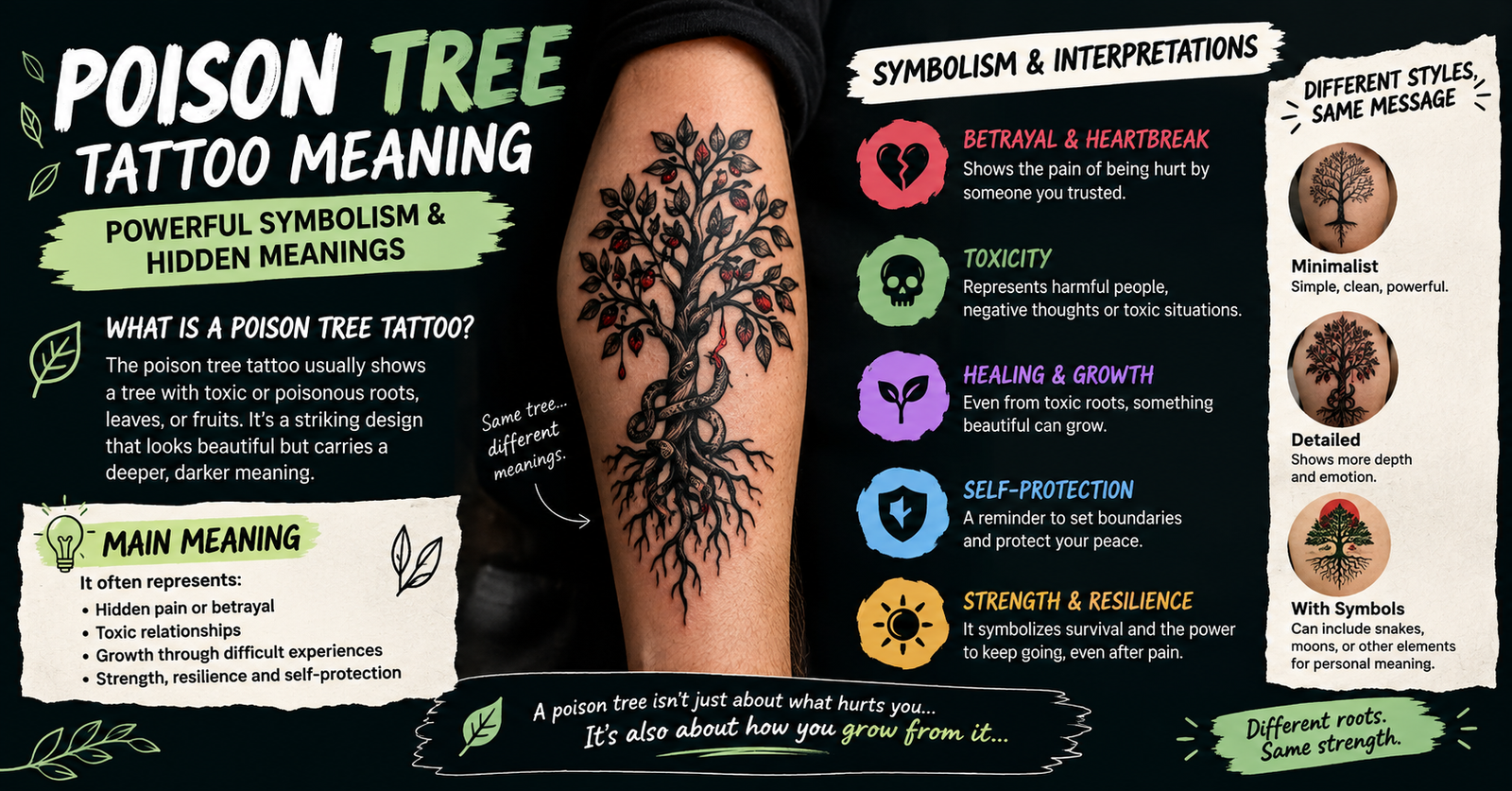
A poison tree tattoo meaning isn’t just about ink. It’s about anger you never spoke out loud. This design comes from a famous poem, and it carries a warning worth knowing before you get it.
At its heart, the poison tree tattoo meaning is simple. Silence feeds resentment until it turns dangerous. Whether you’re drawn to its story, its symbolism, or its striking look, this guide breaks down everything it truly represents.
Some people also use the phrase loosely online, almost like slang. On forums and urban dictionary-style sites, “poison tree” can describe a toxic person, a toxic relationship, or a bad influence that slowly ruins everything around it.
Quick examples of how people use the idea:
- Casual: “That job was a poison tree. It looked fine from outside, but it was killing me slowly.”
- Relationship-based: A woman gets a small poison tree on her wrist after leaving a controlling partner. It marks the moment she stopped feeding the anger and let it go.
- Offensive/edgy: Someone gets a skull tangled in poison tree roots to represent a grudge they never forgave.
- Safe for work: A simple black line-art poison tree on the forearm, worn just as a quiet reminder to communicate instead of bottling things up.
- Strength-focused: A half-dead, half-blooming tree, symbolizing surviving something painful and growing anyway.
This guide breaks down the full poison tree tattoo meaning — its origin, symbolism, design options, placement ideas, and the questions people search most.
What Is a Poison Tree Tattoo?
A poison tree tattoo is a design showing a tree, often twisted or dark, sometimes bearing strange fruit or wrapped in thorns.
At its core, it represents emotional poison. That means anger, jealousy, or hurt that isn’t dealt with directly.
Instead of expressing the feeling, the person buries it. Over time, it grows roots. It becomes bigger than the original problem ever was.
That’s the whole idea behind the poison tree tattoo meaning: unspoken emotion doesn’t disappear. It transforms into something harder to control.
ANOTHER COMMON TEXTING ABBREVIATION IS DTTM
The Origins: William Blake’s “A Poison Tree” (1794)
The tattoo traces back to a real poem. William Blake wrote “A Poison Tree” in 1794, as part of his collection Songs of Experience.
The poem is short, but the message is sharp. Blake writes about being angry with a friend and telling him, so the anger fades. Then he’s angry with a foe and stays silent, so the anger grows.
He waters it with fears, tends it with smiles, and it eventually bears a poisoned apple. His enemy steals the fruit and dies from it.
It’s a poem about how silence and pride can turn a small conflict into something fatal. Many tattoo wearers reference this poem directly, either through quotes, imagery, or symbolic details like the apple and the garden.
Poison Tree Tattoo Meaning: Core Symbolism
The poison tree tattoo meaning isn’t one single idea. It carries a few overlapping themes, depending on the wearer’s story.
Here’s what it commonly represents:
- Suppressed anger. Feelings that were never spoken out loud.
- Toxic relationships. A bond that looked healthy but slowly caused harm.
- Revenge or grudges. Anger nursed quietly until it turns destructive.
- Emotional growth. A warning to the wearer, reminding them not to repeat old patterns.
- Duality. Something that looks beautiful but is dangerous underneath.
Most people don’t get this tattoo to glorify anger. They get it as a personal reminder. It says: speak up before it festers.
Who Gets a Poison Tree Tattoo — and Why
This tattoo attracts a wide range of people, not just one type.
Poison tree tattoo meaning for women often centers on healing after a toxic relationship or friendship. It marks the decision to stop absorbing someone else’s poison.
Poison tree tattoo meaning for men tends to lean toward control, restraint, or a lesson learned about pride and silence. Some men choose it after a falling out they regret handling badly.
Poison tree tattoo meaning for strength appears in designs that pair the tree with new growth, like small green leaves on dead branches. It says the person survived something painful and came out stronger.
Literature lovers get it for Blake’s poem alone, with no personal drama attached. They simply connect with the writing.
Others get it after therapy or self-reflection, as a symbol of choosing honesty over resentment going forward.
Popular Design Variations
The poison tree tattoo meaning can shift slightly depending on the style. Here are the most requested versions.
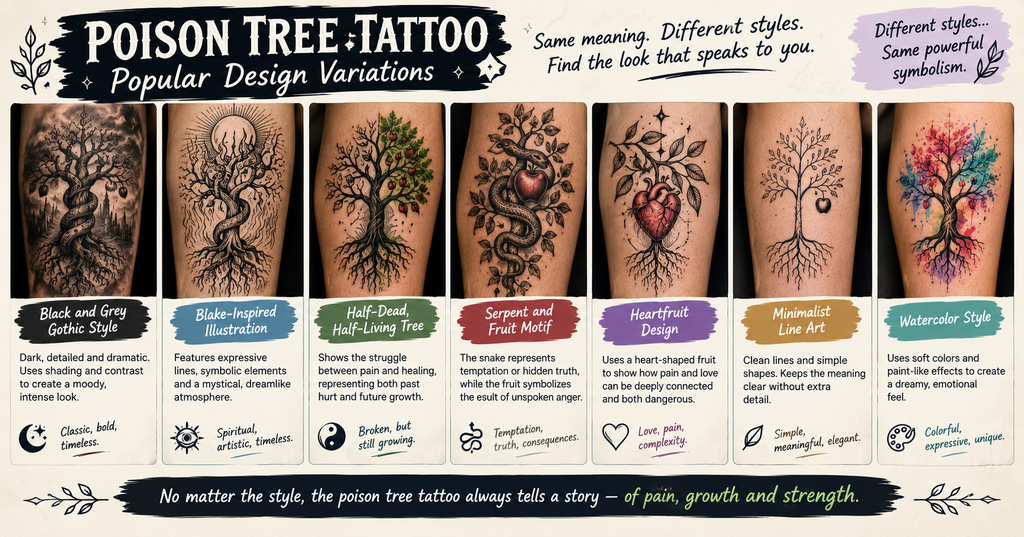
Black and Grey Gothic Style
Dark, shaded, and heavy on contrast. Twisted branches and bare roots dominate the design. This style leans into the “danger” side of the symbolism.
Blake-Inspired Illustration
Often includes a line from the poem, a garden setting, or an apple hanging from the branches. This version stays closest to the original literary meaning.
Half-Dead, Half-Living Tree
One side is bare and cracked. The other side blooms with leaves or flowers. This design represents healing, growth, or moving past a toxic phase.
Serpent and Fruit Motif
A snake wrapped around the trunk, paired with poisoned fruit. This leans on biblical imagery of temptation and consequence.
Heartfruit Design
Instead of an apple, the tree grows a heart-shaped fruit, often cracked or bleeding. This version speaks directly to heartbreak and betrayal.
Minimalist Line Art
A simple, single-line tree with no shading. Popular for small forearm or wrist tattoos. It’s subtle, so most people won’t guess the deeper meaning unless told.
Watercolor Style
Soft color splashes behind a black tree outline. Less gothic, more artistic. Often chosen by people who want the symbolism without a dark visual tone.
SEE OUR GUIDE OF NTR FOR A STRONGER EXPRESSION
Color Meanings in Poison Tree Tattoos
Color changes the tone of the tattoo without changing its base meaning.
| Color | Common Meaning |
| Black | Classic choice; anger, mystery, buried emotion |
| Red | Passion, betrayal, or a wound that hasn’t healed |
| Green (new growth) | Healing, recovery, moving forward |
| Purple | Poison, danger, something toxic but seductive |
| Grey/faded tones | Emotional numbness or distance from the pain |
Most tattoos mix black with one accent color. A single red apple on a black-and-grey tree is a common and effective combination.
Poison Tree Tattoo Meaning in Toxic Relationships
This is one of the most searched angles. Many people get this tattoo after ending a relationship that drained them.
The tree represents the relationship. The poison represents the resentment, lies, or pain that built up over time. Getting the tattoo often marks the end of that chapter, not the middle of it.
Poison Tree Tattoo Meaning and Inner Conflict
Sometimes the “enemy” in Blake’s poem isn’t another person. It’s a part of the wearer’s own personality, like pride, jealousy, or self-doubt.
In this reading, the poison tree tattoo meaning becomes a mirror. It reflects an internal struggle the person is trying to overcome, not someone else’s wrongdoing.
Can a Poison Tree Tattoo Symbolize Healing?
Yes. This surprises people who assume the design is only dark or negative.
Many wearers add a small detail, like a new leaf, a bird, or a bloom, to show growth after pain. The tattoo becomes proof that they survived the poison instead of being consumed by it.
What Each Part of a Poison Tree Tattoo Can Symbolize
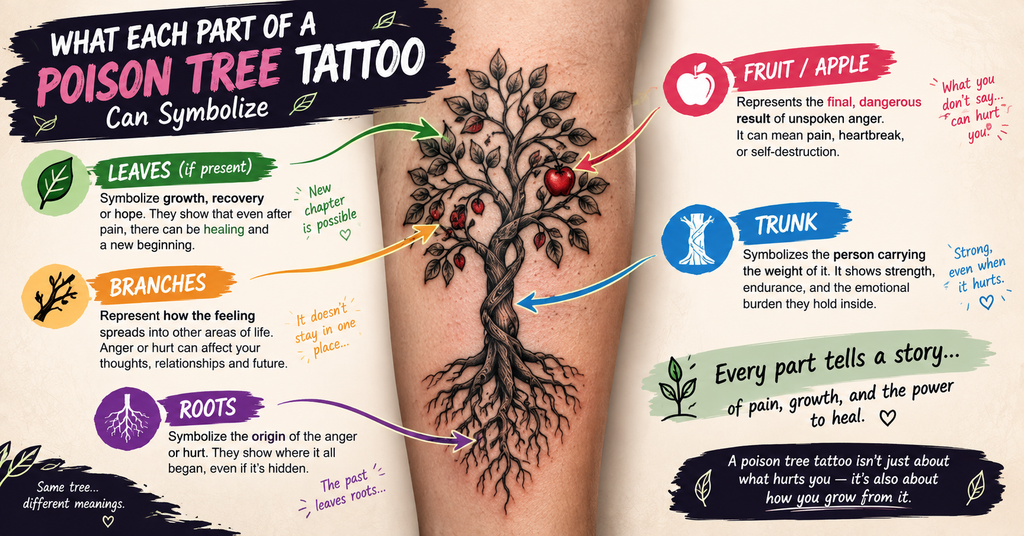
- Roots: the origin of the anger or hurt
- Trunk: the person carrying the weight of it
- Branches: how the feeling spreads into other areas of life
- Fruit/apple: the final, dangerous result of unspoken anger
- Leaves (if present): growth, recovery, or hope
Best Placement Options for a Poison Tree Tattoo
Placement affects visibility and meaning.
- Forearm: One of the most popular spots. A poison tree tattoo meaning on the forearm is easy to see, which suits people who want to talk about their story when asked.
- Upper arm/shoulder: Allows for bigger, more detailed designs with roots and branches.
- Back: Ideal for full illustrative pieces, including quotes from Blake’s poem.
- Ribs or side: A more private placement, chosen by people who want the meaning kept personal.
- Wrist or ankle: Best for minimalist versions, since detail gets lost at small sizes.
Is a Poison Tree Tattoo Always Negative?
No. It looks intense, but the deeper reading is often a warning to the wearer, not a threat to someone else. Many treat it as a personal lesson about honesty.
How to Make Your Poison Tree Tattoo More Personal
- Add a birth flower among the roots
- Include a short line from Blake’s poem
- Use one dead branch and one blooming branch to show a before-and-after story
- Add a date marking when you chose to “stop watering the poison”
- Pick a color that matches a specific memory or emotion, not just aesthetics
KNOW ABOUT CHUD READ THIS ONE ALSO
Psychological Dimension: Why This Symbol Resonates So Deeply
Suppressed anger is a well-documented psychological pattern. Holding in resentment instead of addressing it directly can affect mood, relationships, and stress levels over time.
Blake’s poem captured this centuries before modern psychology gave it a name. That’s likely why the tattoo still resonates today. It puts a very human, very common struggle into a single, striking image.
People are drawn to symbols that name a feeling they’ve had trouble explaining. The poison tree does exactly that.
Common Misunderstandings About Poison Tree Tattoos
Does Every Poison Tree Tattoo Mean Revenge?
No. Revenge is one possible reading, but many wearers connect it to healing, self-awareness, or literature appreciation instead.
Is a Poison Tree Tattoo a Biblical Symbol?
Not directly. Some designs borrow imagery similar to the Garden of Eden, like a serpent or forbidden fruit. But the tattoo’s actual origin is Blake’s poem, not scripture. Wearers who want a biblical connection usually add it intentionally through extra symbols.
Does It Always Represent a Toxic Relationship?
No. It can, but it also represents internal conflict, personal growth, or simple admiration for the poem.
Is a Dark Tree Tattoo Automatically Negative?
Not always. A “dark” visual style doesn’t mean a dark meaning. Many people choose gothic shading purely for artistic contrast, while the underlying message is about resilience.
Conclusion
The poison tree tattoo meaning comes down to one truth. Anger left unspoken doesn’t disappear. It grows roots and turns into something far bigger than the original hurt.
This tattoo isn’t just dark imagery. It’s a personal reminder to speak up, heal, and grow past old pain. Whatever story you carry, it makes for a design with real meaning behind it.
Rooted in William Blake’s 1794 poem, this tattoo has grown into a flexible symbol. It can represent a toxic relationship, an internal struggle, or hard-won healing, depending on the story behind it.
Whether you want it as a warning to yourself, a tribute to a hard chapter you survived, or simply a nod to a poem you love, this design carries real depth. That depth is exactly why it keeps showing up on skin, and in searches, year after year.
FAQs
What does A Poison Tree symbolize?
It symbolizes how unspoken anger festers and grows into something destructive, versus anger expressed openly, which fades away.
Which tattoo to avoid?
Avoid tattoos with unclear or offensive symbolism you haven’t researched, gang or cult-associated imagery, someone’s name (relationship risk), trendy designs you’ll outgrow, and poor-quality flash art from unlicensed artists.
What does aqua tofana tattoo mean?
It references Aqua Tofana, a legendary poison used by women in 17th-century Italy to escape abusive husbands — the tattoo symbolizes hidden female power, quiet revenge, or resistance against oppression.
What does a poison tree tattoo mean?
It generally symbolizes suppressed anger or resentment that grows over time when left unspoken, based on William Blake’s poem “A Poison Tree.”
Is the poison tree tattoo meaning tied to a specific book or poem?
Yes. It comes from William Blake’s 1794 poem “A Poison Tree,” part of his collection Songs of Experience.
Does poison tree tattoo meaning change for women vs. men?
The core meaning stays the same, but women often link it to healing from toxic relationships, while men more often connect it to controlling anger or learning from pride.
Is there a poison tree tattoo meaning connected to strength?
Yes. Designs showing new growth on an otherwise dead tree symbolize surviving hardship and coming out stronger.
Where is the most popular placement for this tattoo?
The forearm is one of the most common spots, offering visibility along with enough space for detail.