
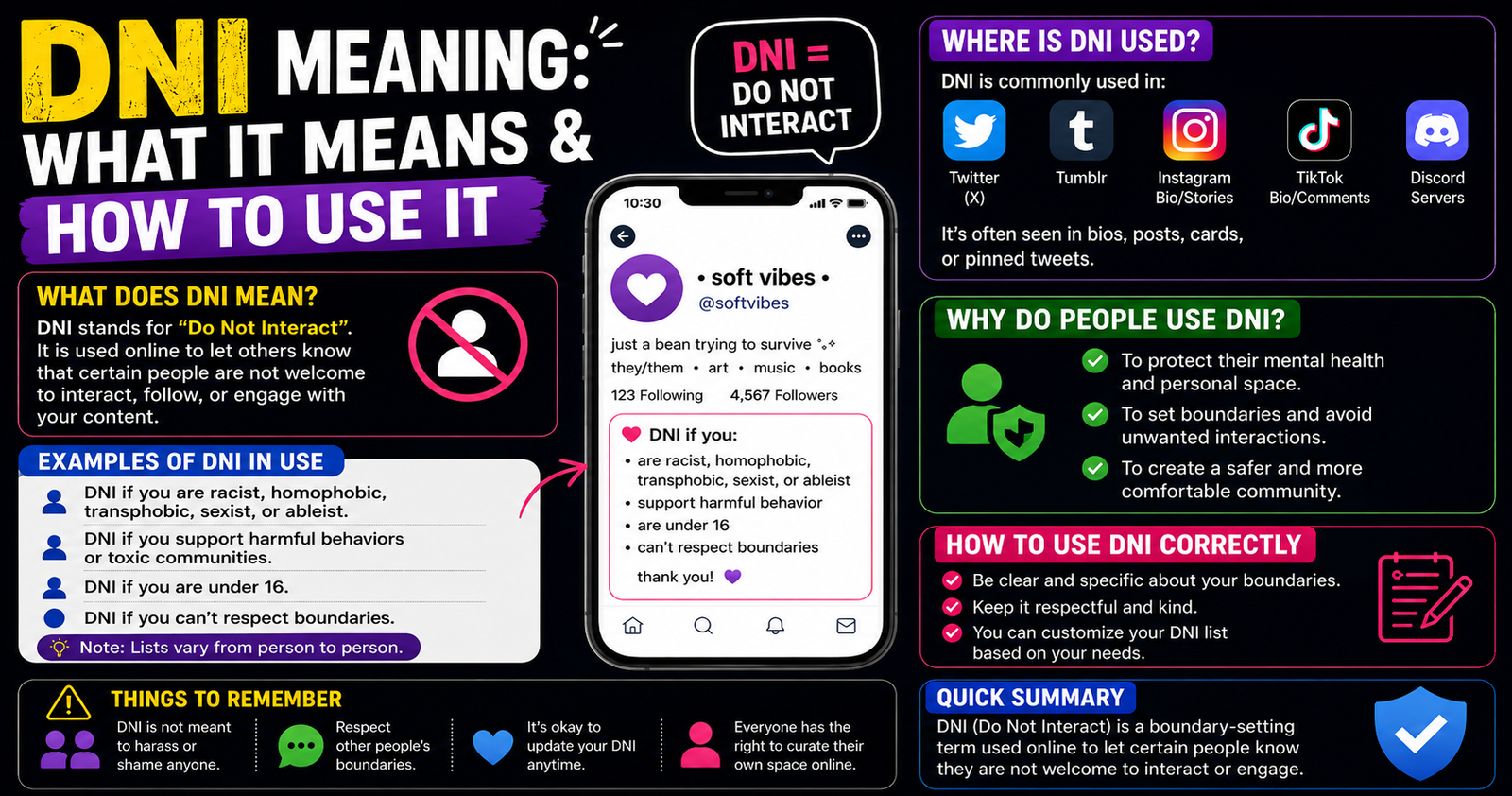
Have you seen “DNI” in a bio, a text, or even a news headline and wondered what it means? It’s not just one thing. The DNI meaning actually changes depending on where you spot it — a text from a friend, a hospital form, or even an Olympic scoreboard.
Online, DNI usually means “Do Not Interact,” a boundary people set in their bio to keep certain followers away. But step outside social media, and DNI can mean “Do Not Intubate” in a hospital, “Did Not Improve” at the Olympics, or even a national ID card in Spain. This guide breaks down every DNI meaning in plain, simple words, so you’ll always know exactly which one applies.
Here’s a fast reference before we go deeper:
| Context | What DNI Stands For | Where You’ll See It |
| Texting/social media | Do Not Interact | TikTok, Instagram, Twitter/X, Snapchat bios |
| Medical | Do Not Intubate | Hospital charts, advance directives |
| Olympics/sports | Did Not Improve | Snowboarding and skiing scoreboards |
| U.S. government | Director of National Intelligence | News, federal agencies |
| Spain/Latin America | Documento Nacional de Identidad | ID cards, passports, official forms |
Below is a full breakdown of each one, starting with the version most people are searching for: DNI in chat and on social media.
DNI Meaning in Text and Chat
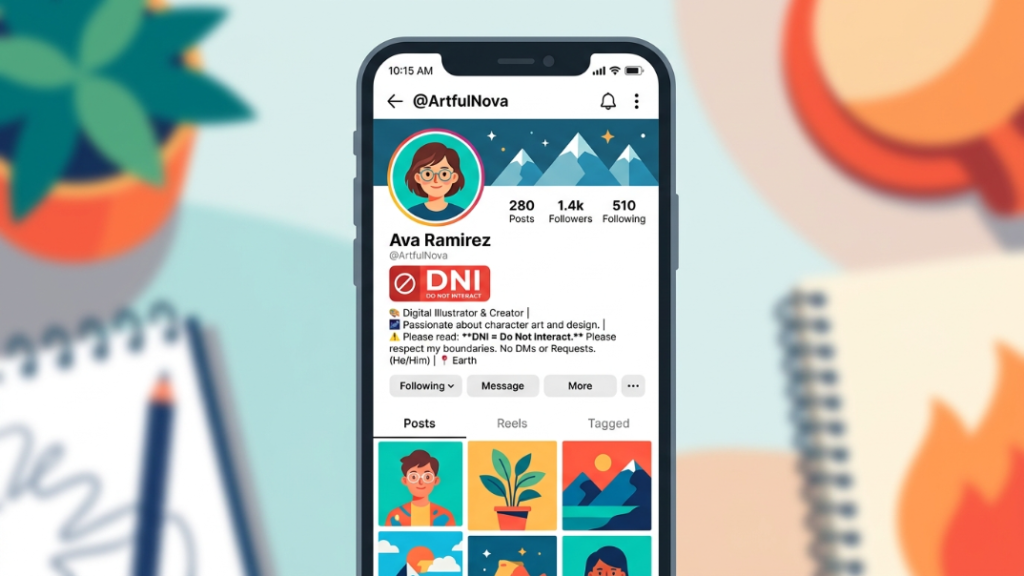
In texting and chat apps, DNI stands for “Do Not Interact.” It’s a boundary-setting phrase, usually placed in a bio or pinned post, telling specific people — or specific types of people — to stay away from an account. It’s not a greeting or filler word; it’s a warning.
Someone might write “DNI if you’re under 18” or “minors DNI” to keep certain age groups from following them. Others use it to block out people with opposing opinions, ex-partners, or accounts they’ve had conflict with.
DNI slang meaning boils down to this: it’s a self-enforced block list written in plain text, before any actual blocking happens.
DNI Meaning on Snapchat, Instagram, TikTok, and WhatsApp
The core meaning doesn’t change across apps, but how it’s used does:
- Snapchat: Often shows up in Snap Story captions or usernames, warning people not to add or message the user.
- Instagram: Common in bios, especially fan or “stan” accounts, listing DNI criteria (e.g., “anti [name] DNI,” “proship DNI”).
- TikTok: The most common home for DNI. Creators pin it in bios or comment sections, especially within fandom and creator communities, to filter out unwanted followers before they even interact.
- WhatsApp: Less common, but it appears in status updates or group descriptions with the same “don’t message me” intent.
DNI Meaning on Twitter/X
On Twitter/X, DNI works the same way as on TikTok and Instagram — it’s placed in a bio to preemptively tell certain people not to follow or reply. It’s especially common among accounts tied to fandoms, political commentary, or niche communities where the user wants to avoid specific arguments or harassment.
YOU MAY ALSO WANT TO KNOW ABOUT IGU MEANS ONLINE
Is DNI an Acronym, Short Form, or Something Else?
DNI is a true acronym — each letter stands for a word (Do Not Interact), and it’s read as three separate letters, not pronounced as one word. It functions like an instruction rather than a standard word, similar to other internet shorthand like “TL;DR” or “NSFW.”
Tone and Context Variations
The same three letters can land very differently depending on tone:
- Funny: “DNI if you think pineapple doesn’t belong on pizza 🍍” — used lightheartedly, not as a real boundary.
- Sarcastic: “Oh, you disagree? DNI then, I guess.” — mocking the seriousness of the phrase itself.
- Romantic/flirty: Rare, but sometimes used jokingly between couples, e.g., “DNI unless you’re bringing snacks.”
- Angry: “If you supported that, genuinely DNI.” — a firm, serious cutoff after conflict.
- Playful: Used in gaming or fandom banter without any real intent to block anyone, more of an inside joke.
Context and punctuation usually make the tone obvious — a laughing emoji softens it, while a period and no emoji signals it’s serious.
Real Examples of DNI in Chat
| Example | Meaning |
| “minors DNI, this account isn’t for you” | Age-based boundary |
| “if you liked [ex]’s post, DNI” | Conflict-based boundary |
| “proshippers DNI” | Fandom content boundary |
| “DNI if you’re gonna argue about it lol” | Light, semi-joking use |
| “trump supporters/anti trump DNI” (either direction) | Political boundary |
| “friends of [name] DNI” | Personal falling-out boundary |
| “18+ only, minors DNI” | Age-restricted content warning |
| “if u dont like [fandom], DNI” | Fandom gatekeeping |
| “DNI, I don’t have the energy today” | Casual, mood-based deflection |
| “spam accounts DNI” | Anti-bot/anti-spam boundary |
Grammar and Language Role
Part of speech: DNI functions as an imperative phrase — it’s a command, similar to “don’t call me.”
Sentence position: It’s almost always placed at the start or end of a sentence, rarely in the middle, since it works best as a standalone directive.
Does it replace a full sentence? Yes. “DNI” alone can stand in for “please do not follow, message, or comment on this account,” which is part of why it’s popular — it compresses a boundary into three letters.
Formal vs. informal: DNI is strictly informal internet slang. It has no place in professional writing, resumes, or formal correspondence.
How to Reply When Someone Says DNI
- Funny reply: “Noted, I’ll interact from a safe distance 👀”
- Serious reply: Simply respect it — don’t comment, follow, or message.
- Flirty reply: “Even if I bring coffee?” (only appropriate with people you already know well)
- Neutral reply: No reply needed. DNI is a boundary statement, not a question, so silence is the normal response.
ANOTHER COMMON TEXTING ABBREVIATION IS BMF
Who Uses DNI, and Where Did It Come From?
DNI is most common among teens and young adults, particularly Gen Z, who grew up setting digital boundaries publicly in bios rather than privately through blocking. Millennials use it less often and are more likely to simply block or mute someone instead of announcing a boundary.
It’s most concentrated on TikTok, Instagram, and Twitter/X, especially within fandom spaces, where DNI lists can get very specific (e.g., “anti-[ship] DNI,” “proship DNI,” “spam DNI”).
Origin: DNI grew out of broader internet “blacklist” culture — similar phrasing exists in gaming communities and older forums as “do not add.” It gained mainstream traction through fandom Twitter and Tumblr in the 2010s before spreading widely on TikTok, where creators use bio real estate to filter followers before problems start. It functions as a form of digital gatekeeping — fast to type, easy to screenshot, and useful for setting a public boundary without individually blocking dozens of accounts.
Is DNI Rude?
DNI isn’t inherently rude — it’s a boundary, and boundaries aren’t impolite by default. Whether it comes across as rude depends on the reason behind it and how it’s phrased. “Minors DNI” on mature content is responsible, not rude. “If you disagree with me about anything ever, DNI” can come across as combative, since it shuts down conversation preemptively.
Is DNI a bad word? No. It’s not profanity or slur-adjacent; it’s a neutral phrase that can be used kindly, jokingly, or harshly depending on context.
Should You Use DNI in School or the Office?
School: DNI is fine in casual conversations between students but doesn’t belong in assignments, presentations, or communication with teachers.
Workplace: Avoid it entirely in professional settings. If you need to set a boundary with a coworker, plain language (“please don’t message me outside work hours”) reads as more professional and less likely to be misread as hostile.
In practice, DNI works well in personal social media spaces where the audience already understands internet shorthand, and poorly anywhere a formal or unfamiliar audience might see it.
DNI Meaning in Medical Settings
Outside of chat, DNI in a medical context stands for “Do Not Intubate.” It’s a specific type of advance directive that tells healthcare providers not to insert a breathing tube (intubate) or place a patient on a mechanical ventilator, even if their breathing fails.
DNI is often discussed alongside DNR (Do Not Resuscitate), but the two aren’t identical:
- A DNR means no CPR and no resuscitation efforts if the heart stops.
- A DNI is narrower — it specifically refuses intubation, but the patient can still receive other treatments like chest compressions or medication.
A patient can have a DNI without a DNR, meaning they’d still want CPR attempted but not a breathing tube placed afterward. These decisions are typically part of advance care planning and are common among patients with terminal illness or serious chronic conditions who want to avoid long-term ventilator dependence.
DNI Meaning in the Olympics and Sports
In Olympic snowboarding and skiing, DNI stands for “Did Not Improve.” It appears on scoreboards in events with multiple runs where not every score counts toward the final result — most notably Big Air, where competitors get three runs but only their best two scores are combined.
If an athlete’s run scores lower than a previous attempt, that run is marked DNI. For example, if a snowboarder scores 80, then 80 again, then 70 on their third run, that third run shows DNI because it didn’t raise their combined total. It’s not a penalty or disqualification — it simply means that particular attempt didn’t count.
DNI is different from other Olympic scoring abbreviations you might see nearby: DNS (Did Not Start) means an athlete couldn’t begin their run, often due to injury, and DNF (Did Not Finish) means they started but didn’t complete it.
DNI Meaning in Government
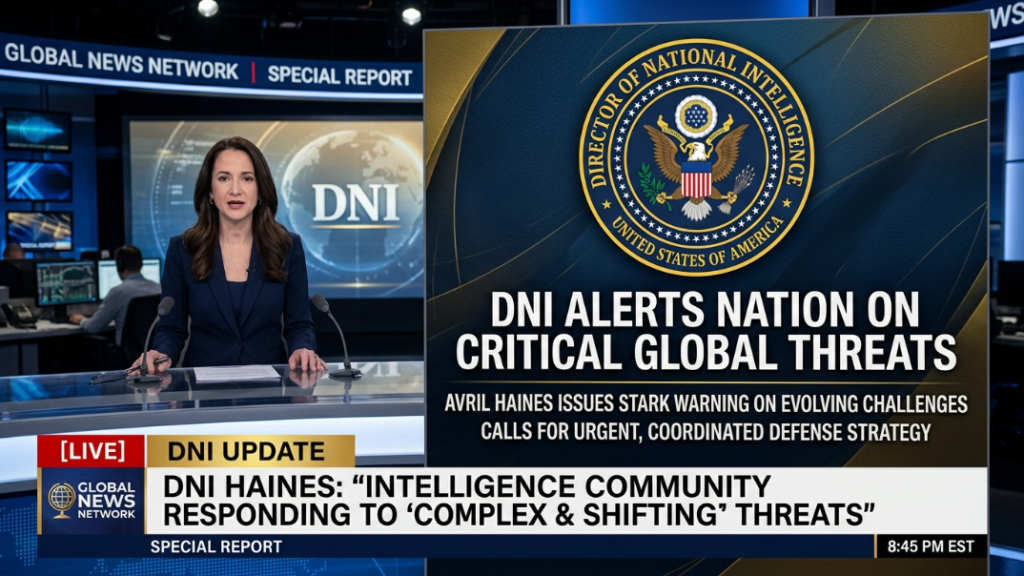
In U.S. government and news coverage, DNI stands for “Director of National Intelligence.“ This is a cabinet-level position that oversees the U.S. intelligence community, coordinating agencies like the CIA, NSA, and FBI’s intelligence functions, and briefing the president on national security matters.
The role was created in 2005, in the aftermath of the 9/11 attacks, to improve coordination between intelligence agencies. As of publishing, the position is under new leadership following a Senate confirmation in 2026, though the office’s occupant changes periodically — check current news for the latest holder of the role.
DNI Meaning for Passports and ID
If you’ve searched “DNI meaning passport,” you’ve likely come across the term in a Spanish-language context. DNI stands for “Documento Nacional de Identidad” (“National Identity Document”), the mandatory identity card issued to citizens in Spain and used as an equivalent term (“Documento de Identidad”) in several Latin American countries.
In Spain specifically, the DNI is a credit-card-sized ID with a photo, an eight-digit number plus a control letter, and an embedded chip. Spanish citizens use it for everyday identification — banking, voting, and official paperwork — and it can also serve as a travel document within the EU and parts of Europe, functioning similarly to a passport for short trips. It’s different from the NIE, which is issued to foreign residents in Spain rather than citizens.
This is a completely separate meaning from the internet slang version, so context always makes clear which one is meant — a form asking for your “DNI number” is asking for an ID number, not telling you to avoid interacting with someone.
DNI Meaning Comparison Table
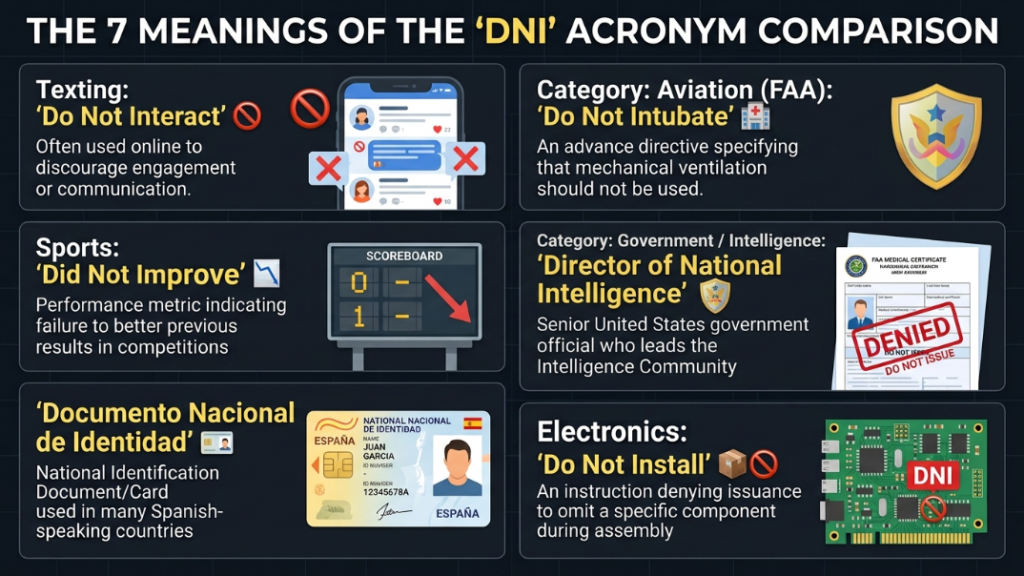
| Field | Meaning | Example Use |
| Texting/social media | Do Not Interact | “minors DNI” |
| Medical | Do Not Intubate | Advance directive form |
| Olympics/sports | Did Not Improve | Snowboarding scoreboard |
| U.S. government | Director of National Intelligence | News headline |
| Spain/Latin America | Documento Nacional de Identidad | National ID card |
| Aviation medical (FAA) | Do Not Issue (medication) | Pilot medical clearance list |
| PCB/electronics design | Do Not Install | Circuit board notes |
Summary
DNI has no single meaning — it depends entirely on where you see it. On social media and in texting, it means “Do Not Interact,” a boundary phrase popular with Gen Z and common in fandom spaces. In medicine, it refers to a “Do Not Intubate” order.
At the Olympics, it flags a run that “Did Not Improve” a score. In U.S. government contexts, it’s short for “Director of National Intelligence.” And on Spanish and Latin American ID documents, it stands for “Documento Nacional de Identidad.”
Usage Tips
- Match the tone to your audience — DNI reads casually and won’t land the same way in formal writing.
- Be specific about who or what the DNI applies to, rather than leaving it vague.
Common Mistakes
- Using DNI in professional or academic writing, where it isn’t understood or appropriate.
- Assuming DNI always means the same thing — always check the context before assuming it’s the “Do Not Interact” slang version.
When to Use It
In casual bios, captions, or messages where you want to set a clear, low-effort boundary with a specific group of people.
When to Avoid It
In professional communication, formal writing, or with an audience unfamiliar with internet slang — plain language works better there.
Conclusion
So now you know what DNI really means. It changes based on where you find it. Online, it means “Do Not Interact.” In a hospital, it means something much more serious.
The key is context. Always look at where the word shows up. That way, you’ll never misread it again.
FAQ
What does DNI mean in text slang?
DNI means “Do Not Interact.” It’s a request asking certain people not to message or reply.
What does DNI mean in Snap?
On Snapchat, DNI means the same thing. It tells people not to add or message you.
What does DNI mean on Discord?
On Discord, DNI means “Do Not Interact.” Users add it to profiles to block unwanted contact.
What is DNI at the Olympics?
DNI means “Did Not Improve.” It shows a run that scored lower than a previous attempt.
What does DNI mean in a hospital?
DNI means “Do Not Intubate.” It tells doctors not to place a breathing tube on the patient.
Is DNI rude?
Not inherently. It’s a boundary, and how rude it feels depends on the reason and tone behind it.
Can adults use DNI?
Yes, though it’s more common among teens and young adults. Adults use it too, especially in fandom or niche online communities.
How do you respond to DNI?
Usually, you don’t reply — you simply respect the boundary by not interacting.
Why do people put DNI in their bio?
To set a public boundary in advance, avoiding unwanted interactions before they happen, rather than blocking people individually after the fact.