
Ever seen “no diddy” pop up in your texts or TikTok comments and had no idea what it meant? You’re not alone. It’s one of those slang terms that spreads fast online but rarely comes with an explanation. Once you know the meaning, though, it’s actually pretty simple to understand.
“Diddy” is internet slang, and it shows up in two main ways. Most often, people say “no diddy” as a joke after saying something that sounds a little flirty or awkward. Other times, “diddy” just means something small or petty. This guide breaks down both meanings, where they came from, and how to use them the right way.
Diddy Meaning in Text, Chat, and Social Media
Diddy Meaning in Text
In texts and DMs, “diddy” almost always shows up as “no diddy” — a quick tag added to the end of a message to clarify “I didn’t mean that in a weird way.” It functions as a disclaimer, not a real statement about anything. If a friend texts “you’re actually kind of a snack, no diddy,” they’re complimenting you while jokingly denying any romantic intent.
Diddy Meaning Slang
There are really two separate slang meanings floating around right now, and mixing them up is the #1 source of confusion:
- “No diddy” (the meme phrase) — a humorous way to cancel out anything that sounded gay, flirty, or too personal. It’s a modern remix of “no homo” and “pause.”
- “Diddy” as an adjective — meaning small, minor, petty, or immature. “That’s a diddy amount of money” means it’s not much at all. This sense is closer to an older British/Scottish informal word for “small,” which Gen Z picked up and reused with a more sarcastic, meme-y tone.
Context tells you which one is being used. If it’s tacked onto the end of a sentence, it’s almost always the “no homo” version. If it’s describing a noun directly (“diddy move,” “diddy problem”), it’s the “small/petty” version.
What Does Diddy Mean in Chat?
In group chats, gaming lobbies, and Discord servers, “no diddy” is used as a fast callout whenever someone says something with an unintentional double meaning. It’s often shouted or typed the instant a sentence lands wrong, almost like a verbal flag on the play. It’s meant to be funny and lighthearted among friends, though — as covered later — it does have a more serious side that’s worth knowing about.
Diddy Meaning on Snapchat
On Snapchat, the term shows up mostly in captions and chat replies rather than snaps themselves. A typical use: someone sends a slightly awkward or overly nice message, then follows up with “no diddy 💀” to laugh it off before the other person can react. It rarely appears as a standalone Snap caption because the joke depends on responding to something specific that was just said.
Diddy Meaning on Instagram, TikTok, and WhatsApp
On Instagram, “no diddy” pops up most in comments under compliments, thirst traps, or ambiguous captions. Commenters use it to poke fun at the original poster or at each other, e.g., “bro said ‘love you’ in the caption… no diddy 😭.” It’s also common in Reels audio and meme templates that reference the phrase directly.
TikTok
TikTok is where the modern version of this slang really took off. Creators use “no diddy” in captions, comment sections, and voiceovers as a reaction to anything sus-sounding in a clip. It’s frequently paired with the word “pause” and reused as a comedic sound bite or meme format layered over unrelated videos.
WhatsApp usage mirrors regular texting — it shows up in one-on-one and group chats among younger users, almost always as a quick add-on after a message, rather than as its own conversation starter. It’s less common here than on TikTok or Instagram simply because WhatsApp skews toward more private, less meme-driven conversation.
Is “Diddy” an Acronym, Short Form, or Something Else?
“Diddy” is not an acronym — it doesn’t stand for anything letter by letter. It’s better described as:
- A nickname, referring to entertainer Sean “Diddy” Combs (formerly Puff Daddy, then P. Diddy).
- A meme-coded slang term, where his stage name got repurposed as a punchline in the “no diddy” phrase.
- Separately, an old informal adjective in British and Scottish English meaning “small,” which predates the meme entirely and is unrelated to Combs.
So depending on which sense someone is using, “diddy” is either a person’s nickname turned meme, or a completely unrelated dialect word for “tiny.” Neither is a formal acronym or abbreviation.
Tone & Context Variations
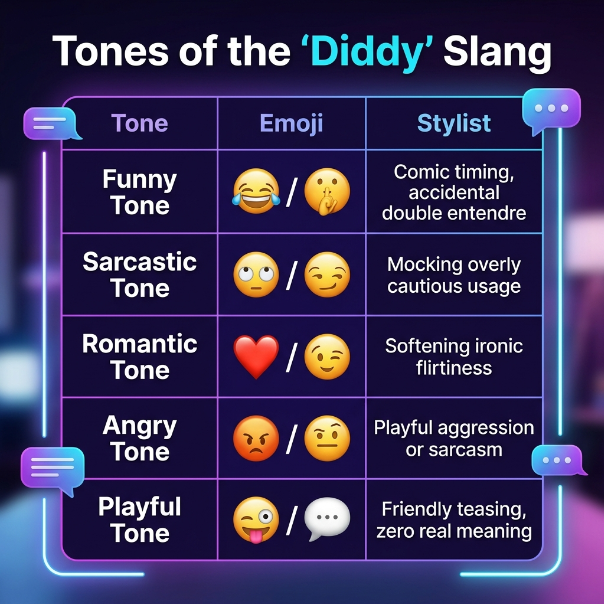
The same word can land very differently depending on tone. Here’s how “diddy” typically shifts across moods:
Funny Tone
Used for pure comic timing after an accidental double entendre. Example: “I’ll come over and tuck you in lol, no diddy.”
Sarcastic Tone
Used to mock someone for being overly cautious or for saying something obviously suspicious. Example: “‘No diddy’ won’t save you after that sentence, bro.”
Romantic Tone
Rarely genuine — usually used ironically right after a message that actually is a little flirty, to soften it or make it feel like a joke rather than a real confession.
Angry Tone
Occasionally used sarcastically in arguments to imply someone’s comment came off aggressive or weird in a way they didn’t intend. Example: “Watch how you’re talking to me… no diddy tho.”
Playful Tone
The most common use — just friends teasing each other after any slightly odd or overly sweet comment, with zero real meaning behind it beyond the joke.
Real Chat Examples (Natural & Relatable)
Example 1 A: bro your hoodie smells so good B: 😭 thanks man, no diddy
Example 2 A: I’d carry you home if you got tired lol B: no diddy right?
Example 3 A: that’s such a diddy excuse, just tell her the truth B: fair 😭
Example 4 A: ngl you’re actually really easy to talk to B: appreciate that… no diddy tho 💀
Example 5 A: I saved you a seat next to me B: aww wait no diddy right
Example 6 A: quit being diddy about it, it’s not that deep B: ok ok fine
Example 7 A: bro I missed you today fr B: no diddy 😭 me too tho
Example 8 A: that tip was so diddy, like $2 on a $60 bill? B: yeah that’s rough
Example 9 A: you looked really good today B: thank you… no diddy 🙏
Example 10 A: I’ll always have your back no matter what B: bro said that with his whole chest, no diddy
Example 11 A: that argument you made was kinda diddy ngl B: rude but ok
Example 12 A: I could talk to you all night honestly B: NO DIDDY 💀💀 bro chill
Grammar & Language Role
Part of Speech
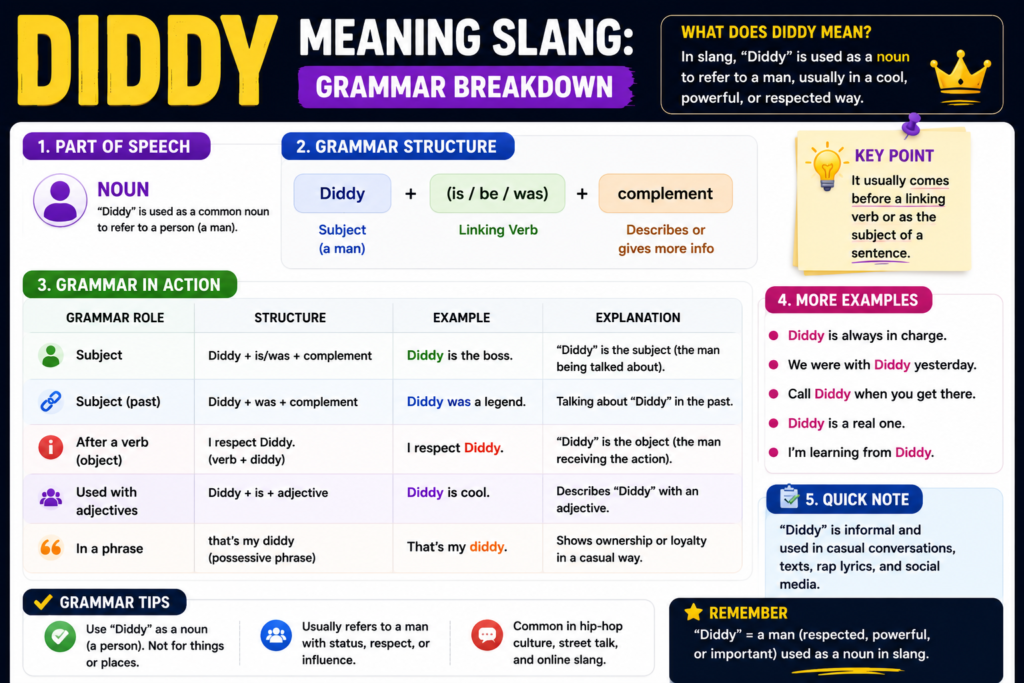
DIddy is used as noun to refer to a person. “Diddy” also functions as an adjective when describing size or pettiness (“a diddy problem”). In the “no diddy” phrase, the whole expression acts more like an interjection or discourse marker — a short reaction phrase rather than a grammatical part of the sentence it follows.
Sentence Position
- As an adjective: before the noun it modifies (“diddy move,” “diddy amount”).
- As “no diddy”: almost always at the end of a sentence or as a standalone reply, similar to “lol” or “jk.”
- As a noun (proper noun): When it refers to the person — Sean “Diddy” Combs’s nickname. In that case, it’s being used as a name, not a descriptive word.
Can It Replace a Full Sentence?
Yes. “No diddy” can stand entirely on its own as a one-word (well, two-word) reply, functioning the same way “same,” “facts,” or “lol” would in a chat.
Tone Impact
Adding “no diddy” instantly signals the message should be read as a joke, not a genuine or serious statement — even if the sentence before it sounded sincere.
Formal vs Informal Use
This is strictly informal slang. It has no place in professional writing, school assignments, resumes, or formal communication of any kind.
How to Reply When Someone Says “Diddy”
Funny Reply
“Bro really said that and followed it with ‘no diddy’ 💀”
Serious Reply
“Haha all good, I knew what you meant.”
Flirty Reply
“Why do you need the disclaimer though? 👀”
Neutral Reply
“Lol fair enough.”
Comparison Table With Similar Chat Terms
| Term | Meaning | Typical Use | Tone |
| No diddy | Denies gay/flirty implication of a statement | End of sentence | Joking, meme-y |
| No homo | Older version of the same disclaimer | End of sentence | Joking, but criticized as homophobic |
| Pause | Same function, older Gen Z/millennial slang | End of sentence | Joking |
| Diddy (adjective) | Small, petty, minor | Before a noun | Playful, dismissive |
| Jk | “Just kidding,” cancels out a statement | End of sentence | Light, casual |
| No cap | Emphasizes something is true, not a joke | Anywhere in sentence | Sincere |
Who Uses This Term?
Age Groups
Primarily teens and young adults, roughly ages 13–25, who are active on TikTok, Instagram, Snapchat, and gaming chat platforms.
Gen Z vs Millennials
Gen Z drives current usage and popularized the “diddy” version specifically. Millennials are more likely to recognize the older relatives of this phrase — “no homo” and “pause” — and may use “no diddy” more self-consciously or ironically, often referencing it as “the thing kids say now.”
Regional Usage
“No diddy” spread nationally through social media rather than staying regional, though earlier versions like “pause” have roots in U.S. hip-hop and street slang before going mainstream online.
Platforms Where It Appears
Most common on TikTok and Instagram comments/captions, followed by group texts, Snapchat, Discord, and gaming voice/text chat. Least common on LinkedIn, email, and other professional platforms, where it essentially never appears.
Origin & Internet Culture Insight
TikTok Influence
The phrase “no diddy” spread rapidly through TikTok clips, sound bites, and comment sections, where users applied it as a rapid-fire reaction to anything that sounded even slightly suggestive. Its catchy rhythm and shock-value pairing with a celebrity’s name made it easy to repeat and remix into countless videos.
Meme Culture
“No diddy” is a direct descendant of “no homo” and “pause” — older disclaimer phrases used to walk back statements that could be read as gay. What made “no diddy” different is the wordplay: it uses Sean “Diddy” Combs’s stage name as the punchline. The timing matters here — the phrase gained massive traction alongside the serious criminal allegations, arrest, and 2025 federal trial involving Combs, which included charges of racketeering and sex trafficking.
He was ultimately acquitted of those top charges but convicted on two lesser counts related to transporting people for prostitution and sentenced to prison in late 2025. That real, well-publicized case is why the meme carries a darker undertone for many people, even though the “no diddy” phrase itself functions as a lighthearted joke format.
Fast Typing Culture
Like most modern slang, “diddy” thrives because it’s short, quick to type, and instantly recognizable — perfect for fast-paced chat environments where a longer explanation would kill the joke’s timing.
Is “Diddy” Rude or Inappropriate?
Is It a Bad Word?
“Diddy” itself isn’t a slur or a banned word. But “no diddy,” like “no homo” before it, has been criticized as subtly homophobic because it implies that sounding gay is something to be embarrassed about or needs correcting. Many people use it without thinking about that history, but it’s worth knowing before you use it casually, especially around people who might find it hurtful.
Can It Be Misinterpreted?
Yes, in two ways. First, because of its link to Sean Combs’s real criminal case, using it around older audiences or in serious conversations can come across as tone-deaf or confusing. Second, because of its “no homo” roots, it can be read as dismissive of LGBTQ+ people even when that’s not the intent.
Should You Use It in School or Office?
No. It’s casual internet slang with a sensitive backstory, so it doesn’t belong in classrooms, workplaces, or any formal setting. Save it for texts and comments among friends who already understand the joke.
Experience-Based Insight
If you scroll through comment sections on TikTok or Instagram for even a few minutes, you’ll notice “no diddy” almost always appears as a reaction to something someone else said — it’s rarely the first line of a post. That pattern matters: the phrase is reactive slang, built to comment on another statement, not to start a conversation on its own.
Understanding that structure is the fastest way to use it correctly instead of dropping it in randomly, which is the most common giveaway that someone doesn’t actually know the term.
Final Summary
“Diddy” slang splits into two lanes: the meme phrase “no diddy,” used as a joking disclaimer after anything that sounds flirty or gay, and the standalone adjective “diddy,” meaning small or petty.
Both are casual, internet-born, and tied loosely or directly to Sean “Diddy” Combs’s name and public persona. It’s popular across TikTok, Instagram, and group chats, mostly among teens and young adults, and it’s not something you’d use in professional or formal writing.
Usage Tips
- Use “no diddy” right after a statement that could sound flirty or ambiguous — not as an opener.
- Use “diddy” as an adjective only for things that are genuinely small, minor, or petty.
- Keep it to casual chats with people who already know the reference.
Common Mistakes
- Using “diddy” alone when you mean “no diddy” (they aren’t interchangeable).
- Confusing “diddy” with “ditty” (a short song).
- Using it in professional, academic, or formal settings.
- Assuming everyone will find it funny — the term’s backstory isn’t universally seen as lighthearted.
When to Use vs When to Avoid
Use it in casual texts, group chats, and social media comments with friends who are familiar with internet slang and won’t be put off by the reference.
Avoid it in professional communication, formal writing, conversations with people unfamiliar with the meme, or any context where a joke tied to a real criminal case could come across as insensitive.
Conclusion
So that’s the full picture behind “diddy” slang. It’s mostly used as a quick joke after saying something that sounds flirty or awkward. It can also just mean something small or petty. Either way, it’s casual slang meant for friends, not formal chats.
Now you know when to use it and when to skip it. Save it for texts, group chats, and comments with people who get the joke. Leave it out of school work, job messages, or serious conversations. Used the right way, it’s just harmless fun between friends.
Frequently Asked Questions (FAQ)
What is the meaning of diddy?
“Diddy” is slang for something small, minor, or petty. It’s also short for Sean “Diddy” Combs, the entertainer whose nickname the meme slang plays on.
What is the meaning of “no diddy”?
“No diddy” is a joking phrase people add after saying something that sounds flirty or gay, to deny that meaning. It works just like “no homo” or “pause.”
What does “getting diddy” mean?
It’s not a fixed, widely agreed-on phrase — it’s mostly used loosely online, often as a dark-humor reference to Sean Combs’s legal case. It’s best avoided since it can easily come across as confusing or insensitive.
Does “diddy” mean small?
Yes. It’s an old British/Scottish informal word for small, which Gen Z slang later borrowed to also mean petty or minor.
Does “diddy” mean song?
No, that’s a mix-up with “ditty,” a different word meaning a short, simple tune.
What does “nice try diddy” mean?
It’s a sarcastic jab at someone trying to sound smooth or convincing and failing, with “diddy” added for meme emphasis.
Is “no diddy” the same as “no homo”?
They serve the same purpose — denying a flirty or gay implication — but “no diddy” is the newer, meme version referencing Sean Combs’s name.
Is it offensive to say?
It can carry mildly homophobic undertones, similar to “no homo,” so it’s worth using thoughtfully depending on who you’re talking to.
1 thought on “Diddy Meaning Slang: What It Means & How to Use It”