
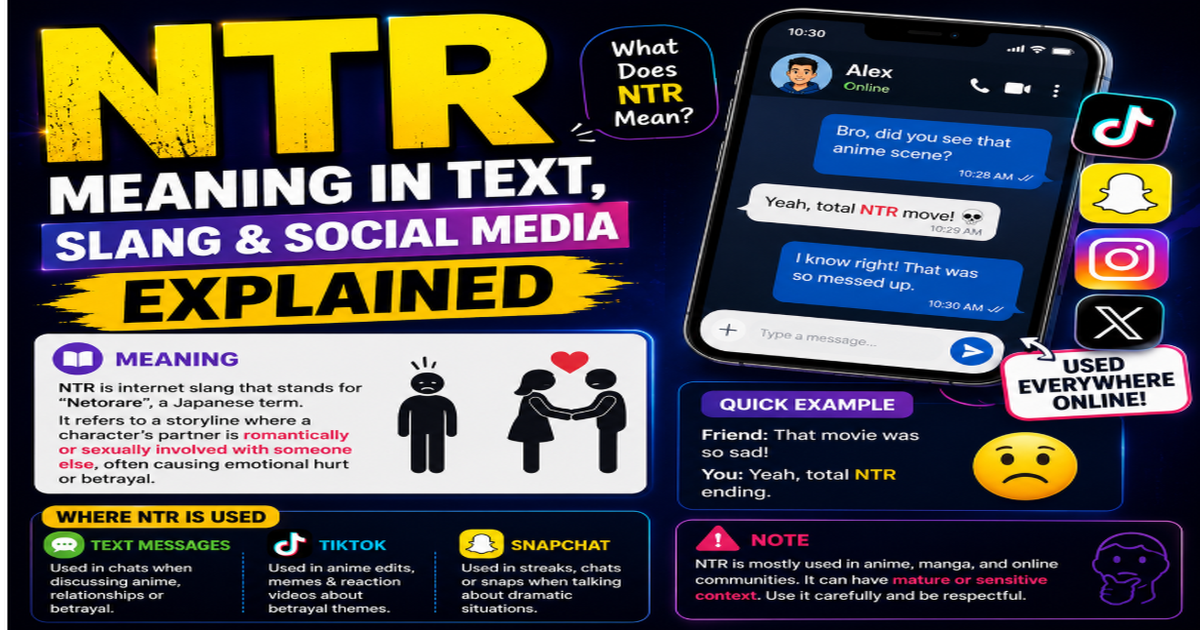
Have you seen “NTR” meaning in a text or online and felt lost? You’re not the only one. This short word shows up a lot these days. But it doesn’t always mean the same thing.
NTR can mean two very different things. In everyday texting, it usually means “Nothing To Report.” In anime and gaming spaces, it points to a story trope about cheating. This guide breaks down both meanings in plain, simple words.
What Does NTR Mean?
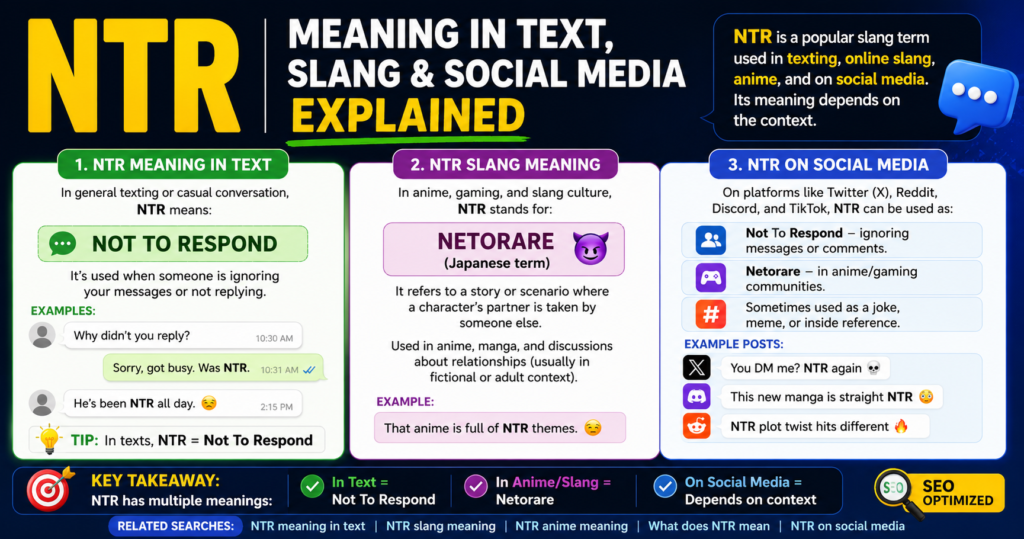
NTR is an initialism, which means each letter stands for a separate word rather than the term being a blended slang word like “yeet” or “simp.” Depending on the platform and the people you’re talking to, it can mean one of two things:
- Nothing To Report — a general-purpose texting reply, similar to saying “same old” or “nothing new.”
- Netorare — a Japanese word (寝取られ) that roughly translates to “taken while asleep” or “taken away,” used to describe fictional storylines centered on a partner’s infidelity. It’s most common in anime, manga, and gaming spaces, and it originated in Japanese adult fiction before spreading into wider internet slang.
There’s a third, much rarer usage: NTR is also the initials of N. T. Rama Rao, a famous Indian actor and politician, which occasionally shows up in search results but has nothing to do with texting slang.
Because the abbreviation is shared across such different contexts, the safest approach is to read the sentence around it before assuming which meaning applies.
NTR Meaning in Text
In one-on-one or group texting, NTR is almost always shorthand for “Nothing To Report.” It works the same way as “nm” (not much) or “same” — a filler response when someone checks in and nothing noteworthy has happened.
Typical texting scenarios:
- A friend asks, “How was your day?” and you reply, “NTR, just work and food.”
- A group chat check-in where everyone posts a one-line update, and someone just types “NTR.”
- A parent or partner texting “you good?” and getting a quick “yeah, ntr” back.
This version of NTR is casual, friendly, and appears in personal or family texting far more often than in public posts. It carries no negative connotation and is safe to use with almost anyone.
NTR Slang Meaning
Outside of the “nothing to report” usage, NTR slang meaning shifts heavily toward anime, gaming, and fandom communities. In this context, NTR meaning in a relationship refers to a fictional trope: a character’s romantic partner becomes involved with someone else, usually against the original couple’s wishes, and the story focuses on the emotional fallout for the person who was left behind.
A few things worth knowing about this slang usage:
- It started in Japanese fan communities discussing manga, visual novels, and adult anime, then spread to English-language forums like Reddit and Discord.
- It’s used almost exclusively to describe fictional content, not to accuse a real person of cheating. Calling a real relationship “NTR” is uncommon and would read as a strange, somewhat crude joke rather than a normal way to talk about infidelity.
- Because its origins are tied to adult content categories, the term can carry a mature or NSFW association even when it’s used in a non-explicit, joking way.
If someone uses NTR to describe a show, game, or story plot, they’re talking about this trope. If someone uses it in a plain group chat with no fandom context, they almost certainly mean “nothing to report.”
What Does NTR Meaning Mean in Chat?
In live chat apps — Discord, group texts, gaming voice chat overlays — NTR tends to follow whichever crowd is using it. Gaming and anime Discord servers lean toward the Netorare meaning, especially in channels discussing a specific show or visual novel. General friend-group chats almost always default to “nothing to report.”
Context clues that point to the fandom meaning:
- The conversation is already about anime, manga, or a specific game.
- NTR is paired with words like “genre,” “trope,” “spoiler,” or a show’s title.
- Someone tags it with a content warning or says “NTR warning” before describing a plot.
Context clues that point to the everyday meaning:
- It’s a direct answer to “what’s up” or “how’s it going.”
- There’s no fandom or story discussion nearby.
- It’s used by someone outside anime or gaming circles, like a coworker, parent, or classmate.
NTR Meaning on Snapchat
On Snapchat, NTR usually shows up in captions, chat replies, or story replies as the quick “nothing to report” version. Snapchat’s culture favors short, low-effort text because most communication happens through photos and video, so a three-letter filler word fits naturally into captions like “ntr, just chilling” under a boring selfie.
It’s less common to see the anime-related meaning on Snapchat specifically, since that community tends to gather more on Discord, Twitter/X, and Reddit rather than Snapchat’s more personal, friend-based format.
NTR Meaning on Instagram, TikTok & WhatsApp
On Instagram, NTR appears in two main places: comment sections on anime or gaming accounts (fandom meaning) and personal captions or DMs (texting meaning). Instagram’s broader, more public audience means the term is more likely to be misunderstood there than in a smaller Discord server, so people using the fandom meaning often add extra context, like tagging a show name or using it alongside hashtags such as #anime or #hentaigenre.
TikTok
TikTok is where the Netorare meaning gets the most visibility. Anime edit accounts, manga recap creators, and gaming commentary videos frequently use NTR in captions or comments to tag a specific plot type, often with a content warning since the genre is tied to mature source material. TikTok’s algorithm and short-form format have helped push niche anime terminology like NTR toward a much wider, non-fandom audience, which is part of why so many people encounter the term for the first time and search for what it means.
WhatsApp usage mirrors regular texting. Since WhatsApp is dominated by personal and family conversations, especially internationally, NTR almost always means “nothing to report” here. This is also where the “NTR meaning in text in Urdu” searches come from — in South Asian WhatsApp and SMS culture, NTR is borrowed the same way as other English texting abbreviations, used simply as a quick “nothing new” response rather than carrying any Japanese-slang meaning. The fandom definition is far less common in everyday Urdu or Hindi-language chats unless the person is specifically active in anime fan communities.
Is NTR an Acronym, Short Form, or Internet Slang?
NTR Is an Acronym
Technically, NTR functions as an initialism rather than a true acronym, since it’s pronounced letter by letter (“en-tee-are”) rather than as a single word. In casual usage, though, most people call any shortened letter-combination like this an “acronym,” so you’ll see it labeled that way across the internet even though it’s not strictly accurate by linguistic standards.
It also qualifies as internet slang because its meaning isn’t fixed by a dictionary — it shifts based on community and context, which is typical of terms that evolve through forums, fandoms, and texting culture rather than formal language.
Tone & Context Variations of NTR
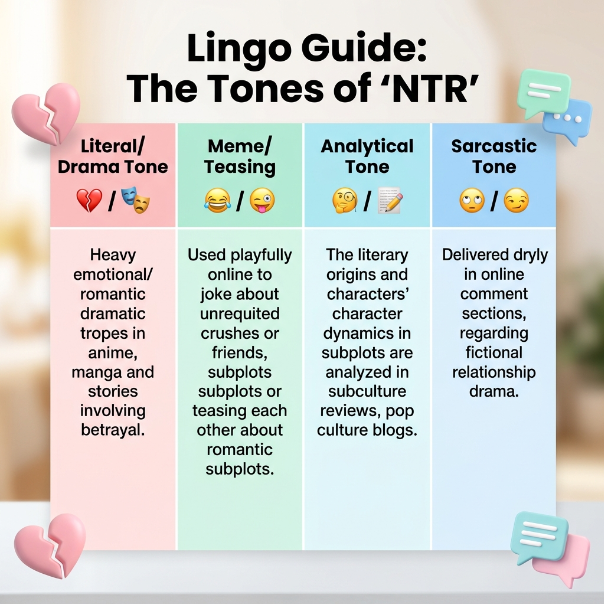
The same three letters can land very differently depending on tone. Here’s how NTR shifts across common moods.
Funny Tone
Used as a throwaway joke, often self-deprecating: “spent 3 hours reorganizing my Spotify playlists, NTR.”
Sarcastic Tone
Deployed when something clearly did happen, but the person is downplaying it: “failed my exam, cried in the bathroom, ntr though.”
Romantic Tone
Rare, and almost always tied to the fandom meaning — used when discussing a show’s plot rather than an actual relationship, like “this arc is such a gut punch, total NTR moment.”
Angry Tone
In fandom spaces, NTR can be used with frustration when a favorite couple’s storyline takes this turn: “why would they do an NTR arc, I’m furious.”
Playful Tone
Friends teasing each other with the trope term as a joke, unrelated to real feelings: “bro got NTR’d in Fortnite, someone took his loot.”
Real Chat Examples of NTR Meaning
Example 1 “hey how was the weekend?” → “ntr, just slept a lot”
Example 2 “anything new with you?” → “nah ntr, same routine”
Example 3 “did you finish that anime?” → “yeah but the NTR subplot ruined it for me”
Example 4 “why do you look upset” → “watched an NTR arc last night lol still recovering”
Example 5 “what’s the group chat update today” → “NTR from me, quiet week”
Example 6 “you good?” → “yeah ntr, just tired”
Example 7 “bro got wrecked in the game” → “yeah he got NTR’d, someone stole his win”
Example 8 “how’s the job hunt going” → “ntr honestly, still waiting to hear back”
Example 9 “saw you online at 2am, what happened” → “nothing lol ntr just couldn’t sleep”
Example 10 “is that manga worth reading” → “good story but heads up, it has an NTR plotline”
Example 11 “family dinner update?” → “ntr, usual small talk”
Example 12 “what’s new with the renovation” → “ntr this week, waiting on materials”
Grammar & Language Role of NTR
Part of Speech
NTR usually functions as a noun phrase (referring to the concept, “that show has NTR”) or as a standalone interjection/reply (used alone to mean “nothing new”). In fandom spaces, it’s occasionally verbed, as in “he got NTR’d,” where it acts as a past-tense slang verb.
Sentence Position
As a reply, it typically stands alone or opens a sentence: “NTR, just chilling.” As a fandom term, it usually sits mid-sentence, describing a plot element: “that arc had a heavy NTR theme.”
Does It Replace a Full Sentence?
Yes, in the texting sense. “NTR” on its own replaces a full sentence like “nothing new to report” or “nothing happened.” It works the same way “same” or “nm” do in casual conversation.
Tone Impact
Because it’s short and low-effort, NTR often signals a relaxed, non-urgent tone. Typing it out in full (“nothing to report”) can actually feel more formal or deliberate by comparison.
Formal vs Informal Use
NTR is strictly informal. It has no place in professional emails, school assignments, or formal writing, in either meaning.
How to Reply When Someone Says NTR
Funny Replies
“NTR? Living the dream, I see.” “NTR gang, we move in silence.”
Serious Replies
“Good, glad it’s a calm week.” “Noted — let me know if anything changes.”
Flirty Replies
“NTR? Boring, let’s fix that.” “Nothing to report, or nothing you’re telling me?”
Neutral Replies
“Cool, same here.” “Got it, thanks for the update.”
Comparison Table: NTR vs Similar Slang Terms
| Term | Common Meaning | Typical Platform | Tone |
| NTR | Nothing to report / Netorare (fandom) | Texting, TikTok, Discord | Neutral to niche/mature |
| NM | Not much | Texting, Instagram DMs | Casual |
| SMH | Shaking my head | Twitter/X, Instagram | Disapproving |
| IYKYK | If you know, you know | TikTok, Instagram | Inside-joke, playful |
| GG | Good game | Gaming chat, Discord | Sportsmanlike |
| Simp | Someone overly devoted to a crush | TikTok, Twitter/X | Teasing, sometimes critical |
Who Uses the Term NTR?
Age Group
NTR skews toward teens and young adults, largely because both of its meanings — quick texting slang and anime/gaming terminology — are most active in those age groups. Younger Gen Z users are especially likely to know the fandom meaning through TikTok and gaming culture.
Gen Z vs Millennials
Gen Z More likely to know and casually use the Netorare/fandom meaning, largely due to exposure through TikTok edits, Discord servers, and gaming communities.
Millennials More likely to use or recognize only the “nothing to report” texting meaning, often without any awareness of the anime-related definition.
Regions Where It’s Common
The “nothing to report” texting usage is common across English-speaking regions, including the US, UK, and increasingly in South Asian texting culture on WhatsApp and SMS, including among Urdu and Hindi speakers who use it as a borrowed English abbreviation.
The fandom meaning is strongest in communities with active anime and manga followings — this spans North America, parts of Europe, and Southeast Asia, largely tracking wherever anime and gaming culture is popular rather than any single country.
Platforms Where NTR Appears Most
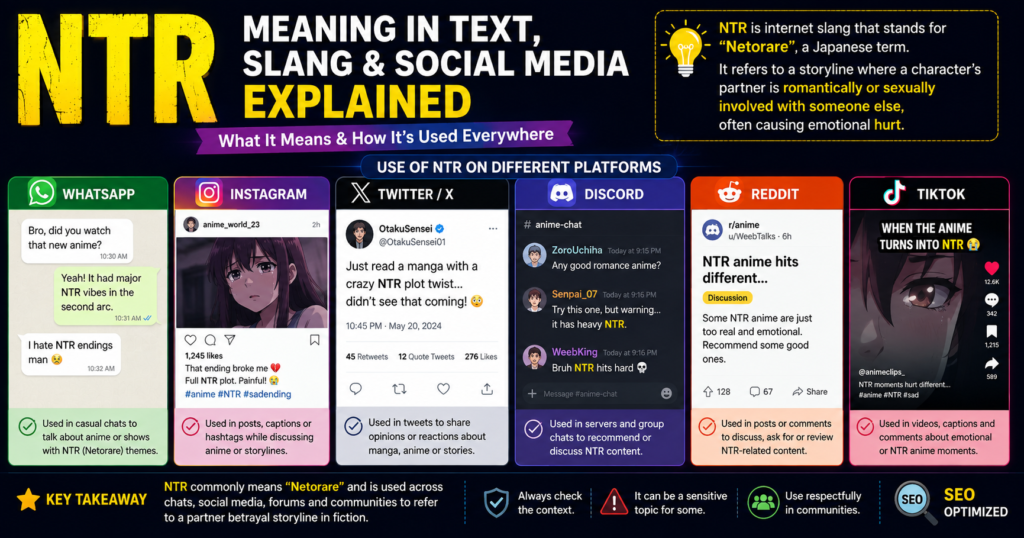
- TikTok — fandom meaning, often with content warnings
- Discord — fandom meaning, especially in anime/gaming servers
- Reddit — fandom meaning, used in genre discussions and spoiler tags
- WhatsApp — texting meaning almost exclusively
- Snapchat — texting meaning, casual captions
- Instagram — a mix, depending on the account type
Origin & Internet Culture Insight
Possible Origin of NTR
The fandom sense of NTR traces back to Japanese fan communities discussing manga and visual novels, where “netorare” was already an established term for stories involving a partner’s infidelity. As English-speaking fans engaged with translated content and fan forums, the initialism NTR was adopted directly rather than translated, which is common with Japanese fandom terminology (similar to how “isekai” or “tsundere” entered English fan vocabulary without full translation).
The “nothing to report” meaning developed separately, through general texting-abbreviation culture, and has no connection to the Japanese term beyond sharing the same three letters.
TikTok Influence on NTR Meaning
TikTok’s short-form, caption-heavy format has amplified niche fandom vocabulary far beyond its original forums. Creators reacting to anime plot twists or summarizing manga chapters use NTR as shorthand in captions, which exposes the term to viewers who have never been part of an anime-specific community — a major reason search interest in “what does NTR mean” has grown.
Meme Culture Role
Because the fandom meaning centers on a dramatic emotional trope, it lends itself to memes and reaction content — exaggerated “betrayal” reaction videos, dramatic plot recaps, and joking uses in gaming contexts (like losing an item to another player) all borrow the term’s emotional weight for comedic effect.
Fast Typing Culture
The “nothing to report” meaning fits a broader pattern in texting culture: shortening common phrases to save keystrokes, similar to “nm,” “brb,” or “idk.” It’s less about secrecy and more about speed and low-effort replies in fast-moving conversations.
Why People Say NTR Meaning on TikTok
People search “NTR meaning on TikTok” specifically because the term shows up in captions and comments without explanation, often assuming viewers already know the fandom context. Since TikTok’s audience is much broader than a niche anime forum, plenty of viewers encounter the term for the first time through a video that never actually defines it.
Is NTR Rude or Offensive?
Is NTR a Bad Word?
NTR itself isn’t a slur or an inherently offensive word. However, its fandom meaning is tied to a mature/adult content genre, so using it in that sense around the wrong audience can come across as inappropriate, similar to referencing adult content generally. The “nothing to report” meaning is completely neutral and inoffensive.
Is It Appropriate for School or Work?
The texting meaning (“nothing to report”) is fine in casual school or workplace chat, though it’s still informal enough to avoid in an email to a teacher or manager. The fandom meaning should be avoided in school or work settings entirely, since it references adult content categories and could be read as inappropriate regardless of intent.
Is It Safe to Use Publicly?
Generally yes, for the texting meaning. For the fandom meaning, it’s safer in dedicated anime/gaming spaces than in mixed public comment sections, where the mature association might not be obvious to everyone reading it.
Experience-Based Insight on How People Use NTR
Across texting threads, gaming chats, and fandom comment sections, one pattern stands out: confusion almost always comes from mixing contexts. Someone who only knows the “nothing to report” meaning can be genuinely thrown off seeing NTR attached to a show description, while someone from anime fan spaces might read a plain “ntr, nm here” text and briefly wonder why a friend is casually referencing an adult content trope.
The mismatch is rarely intentional — it’s simply two unrelated slang traditions sharing the same three letters. When in doubt, checking whether the conversation is already about a show, game, or fandom topic is the fastest way to tell which meaning applies.
Conclusion
NTR isn’t one simple word. It has two different meanings online. In texting, it usually means “Nothing To Report“. In anime and gaming spaces, it means something tied to a cheating storyline in fiction. The right meaning depends on where you see it.
Context is the real key here. If a friend texts “NTR” after you ask what’s up, they just mean nothing new. If it shows up under an anime clip or game chat, it’s talking about that storyline trope. Once you know both meanings, the confusion disappears for good.
FAQ
What does NTR mean in a text?
It usually means “Nothing To Report” — a quick reply when nothing new happened.
What does NTR stand for?
NTR stands for “Netorare,” a Japanese term used in anime and gaming slang.
What does NTR mean on TikTok?
On TikTok, NTR usually refers to a cheating-themed storyline trope in anime or manga.
Is NTR a bad word?
No, NTR itself isn’t a bad word, but its followers meaning is tied to mature content.
What does it mean when someone says NTR?
It means “nothing new” in texting, or it refers to a betrayal storyline in fandom talk.
What does NTR mean in slang?
In slang, NTR usually refers to a fictional storyline where a character’s partner is unfaithful or taken by someone else.
What is full form NTR?
The full form is “Netorare,” a Japanese word meaning roughly “taken away” or “taken while asleep.”
What does NTR warning mean?
It’s a heads-up tag creators use before content that includes a cheating-related storyline, so viewers know in advance.
What is meant by NTR content?
NTR content refers to anime, manga, or game stories built around a partner’s infidelity as the main plot focus.
2 thoughts on “NTR Meaning in Text, Slang & Social Media Explained”