
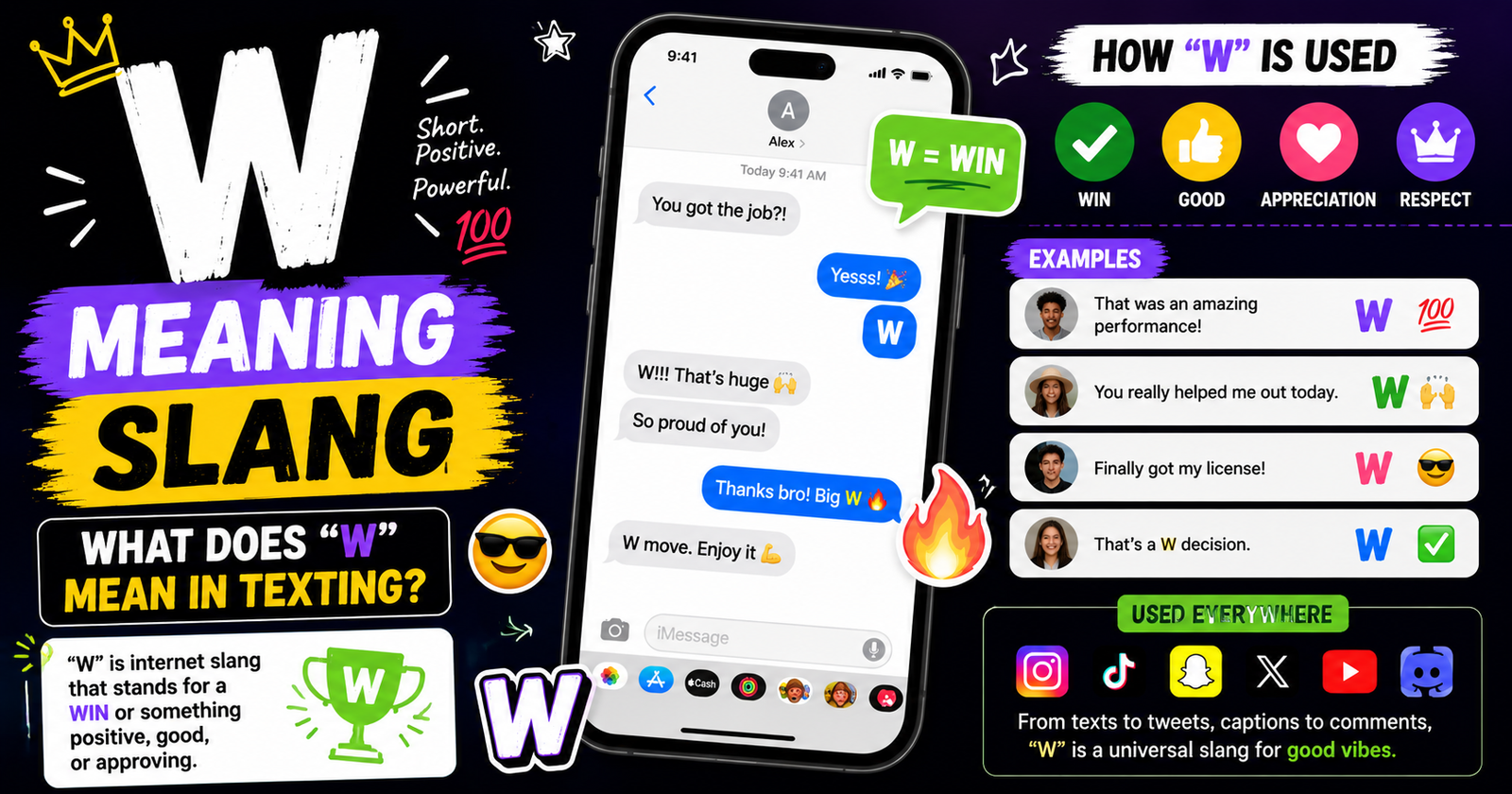
Ever seen someone reply to your text with just “W”? It’s not a typo. W meaning slang is short for “win,” and people use it to celebrate good news, praise a friend, or show quick approval. You’ll spot it everywhere — texts, TikTok comments, Instagram, and group chats.
Understanding W meaning slang helps you keep up with how younger texters talk today. It’s simple, fast, and always positive. Once you know it, you’ll notice it in almost every casual chat.
Quick answer: W = win. It shows approval, celebration, or agreement.
Related slang terms to know:
- L — loss, the opposite of W. Example: “That fumble was a big L.”
- W or L — asking someone to judge if a situation is good or bad. Example: “I texted my ex back, W or L?”
- Ratio — when replies outnumber likes on a post, often a loss for the poster.
- Rizz — charisma, especially in flirting. A good rizz moment is often called a W.
- Based — used to agree strongly with someone’s opinion, similar energy to W.
W Meaning in Text and Slang
W Meaning in Text
In a text message, W usually stands alone or ends a sentence to mark something as a win. It’s fast, casual, and doesn’t need explanation between friends.
Examples:
- “Got the job! 🎉” → “W!!”
- “Just hit my step goal for the week.” → “That’s a W.”
- “He apologized first.” → “Big W.”
W Slang Meaning
The core W meaning slang definition never changes: it means win, success, or approval. What shifts is the context — sports, gaming, relationships, school, or everyday life.
Examples:
- “Passed my driving test on the first try.” → “W.”
- “Found a parking spot right in front.” → “Small W but I’ll take it.”
- “She said yes to prom.” → “That’s a certified W.”
What Does W Mean in Chat?
In group chats and DMs, W often works as a one-word reaction. It replaces longer replies like “nice job” or “that’s great,” saving time while still showing support.
Examples:
- “Finally finished the assignment.” → “W energy.”
- “Team won overtime.” → “WWW” (repeated for emphasis)
- “I said no to the extra shift.” → “That’s a W for your peace of mind.”
W Meaning on Snapchat
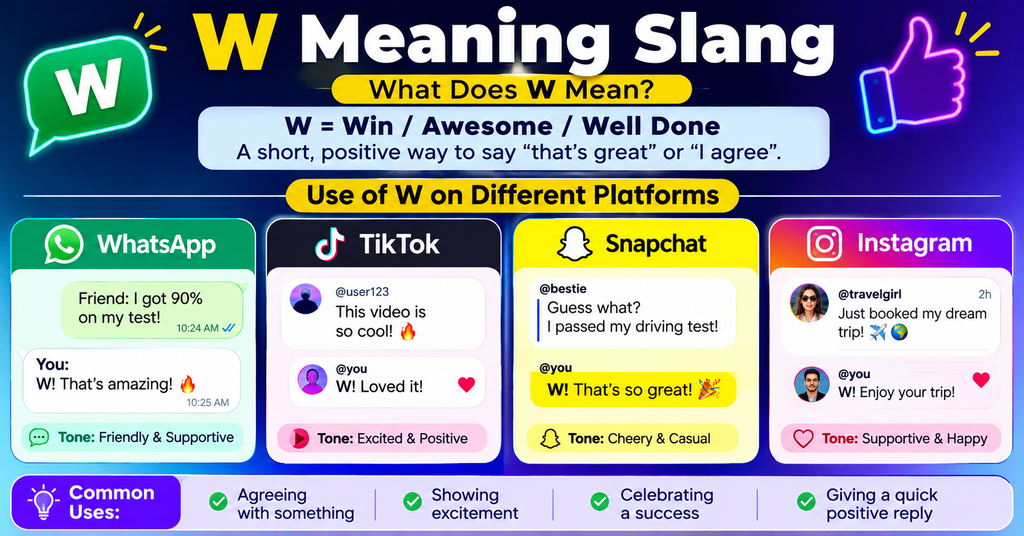
On Snapchat, W usually appears in captions or chat replies to react to a snap — a good grade, a funny moment, or a flex. It’s used the same way as in texting, just faster and more casual because Snapchat conversations move quickly.
Example: A friend posts a snap of a report card with all A’s, and someone replies “Ws only.”
ANOTHER COMMON TEXTING ABBREVIATION IS CUH
W Meaning on Instagram, TikTok, and WhatsApp
On Instagram, W meaning in social media shows up most in comments. People comment “W” under posts they like — a new outfit, a good meme, or an achievement post. It’s a quick, low-effort way to show support without writing a full comment.
Example comment under a graduation photo: “W. So proud of you.”
TikTok
W meaning slang TikTok use is huge in comment sections, especially under videos showing skills, glow-ups, or funny wins. Creators also caption their own videos with “W” to signal confidence about the content.
Example: A cooking video where the dish turns out perfect might get comments like “That plating is a W” or just “WWWW.”
WhatsApp use is more personal since chats are usually with close contacts or family groups. W still means win, but the tone tends to be warmer and less performative than on public platforms.
Example: “Booked our flights for the trip.” → “W! Can’t wait.”
Is W an Acronym or Short Form?
W is not a traditional acronym. It’s a short form — a single letter standing in for the whole word “win.” There’s no hidden meaning or multiple letters to expand; it’s purely a shortcut for speed and style in casual writing.
Tone and Context Variations
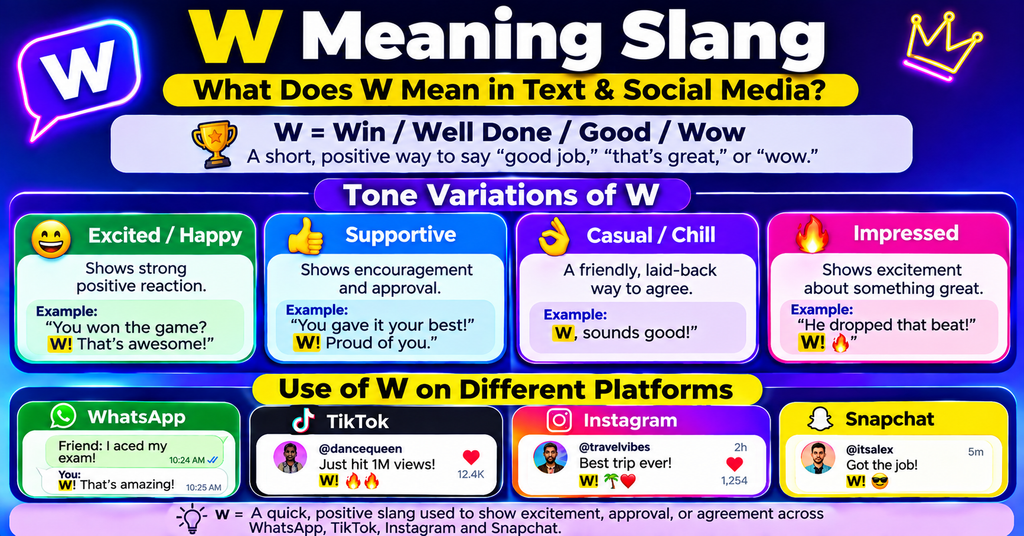
The same letter can feel different depending on tone. Here’s how W meaning slang shifts across common moods.
Funny Tone
Used ironically for small or silly “wins.” Example: “Ate the whole pizza by myself.” → “That’s actually a W ngl.”
Sarcastic Tone
Used to mock a fake or exaggerated win. Example: “Studied for 5 minutes and passed.” → “Big W scholar.”
Romantic Tone
Used when a crush or partner does something sweet. Example: “He remembered my coffee order.” → “That’s a W boyfriend move.”
Angry Tone
Rare, but used bitterly when a win feels forced or unfair. Example: “They won by cheating.” → “Cool, W I guess.” (dripping with sarcasm)
Playful Tone
Used between friends to hype each other up. Example: “Beat my high score!” → “Absolute W, let’s go!”
Real Chat Examples (Natural Conversations)
Example 1 — Friends texting:
A: “Manager gave me Friday off.” B: “W. Enjoy it.”
Example 2 — Group chat:
A: “We got the group project done early.” B: “Ws all around.” C: “Real W energy this semester.”
Example 3 — Gaming chat:
A: “Clutched that last round.” B: “Certified W player.”
Example 4 — Casual flex:
A: “New sneakers just dropped and I got a pair.” B: “W purchase.”
Grammar and Language Role
Part of Speech
W usually functions as a noun (“that’s a W”) or an interjection standing alone (“W!”). It can also act informally as an adjective, as in “W move” or “W energy.”
Sentence Position
It most often appears at the end of a sentence or as a standalone reply. It rarely starts a formal sentence because it works best as a quick reaction, not a subject.
Can It Replace a Full Sentence?
Yes. On its own, “W” can fully replace phrases like “that’s great” or “nice job.” This is one reason it’s popular — it says a lot with almost no typing.
Tone Impact
A single “W” reads as genuine praise. Repeating it (“WWW”) adds excitement. Adding punctuation or emojis (“W!! 🔥”) intensifies enthusiasm.
Formal vs Informal Use
W belongs strictly to informal, casual communication. It’s not appropriate in emails, reports, or professional messages.
SEE OUR GUIDE OF ICL FOR A STRONGER EXPRESSION
How to Reply When Someone Says “W”
Funny Reply
“W confirmed. I’ll add it to my resume.”
Serious Reply
“Thanks, really means a lot.”
Flirty Reply
“Only a W because you noticed 😉”
Neutral Reply
“Haha thanks!”
Comparison Table
| Reply Style | Example Response | Best Used With |
| Funny | “W confirmed, screenshot this” | Close friends |
| Serious | “Thank you, that means a lot” | Mentors, coworkers (rare use) |
| Flirty | “Only a W because of you” | Crush or partner |
| Neutral | “Haha appreciate it” | Acquaintances |
Who Uses This Term?
Age Group
Mostly used by teens and young adults, roughly ages 13 to 28. It’s tied closely to gaming culture and social media habits that skew younger.
Gen Z vs Millennials
Gen Z uses W constantly and naturally in daily texting. Millennials tend to understand it but use it less often, usually only when replying to younger friends, siblings, or coworkers.
Regions
The term is most common in the United States but has spread through gaming and social media to English-speaking audiences worldwide, including the UK, Canada, and Australia.
Platforms Where It’s Most Common
Comment sections on TikTok and Instagram see the heaviest use, followed by gaming chats (Discord, Twitch) and everyday texting between friends.
Origin and Internet Culture
The W meaning slang trend traces back to online gaming culture, where match results were often labeled “W” for win and “L” for loss. Scoreboards and stat trackers used these single letters for years before they moved into everyday chat.
Why It Became Popular
Speed drove its rise. Typing one letter is faster than typing “nice job” or “congrats.” As gaming and streaming culture merged with mainstream social media, the shorthand spread from Twitch and Discord into TikTok comments, then into general texting. Its simplicity is what keeps it alive — it works in almost any celebratory context without needing explanation.
Is W Rude or Offensive?
Is It a Bad Word?
No. W is not offensive on its own. It’s a positive, celebratory term.
Is It Rude?
It can feel dismissive if used sarcastically in a serious moment, such as replying “W” to someone sharing bad news by mistake. Context matters more than the word itself.
Should You Use It in School or Work?
Avoid it in formal school assignments, professional emails, or workplace messages to supervisors. It’s fine in casual chats with classmates or coworkers you’re close with, but it reads as unprofessional in formal settings.
KNOW ABOUT NPC READ THIS ONE ALSO
Experience-Based Insight
Anyone who spends time in TikTok or Instagram comment sections has likely seen “W” used dozens of times a day, often stacked as “WWWW” under impressive videos. It’s become a default first reaction, similar to how a thumbs-up emoji works, but with more energy.
Teachers and parents who’ve started noticing the term in texts often ask what it means — and the honest answer is that it’s simply a fast way for younger users to say “nice job” without breaking their typing rhythm.
Final Summary
W meaning slang stands for “win.” It shows up in texts, comments, and captions to celebrate good news, agree with something, or hype someone up. It’s the direct opposite of “L,” which means loss.
Key Takeaways
- W means win; L means loss.
- It works as a noun, reaction, or standalone reply.
- Common on TikTok, Instagram, Snapchat, and in texting.
- Popular mainly with Gen Z, rooted in gaming culture.
- Not offensive, but not appropriate for formal writing.
Usage Tips
- Use it to react quickly to good news from friends.
- Repeat it (“WWW”) for extra enthusiasm.
- Pair it with emojis for a stronger tone.
Common Mistakes
- Using it in professional emails or school essays.
- Replying “W” to serious or sad news by accident.
- Overusing it until it loses meaning in a conversation.
When to Use or Avoid
Use it in casual texts, social comments, and gaming chats. Avoid it in job applications, formal emails, academic writing, or conversations with people who may not know the slang.
Conclusion
Now you know what W meaning slang really means. It’s a fast, friendly way to say “win” or “nice job.” You’ll see it in texts, comments, and captions across every major app.
Use it with friends, keep it casual, and skip it in formal writing. Once you get the hang of it, replying with a simple “W” feels natural. It’s a small word, but it says a lot.
FAQs
What is W in Gen Z slang?
W means “win.” Gen Z uses it to celebrate good news or agree with something positive.
What does “W person” mean in slang?
A “W person” is someone seen as awesome, reliable, or a good influence — basically a “winner” in character or actions.
What does W stand for in text?
It stands for “win,” used to react positively to something good.
Why do kids say W slang?
It’s quick, fun, and comes from gaming culture, where scoreboards used “W” for wins — it stuck as an easy way to show approval.
What is the opposite of W in slang?
“L,” which stands for loss.
Can W be used sarcastically?
Yes. It’s sometimes used ironically to mock a small or fake achievement.
Does W mean the same thing on every platform?
Yes, the core meaning stays the same across TikTok, Instagram, Snapchat, WhatsApp, and texting — only the tone and context change.
1 thought on “W Meaning Slang: What Does W Mean in Texting?”