
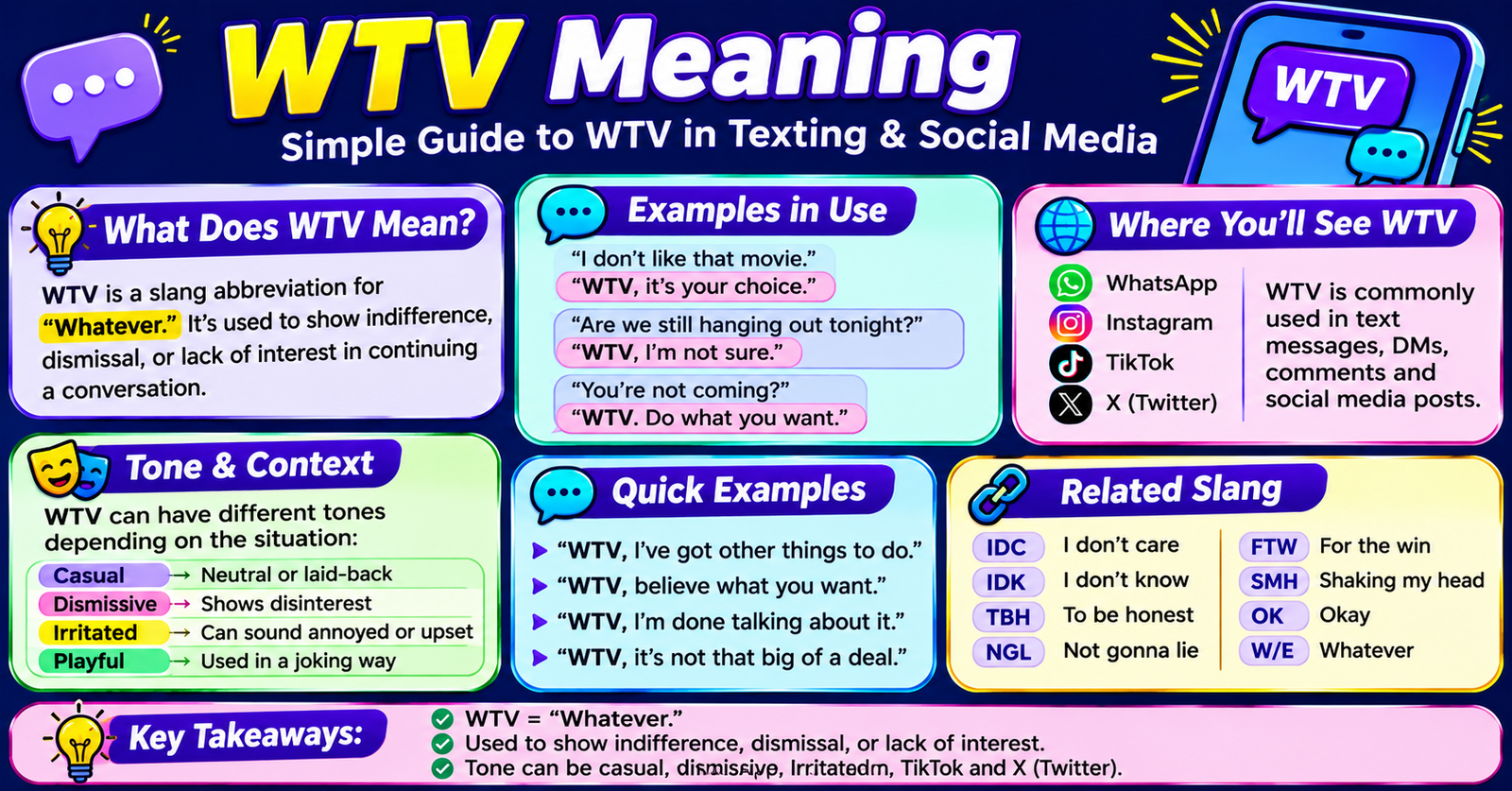
WTV meaning is simply “whatever.” It’s used to show you don’t care much either way, or that a topic isn’t worth more discussion. People use it when they don’t have a strong opinion or want to keep things low-key.
Ever seen “wtv” in a text and wondered what it means? You’re not alone. Understanding WTV meaning helps you keep up with casual texts, comments, and DMs without any confusion. This guide covers every meaning, tone, and real example so you’ll never have to guess again.
Related Slang You Might Also See
Here are a few similar abbreviations people often use alongside or instead of WTV:
| Acronym | Meaning | Example |
| WTV | Whatever | “wtv, doesn’t matter to me” |
| IDC | I don’t care | “idc what we watch” |
| NVM | Never mind | “nvm, forget it” |
| K | Okay | “k, sounds good” |
| SMH | Shaking my head | “smh, that’s wild” |
Now let’s break down what WTV really means, where it’s used, and how to avoid sounding rude by accident.
WTV as an Abbreviation
WTV meaning boils down to one word: “whatever.” It’s a shortcut people use when typing fast, texting casually, or reacting to something without much interest.
Examples:
- “wtv, I’ll just go with the flow”
- “u can pick, wtv works for me”
- “wtv, not a big deal”
- “she said wtv and walked off”
- “wtv you think is best”
History and Origin of WTV
WTV grew out of everyday texting shorthand, similar to other short-letter abbreviations like “idk” or “nvm.” It doesn’t have one clear inventor or viral moment — it spread naturally as people looked for faster ways to type “whatever” on early flip phones and, later, smartphones. Its rise tracks closely with the broader shift toward abbreviated texting language in the 2000s and 2010s.
Other Meanings of WTV
Outside of texting, WTV rarely stands for anything else in everyday use. Some people search WTV meaning medical expecting a clinical abbreviation, but WTV is not a recognized medical term — it’s almost always the slang meaning “whatever,” even in health-related chats between friends. A few niche contexts, like certain broadcast call signs, use the same letters, but these have no connection to the texting meaning.
Examples and Usage of WTV
WTV works as a quick reaction, a casual response, or a way to end a conversation without conflict.
Common formats:
- Standalone: “wtv”
- Softening a decision: “wtv you want is fine”
- Ending an argument: “wtv, I’m done talking about it”
- Light indifference: “wtv happens, happens”
Related Abbreviations
WTV often shows up alongside similar low-effort texting responses like “idc,” “nvm,” and “k.” These words share a common purpose: keeping replies short when the sender doesn’t want to elaborate.
YOU MAY ALSO WANT TO KNOW ABOUT ATP MEANS ONLINE
WTV Meaning in Text, Chat, and on Social Media Platforms
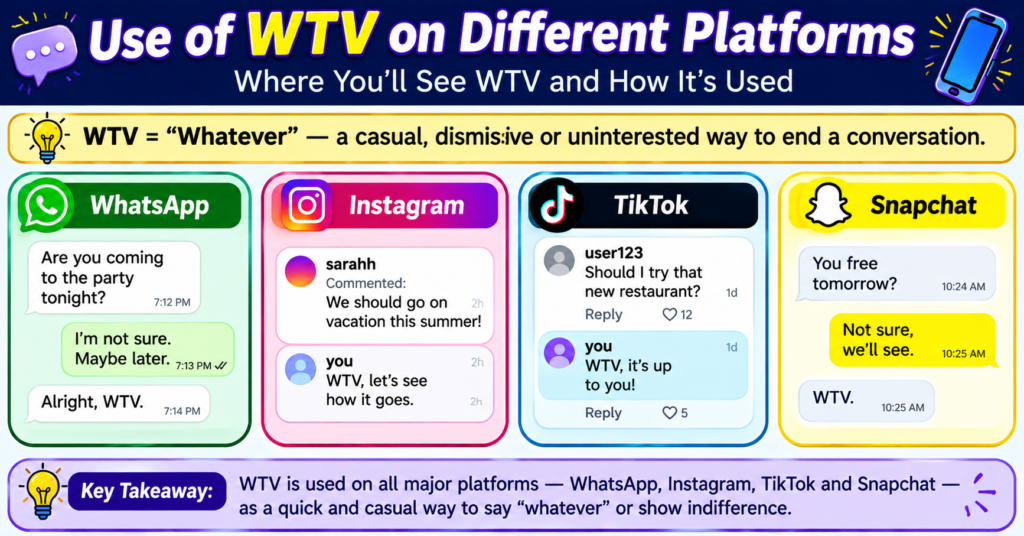
The WTV meaning in chat stays the same across platforms, though tone can shift based on where and how it’s sent.
- WTV meaning Instagram: Often used casually under posts or in comments, usually as a low-key reaction rather than a strong opinion.
- What does WTV mean Snapchat: Frequently paired with an emoji, sent as a quick reply to snaps or chats when someone doesn’t have a preference.
- Wtv meaning in text from a guy: No different meaning based on gender — it usually signals indifference or that he’s fine with any option.
- What does WTV mean from a girl: Same core meaning applies. It’s not flirty or negative by default; it usually just means she doesn’t have a strong preference.
- TikTok comments: Common as a throwaway reaction to a video, often without much thought behind it.
- Wtv meaning urban dictionary: Crowdsourced entries align with “whatever,” with some users noting it can carry a dismissive or annoyed undertone depending on context.
Other Meanings for WTV
While rare, WTV can also appear as shorthand in niche contexts like broadcast call signs or internal company codes. These meanings are unrelated to slang and depend entirely on the specific field or organization using them.
Tone and Context Variation of ‘WTV’
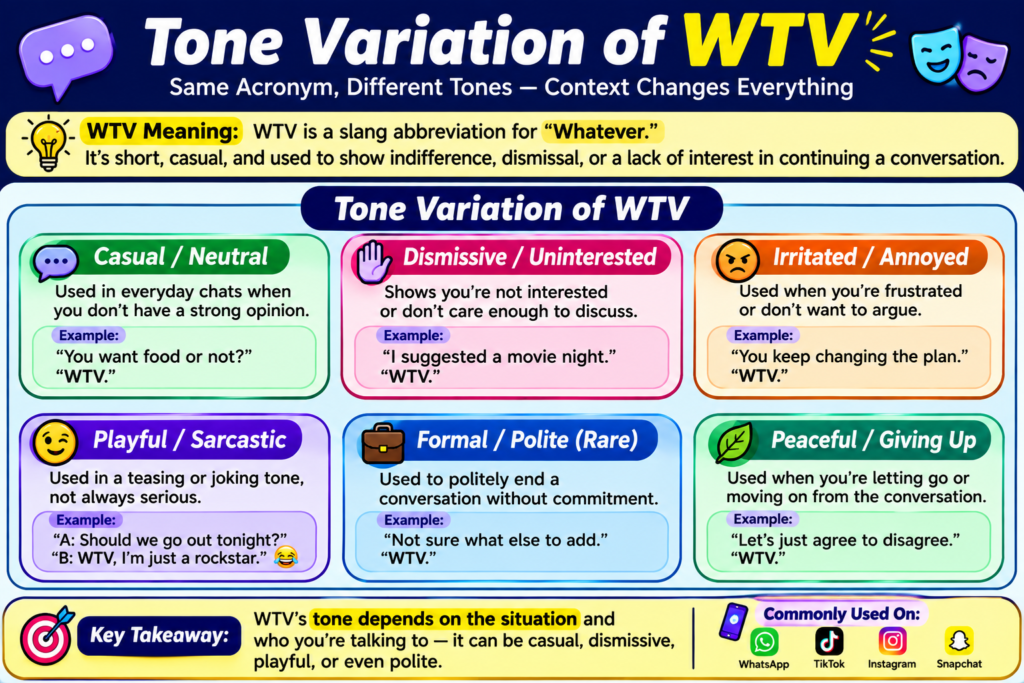
The same word can feel completely different depending on tone and punctuation.
Normal “wtv you decide is fine”
Playful / Funny Tone “wtv lol you always pick the same place”
Sarcastic Tone “oh wtv, sure, whatever you say”
Serious / Confrontational Tone “WTV. I’m not doing this anymore.”
How to Respond to WTV
If someone replies with WTV, it often means they don’t have a strong opinion or don’t want to keep discussing something. A simple follow-up like “you sure?” or “okay, I’ll decide then” works well without pushing the conversation further.
ANOTHER COMMON TEXTING ABBREVIATION IS ICL
Real Chat Conversation Examples
Example 1 — Casual decision
- Friend: “pizza or tacos tonight?”
- You: “wtv, both sound good”
Example 2 — Mild annoyance
- “wtv, I already told you twice”
Example 3 — Ending a disagreement
- “wtv, let’s just drop it”
Example 4 — Playful indifference
- “wtv 😂 you always overthink this stuff”
Grammar and Language Role of WTV
Part of Speech
WTV functions as a pronoun/interjection, standing in for the word “whatever” in casual speech and writing.
Does It Replace a Full Sentence?
Sometimes. WTV can replace a full sentence like “It doesn’t matter to me” or “I don’t have a preference,” depending on context.
Formal vs Informal
WTV is strictly informal. It’s not appropriate for professional emails, school assignments, or formal communication.
Who Uses WTV?
Age Groups
WTV is most common among teens and young adults, though it’s widely understood across most age groups that text regularly.
Gen Z vs Millennials
Gen Z tends to use WTV more casually and frequently in everyday texts, while millennials often reserve it for genuine indifference rather than habitual use.
Regional Usage
WTV has no strong regional pattern in the U.S. — it’s used broadly across texting culture nationwide.
Platforms Where It Is Most Common
- Text messages (iMessage, Android messaging)
- Instagram comments and DMs
- TikTok comments
- Group chats
- Snapchat captions and replies
Is WTV Rude? Safety and Appropriateness
Does It Contain Profanity?
No. WTV contains no profanity and is safe for work in terms of language.
Is It a Slur or Hate Speech?
No. WTV is not a slur or form of hate speech in any common usage.
Is It Rude?
WTV can come across as dismissive or dry, especially in a serious conversation, but it’s not inherently rude. Tone and context determine how it lands.
Should You Use It at School?
It’s fine in casual conversations with classmates but should be avoided in messages to teachers or formal school communication.
Should You Use It at Work?
Avoid WTV in professional emails or messages to supervisors. It can come across as careless or uninterested in a work setting.
Who Should Be Careful?
Anyone in a sensitive conversation — like resolving a conflict or discussing something important to the other person — should avoid WTV, since it can unintentionally sound like you don’t care.
SEE OUR GUIDE OF ATE FOR A STRONGER EXPRESSION
Summary, Usage Tips, and When to Avoid It
Usage Tips
- Lowercase feels casual; all caps can feel harsh or final.
- Pair with an emoji to soften the tone if needed.
- Use it only with people who won’t misread it as rude.
Common Mistakes to Avoid
- Don’t use WTV in professional or formal writing.
- Don’t use it during serious or emotional conversations — it can feel dismissive.
- Don’t assume it always means real indifference; sometimes it’s just a filler response.
When to Use It
Use WTV in casual chats when you genuinely have no strong preference or want to keep a conversation light.
When to Avoid It
Avoid WTV in formal settings, serious discussions, or any conversation where the other person needs a thoughtful response rather than a quick brush-off.
Conclusion
Now you know the real WTV meaning. Most of the time, it simply means “whatever.” It shows up in texts, comments, and chats when someone doesn’t have a strong opinion. Context and tone usually make the meaning clear right away.
Slang like this keeps conversations quick and casual. Use WTV with friends, not in formal messages. Once you understand how it works, you’ll never second-guess it again.
FAQ
How to respond to WTV in text?
A simple reply like “okay” or “you sure?” works well. You can also just move forward with a decision yourself.
What does WTW mean in texting?
WTW means “what’s the word” or “what’s up,” used as a casual greeting — different from WTV (“whatever”).
What does WTV mean in chat?
Same meaning as texting — “whatever” — often used as a quick, low-effort reply.
Is WTV rude to say?
Not inherently, but it can come across as dismissive depending on tone, punctuation, and context.
What does WTV mean on Instagram or TikTok?
Same meaning as texting — “whatever” — often used as a casual comment or reply.
Can WTV be used at work or school?
It’s best avoided in formal settings like emails to teachers or supervisors, since it can sound careless.
What’s the difference between WTV and IDC?
WTV means “whatever,” while IDC means “I don’t care.” They’re similar but WTV can sound slightly softer depending on context.
1 thought on “WTV Meaning: Simple Guide to WTV in Texting & Social Media ”