
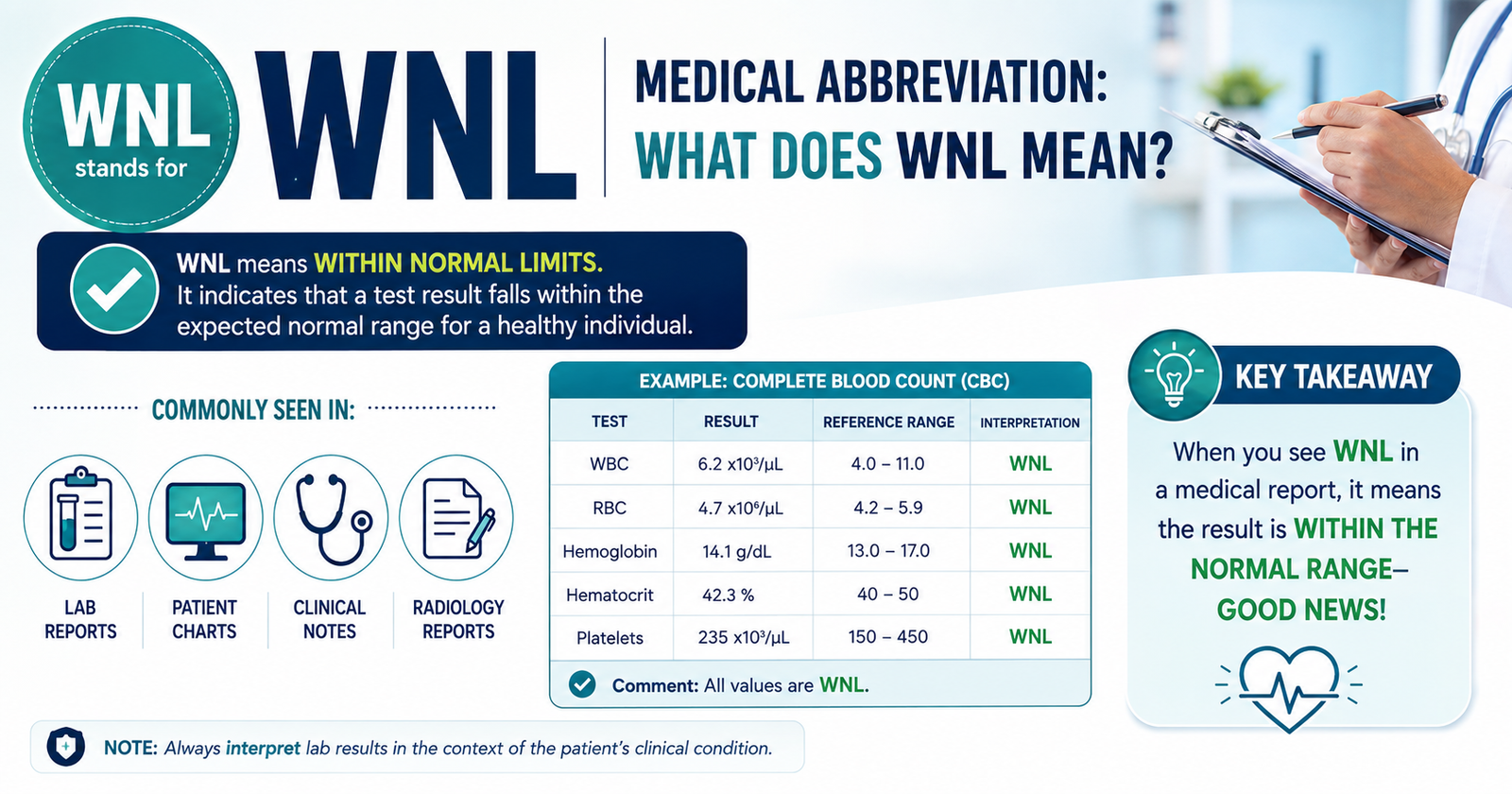
Seen “WNL” on a lab report or medical chart and wondered what it means? You’re not alone. The WNL medical abbreviation stands for “Within Normal Limits,” a quick way doctors and nurses show that a specific test or exam result fell inside a healthy range.
But WNL doesn’t mean you’re perfectly healthy overall — it only covers that one specific finding. This guide explains exactly what the WNL medical abbreviation means, where you’ll see it, and what it doesn’t tell you about your health.
Quick Answer
The WNL medical abbreviation stands for “Within Normal Limits.” Doctors and nurses use it to show that a test result, vital sign, or physical exam finding falls inside the expected healthy range. It doesn’t mean a patient is perfectly healthy overall — it only means that specific measurement didn’t show anything abnormal.
What Does WNL Mean?
WNL means “within normal limits.” You’ll see it written next to vital signs, lab results, or a body system during a physical exam, whenever that specific finding falls inside the expected range for a healthy person.
WNL Meaning in Healthcare
Across healthcare settings, the WNL medical abbreviation works as a quick, standardized way to record a normal finding. Instead of writing out “the patient’s heart rate, blood pressure, and temperature are all normal,” a provider can simply write “Vitals: WNL.”
Why Is WNL Used?
- Saves time during charting
- Keeps documentation consistent across providers
- Lets readers quickly spot normal versus abnormal findings
- Reduces repetitive, unnecessary detail in routine notes
What Does WNL Mean in Medical Charts?
In a chart, WNL is usually attached to a specific system or test, not the patient as a whole.
Example “Cardiac: WNL” — the heart exam showed no abnormal sounds, rhythm, or findings.
Example “CBC: WNL” — the complete blood count came back within the expected reference range.
WNL in Nursing Documentation
Nurses use WNL constantly during shift assessments to record normal findings quickly across multiple body systems, especially when a patient’s condition is stable and unchanged from the last check.
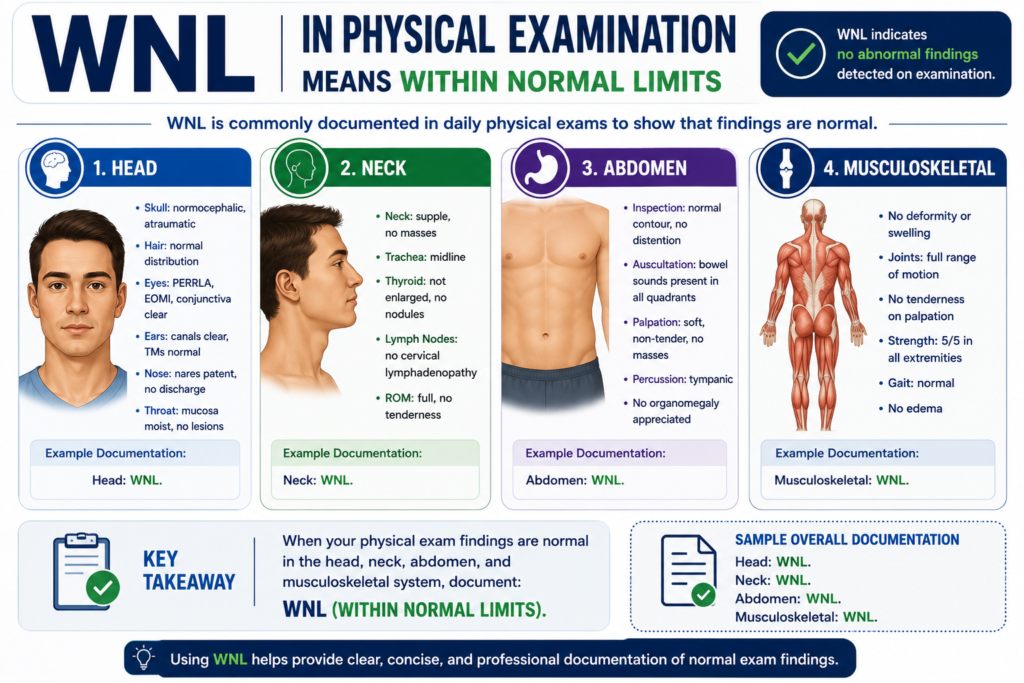
WNL in Physical Examinations
Head and Neck
“Head and Neck: WNL” means no swelling, tenderness, or abnormal findings during that part of the exam.
Abdomen
“Abdomen: WNL” means the abdomen was soft, non-tender, and showed no unusual masses or sounds on exam.
Musculoskeletal System
“Musculoskeletal: WNL” means normal range of motion, strength, and no visible deformities or pain on movement.
Does WNL Mean Everything Is Perfectly Healthy?
No. WNL only confirms that a specific test or exam finding was normal. It doesn’t rule out every possible health issue, and it isn’t a full statement about a patient’s overall health.
WNL vs Normal: Is There a Difference?
Normal
“Normal” is a general, plain-language term that can apply broadly to a result or overall impression.
Within Normal Limits
“Within normal limits” is more precise — it specifically means a measurement falls inside an established reference range, based on population data for that specific test or system.
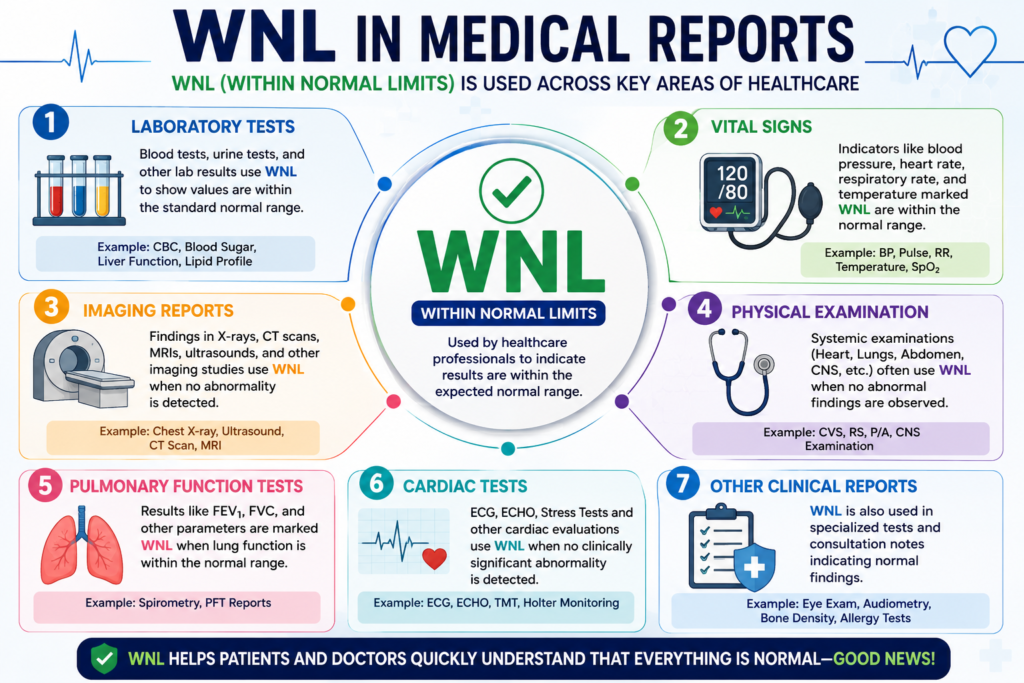
Common Areas Where WNL Appears
Vital Signs
Blood pressure, heart rate, temperature, respiratory rate, and oxygen saturation are all commonly marked WNL when stable.
Laboratory Results
CBC (complete blood count), CMP (comprehensive metabolic panel), and liver or kidney function tests often use WNL when values fall inside the reference range.
Neurological Assessment
Reflexes, coordination, and mental status can all be documented as WNL during a neuro exam.
Cardiovascular Assessment
Heart sounds, rhythm, and pulses are frequently marked WNL when no abnormalities are detected.
Examples of WNL in Medical Notes
Example 1 “General: Alert and oriented, VS WNL.”
Example 2 “Lungs: Clear to auscultation, WNL.”
Example 3 “CBC, CMP, LFT all WNL except Hgb, which was low at 10 g/dL.”
Example 4 “Neuro: WNL, no focal deficits noted.”
Example 5 “Extremities: WNL, no edema or tenderness.”
KNOW ABOUT DOE READ THIS ONE ALSO
Why Patients Often Misunderstand WNL
Medical Terminology
Patients unfamiliar with clinical shorthand can assume WNL means “totally healthy,” when it’s actually a narrower, test-specific term.
Different Contexts
The same three letters can apply to a single lab value, an entire body system, or a full set of vitals, which can make it confusing without context.
Incomplete Understanding
Seeing WNL next to one test doesn’t tell a patient what other tests may still show, or what symptoms might not be reflected in that particular result.
Related Medical Abbreviations
WNL vs WDL
WNL — Within Normal Limits, the most widely used version across most healthcare settings.
WDL — Within Defined Limits, functionally similar but used in some institutions to mean the finding matches specific pre-established criteria rather than a general reference range.
Is WNL Still Used in Modern Healthcare?
Yes. Despite the rise of structured electronic health records, WNL remains common in both verbal handoffs and written documentation because it’s fast, familiar, and universally understood among clinicians.
When WNL May Not Be Enough
Some hospitals discourage vague use of WNL in favor of more specific documentation, especially in legal or high-risk cases, since “within normal limits” alone doesn’t record the actual values or specific findings behind that judgment.
Understanding WNL in Lab Results
Example “Glucose, WBC, and platelet count: WNL” simply means each of those specific values fell inside its expected reference range for that lab.
Can Test Results Be WNL Even If Symptoms Exist?
Yes. A patient can have real symptoms while specific test results still come back WNL, since not every condition shows up on every test. This is one of the most important limits of the term — a normal result doesn’t rule out an underlying problem the test wasn’t designed to detect.
WNL in Different Medical Specialties
Primary Care
Used constantly during annual physicals to summarize normal findings across multiple systems.
Emergency Medicine
Used to quickly document stable vitals and unremarkable findings during a fast-paced visit.
Physical Therapy
Used to record normal range of motion, strength, or gait during an assessment.
Pediatrics
Used to document normal growth, reflexes, and developmental findings during well-child visits.
Mental Health
Used more narrowly, often to describe a normal mental status exam (orientation, mood, and thought process) rather than a broader psychological evaluation.
Real-World Examples of WNL Documentation
Example 1: Annual Physical “VS WNL, heart and lungs WNL, abdomen soft and non-tender.”
Example 2: Emergency Department Visit “Neuro WNL, no signs of trauma, vitals stable and WNL.”
Example 3: Physical Therapy Assessment “ROM WNL bilaterally, strength 5/5 throughout.”
Example 4: Pediatric Visit “Growth WNL for age, reflexes WNL, developmental milestones met.”
Example 5: Postoperative Follow-Up “Incision site WNL, no signs of infection, vitals WNL.”
What Should Patients Do If They See WNL?
Understand the Context
Check what specific test or system the WNL is attached to, rather than assuming it applies to your entire health picture.
Review the Full Report
Look at the complete set of results, since one WNL value doesn’t summarize an entire visit or test panel.
Ask Questions
If anything is unclear, ask your provider directly what a specific WNL result means for your situation.
Avoid Self-Diagnosis
Don’t use WNL alone to rule out or confirm a condition — only a healthcare provider can interpret results in the context of your full health history.
Common Misconceptions About WNL
Myth 1: WNL Means Perfect Health
It only confirms one specific finding was normal, not overall health.
Myth 2: WNL Means No Medical Problems Exist
Other tests or symptoms not covered by that specific result can still indicate a problem.
Myth 3: WNL Means No Further Testing Is Needed
Providers may still order more testing based on symptoms, history, or clinical judgment, regardless of one normal result.
Myth 4: WNL Is a Diagnosis
It’s a documentation shorthand, not a diagnosis or medical conclusion on its own.
Myth 5: WNL Always Means the Same Thing
Its exact reference range can vary slightly depending on the lab, the test, and even factors like age or sex.
Why Healthcare Providers Prefer WNL
Efficiency
It shortens documentation time during busy shifts and high patient volumes.
Standardization
It gives a consistent shorthand that’s recognized across most U.S. healthcare settings.
Clarity
It helps readers of a chart quickly separate normal findings from ones that need closer attention.
Consistency
It keeps documentation style uniform across different providers reviewing the same patient’s chart.
Experience-Based Insight
Reading a chart full of WNL notations is often reassuring, but it’s worth remembering that WNL reflects what was specifically tested or examined — not everything about a patient’s health. Two patients can both have a note that reads “Abdomen: WNL,” but one might have a condition that simply doesn’t show up on a physical exam. That’s why providers pair WNL notations with a patient’s reported symptoms and history, rather than relying on them alone.
YOU MAY ALSO WANT TO KNOW ABOUT HG MEANS ONLINE
Conclusion
The WNL medical abbreviation simply means “within normal limits.” It’s a fast, standardized way for doctors and nurses to show that a specific test or exam finding fell inside a healthy range. It’s common, useful, and something you’ll keep seeing in your medical records.
Still, WNL isn’t a full statement about your overall health. It only covers the one result it’s attached to, nothing more. If a WNL note doesn’t match how you’re feeling, always talk to your provider directly.
Usage Tips
- Always check which specific system or test a WNL note is attached to
- Use WNL result as one piece of the full picture, not the whole picture
- Ask your provider directly if a WNL note doesn’t match how you’re feeling
Common Mistakes
- Assuming WNL applies to your entire health status
- Treating WNL as a final diagnosis
- Ignoring symptoms just because a related test came back WNL
When WNL Is Helpful
- Quickly reviewing routine, stable findings
- Comparing results across multiple visits
- Streamlining documentation during high-volume care settings
When to Seek Clarification
- If WNL results don’t match your symptoms
- If you don’t understand which test or system a WNL note refers to
- If you have ongoing concerns despite a WNL result
This article is for general informational purposes only and is not a substitute for professional medical advice. Always talk to your healthcare provider about your specific test results and symptoms.
Frequently Asked Questions
What does “vs WNL” mean in medical abbreviation?
“VS WNL” means “vital signs within normal limits,” referring to measurements like blood pressure, heart rate, temperature, and respiratory rate.
What does WNL mean in a pregnancy report?
It means a specific finding — like blood pressure, fetal heart rate, or a lab value — fell within the expected healthy range for that stage of pregnancy.
What does WNL mean in an eye exam?
It means the specific part of the eye exam, such as vision, eye pressure, or external structures, showed no abnormal findings.
What does “grossly WNL” mean?
“Grossly WNL” means the finding appeared normal on a general, visible level, without a more detailed or specialized evaluation.
What does “Cx WNL” mean?
“Cx” is shorthand for “cervix,” so “Cx WNL” means the cervix appeared normal on examination.
What does CBC WNL mean?
It means a complete blood count test came back with values inside the expected healthy reference range.
What does RLE mean in medical abbreviation?
RLE stands for “Right Lower Extremity,” referring to the right leg from the hip down to the foot. It’s a separate abbreviation from WNL, though both are common in physical exam documentation.
What is WNL in ECG?
On an ECG, WNL means the heart’s electrical rhythm and pattern appeared normal, with no abnormal findings detected.
What does “WNL” mean in slang?
Outside medicine, WNL has no single fixed slang meaning — it occasionally shows up informally as “whole ‘notha level” on social media, but this usage is rare and not widely recognized.