
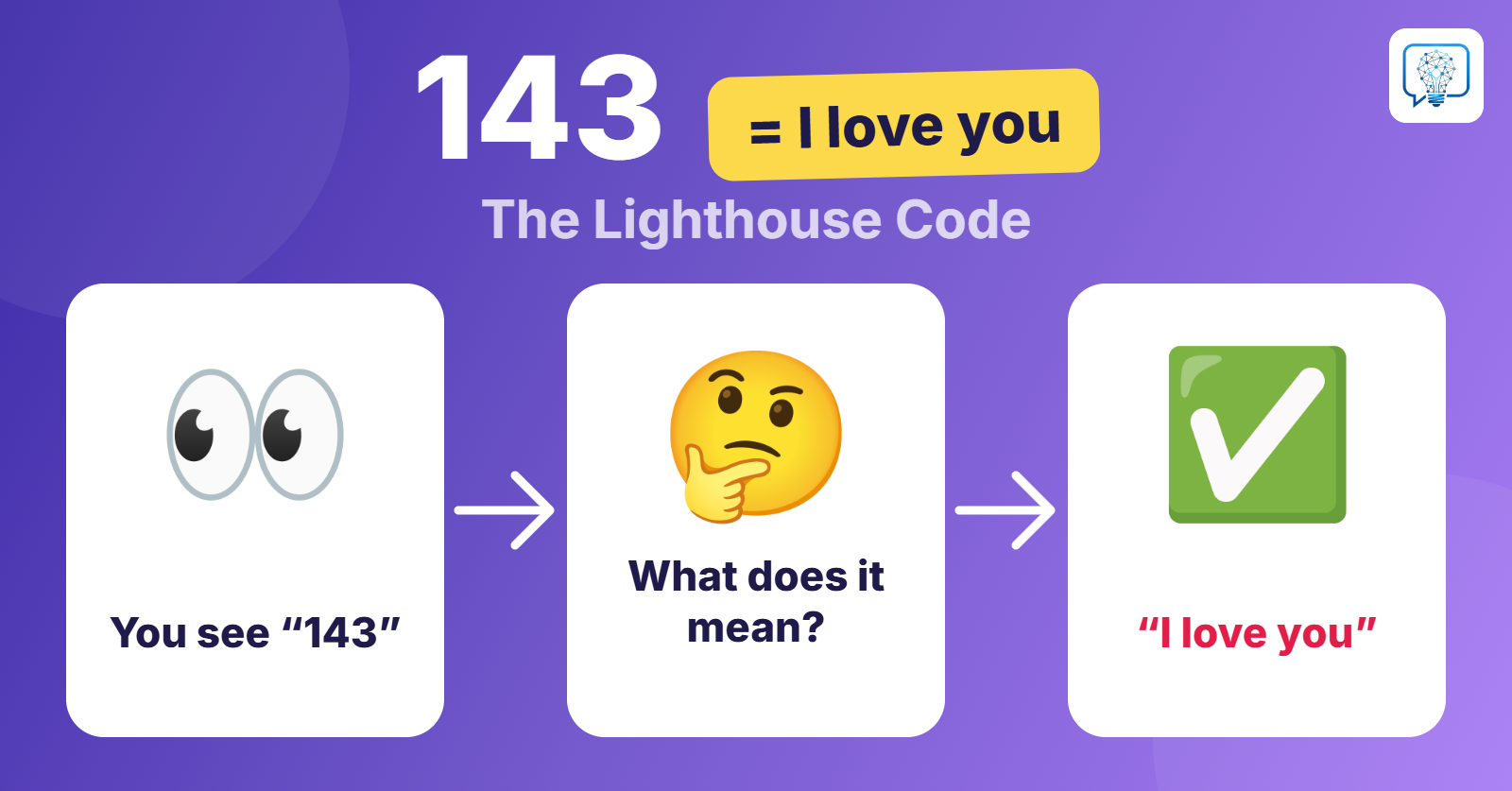
“goodnight, 143.” If you’ve gotten a text that’s just three numbers, it’s not random: it’s one of the oldest coded ways to say “I love you.”
Quick answer: 143 means “I love you.” Dictionary.com explains the code: it’s based on the number of letters in each word, I (1), love (4), you (3).
The lighthouse story behind 143
According to Dictionary.com, the code may go back to 1915 at Minot’s Ledge Lighthouse in Massachusetts. The lighthouse flashed in a 1-4-3 pattern (one flash, four flashes, three flashes), a pattern chosen at random years earlier for navigation. A lighthouse keeper’s wife, Mary Thompson, is said to have told her children it was the “I Love You” flash, since their family could see it from a nearby island at night. The nickname stuck, and 143 later spread through pagers in the 1990s, when people had to fit messages into just a few digits.
How 143 is used today
| Use | Example |
|---|---|
| Ending a text | “night, 143” |
| A quick, private way to say it | “143 💕” |
| In captions | A photo caption with just “143” |
Real chat examples
- A: “drive safe!”
- B: “will do, 143”
- A: “miss you already”
- B: “143, see you soon”
Similar codes
- IMY (I miss you) is another short way to show affection.
- Te amo is “I love you” in Spanish and Portuguese.
- Red heart ❤️ is the emoji version of the same message.