
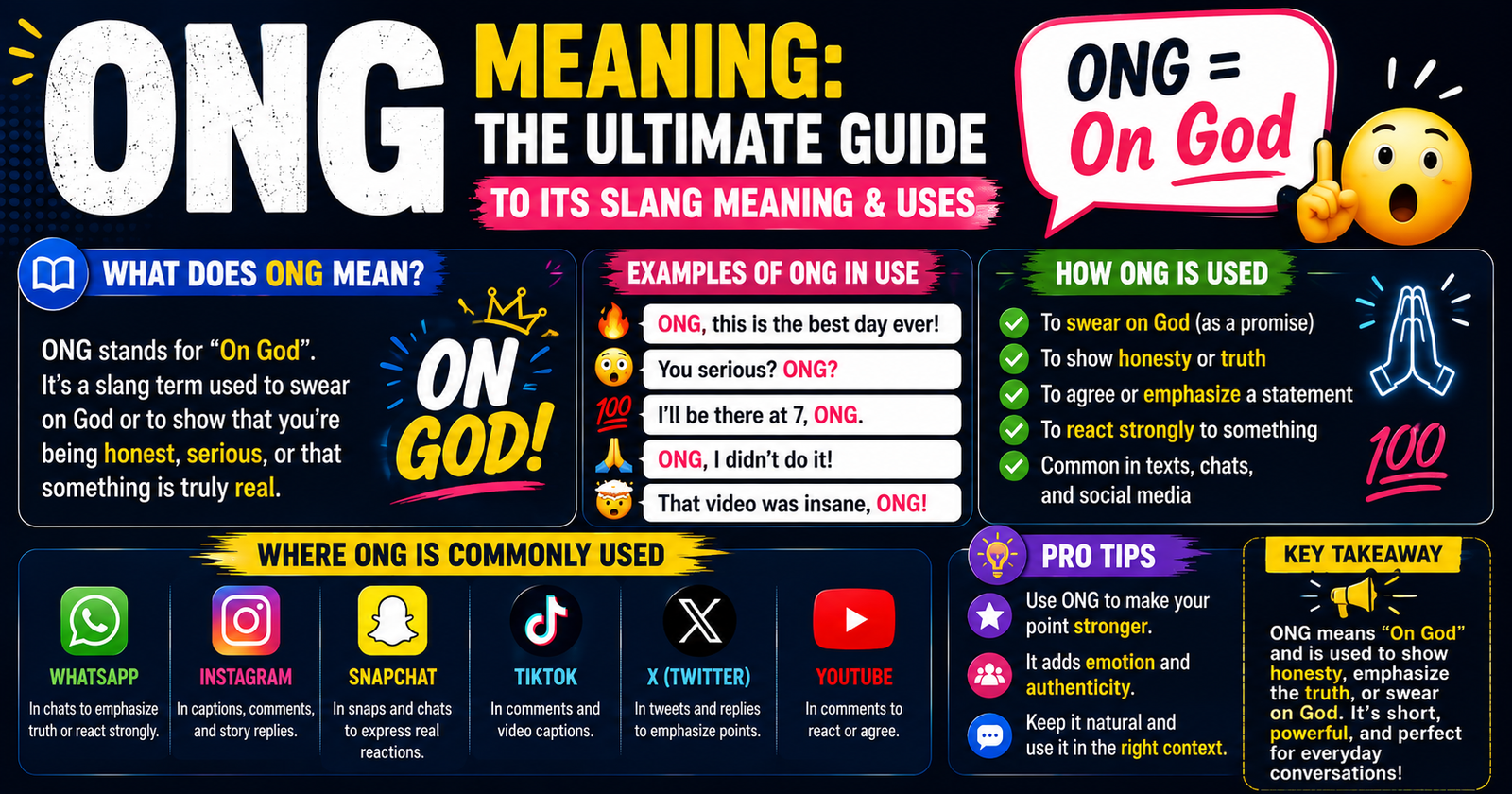
You’ve probably seen “ONG” pop up in a text or comment and wondered what it actually means. The ONG meaning is simple: it stands for “on god,” a slang phrase people use to show they’re being completely honest. It’s become one of the most common words in online chats, especially among younger internet users.
This guide breaks down everything you need to know about ONG meaning, from how it’s used in casual texts to why it suddenly took over TikTok and Instagram comments. Whether you’re trying to keep up with Gen Z slang or just want to reply the right way, you’ll find clear answers here.
What Does ONG Mean in Text?
In texting, ONG is an intensifier. You add it to a sentence to show you’re being 100% honest or that you feel strongly about what you just said.
- “This is the best burger I’ve ever had, ONG.”
- “ONG I studied for six hours straight.”
- “He really said that to your face? ONG?”
It works as a standalone reaction (“ONG?!” meaning “Are you serious?”) or tacked onto the end of a sentence for emphasis.
What Does ONG Mean Slang Meaning?
The slang meaning of ONG is “On God.” In casual speech, “on God” is an oath — you’re putting your word on the line to back up a claim. Saying “ONG” is a quicker, typed-out way of doing the same thing without spelling out the whole phrase.
It’s most often used to:
- Confirm something is true
- React with disbelief or shock
- Add weight to an opinion or story
- Agree strongly with someone else
What Does ONG Mean in Chat?
In chat apps and DMs, ONG functions almost like punctuation. People drop it in mid-conversation the way they’d use “literally” or “no cap” — not always because they’re making a huge claim, but because it’s become a natural rhythm of casual digital speech.
What Does ONG Mean on Snapchat?
On Snapchat, ONG carries the same “on God” meaning, usually appearing in snap captions or chat replies to react to something surprising, funny, or dramatic. Because Snapchat conversations tend to be quick and visual, ONG often stands alone as a one-word reaction rather than part of a full sentence.
What Does ONG Mean on Instagram, TikTok, and WhatsApp?
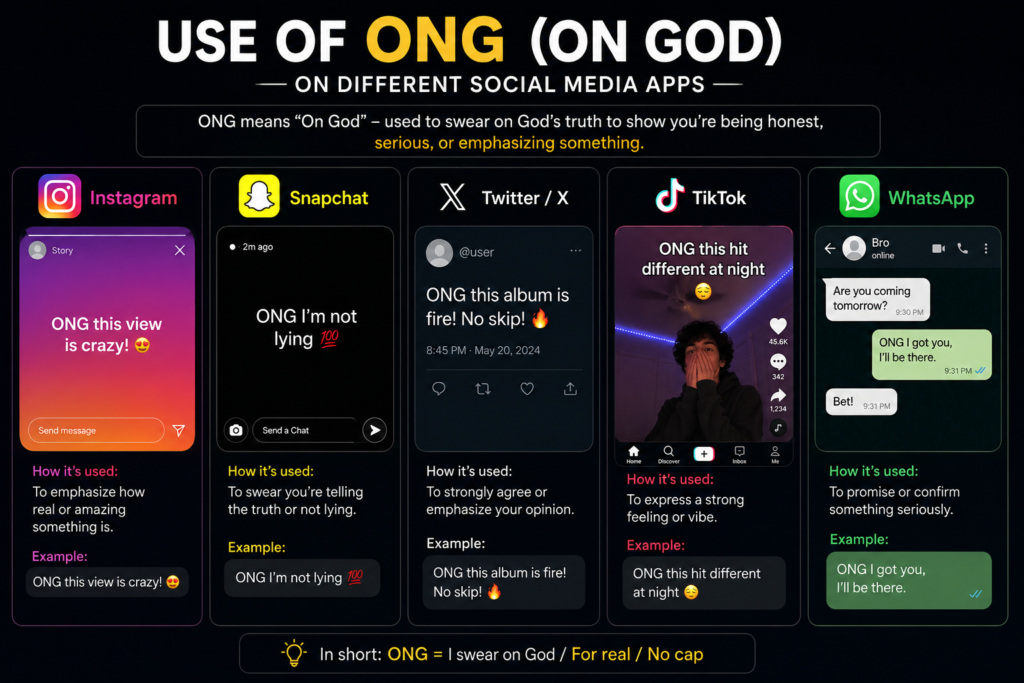
The core meaning doesn’t change across platforms, but the way people use it shifts slightly depending on the app.
Common in comments and captions to react to a photo, reel, or someone else’s post: “You look amazing ONG 😍”
TikTok
This is where ONG meaning TikTok content really took off. Creators say it out loud in videos to add emphasis to a story or reaction, and it’s become a caption staple for “storytime” and reaction videos. Because TikTok skews younger, this is a big reason ONG is now closely tied to Gen Z slang.
WhatsApp usage leans more conversational, often used between friends or family to confirm plans or emphasize a point in longer text threads: “ONG I’ll be there by 7, don’t worry.”
Is ONG an Acronym, Short Form, Phonetic Spelling, or Typo?
Technically, ONG is an initialism — a term formed from the first letters of a phrase (“On God”) that’s pronounced letter by letter or read as its own short word, rather than spoken out as the full phrase every time. It’s not a typo, and it’s not random; it’s a deliberate shortcut that fits fast typing culture, similar to “fr” (for real) or “ngl” (not gonna lie).
Tone and Context Variations
ONG changes flavor depending on how it’s used. Here’s how the tone shifts:
Funny Tone: “I ate an entire pizza by myself, ONG.” — used for exaggeration or self-deprecating humor.
Sarcastic Tone: “Oh sure, ONG you totally didn’t eat my leftovers.” — the honesty claim becomes ironic.
Romantic Tone: “You’re the best thing that’s happened to me, ONG.” — adds sincerity to a compliment.
Angry Tone: “ONG if you do that again I’m done.” — signals a serious warning, not a joke.
Playful Tone: “ONG I can’t believe you did that 😂” — light teasing among friends.
Real Chat Examples
- “ONG this show is actually insane.”
- “You passed the exam? ONG???”
- “I’m not lying, ONG, he said that.”
- “ONG I need to sleep, I’m exhausted.”
- “That was the scariest movie ONG.”
- “ONG she showed up an hour late again.”
- “I’ll pay you back tomorrow, ONG.”
- “ONG this coffee slaps.”
- “He canceled again? ONG that’s wild.”
- “ONG I’ve never laughed that hard.”
- “This traffic is criminal ONG.”
- “ONG I almost cried during that movie.”
- “You’re joking, ONG?”
- “ONG I’ve been saying that for years.”
- “That test was so hard ONG.”
Grammar and Language Role
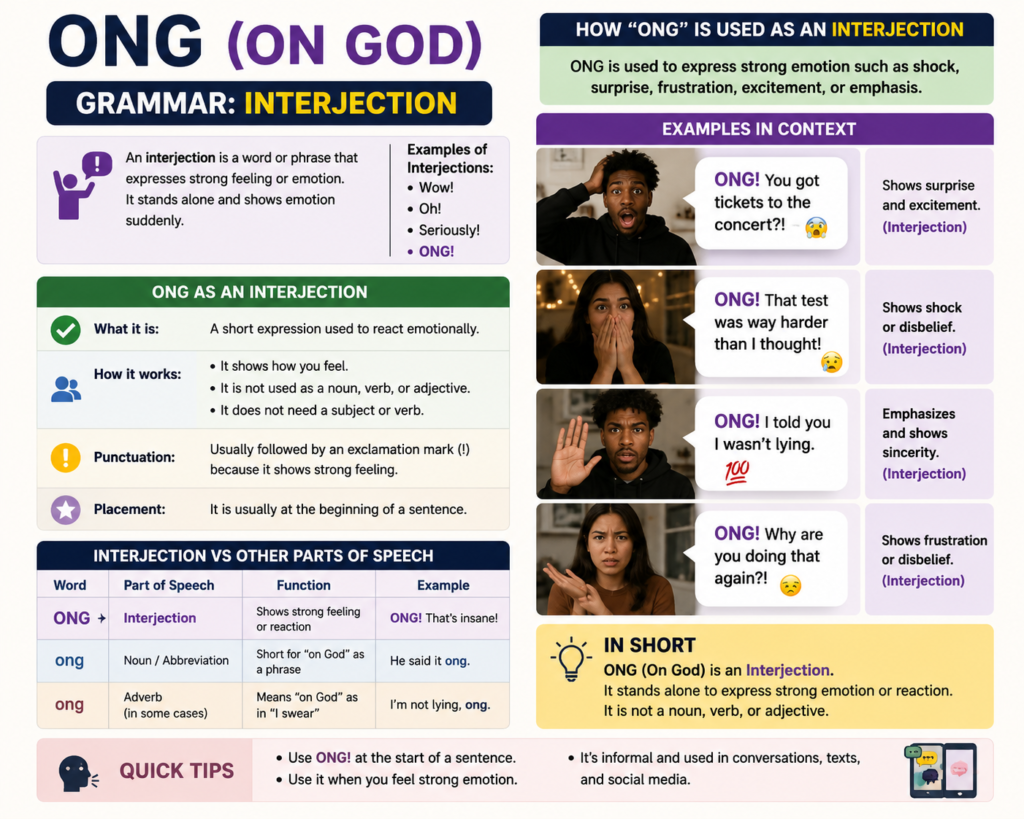
What Part of Speech Is ONG?
ONG functions as an interjection or discourse marker — it doesn’t have a fixed grammatical role like a noun or verb. Its job is to add emphasis or emotional weight to a sentence, not to describe or name anything.
Sentence Position
It’s flexible. ONG can go at the start (“ONG that’s crazy”), the middle (“that’s, ONG, actually crazy”), or the end (“that’s crazy, ONG”).
Does It Replace a Full Sentence?
Sometimes, yes. Used alone as a reply (“ONG.”), it stands in for a full sentence like “I swear that’s true” or “I completely agree.”
Tone Impact
Because it’s so flexible, ONG’s tone depends entirely on context — the same three letters can sound sincere, sarcastic, dramatic, or casual depending on what surrounds them.
Formal vs Informal Use
ONG is strictly informal. It has no place in formal writing, professional emails, or academic work.
How to Reply When Someone Says ONG
Funny Replies: “ONG or on Wi-Fi?” / “Say less.”
Serious Replies: “Wow, really?” / “That’s a lot, I hear you.”
Flirty Replies: “ONG you’re too sweet.” / “Stop, you’re making me blush.”
Neutral Replies: “Okay, noted.” / “Got it.”
Comparison Table: ONG vs Similar Slang Terms
| Term | Full Meaning | Typical Use |
| ONG | On God | Swearing something is true |
| ISTG | I Swear To God | Stronger, more emphatic oath |
| FR | For Real | Confirming or agreeing |
| NGL | Not Gonna Lie | Prefacing an honest opinion |
ONG vs ISTG
ISTG (“I swear to God”) is slightly more intense and often used when someone is frustrated or making a firm promise. ONG feels more casual and versatile, fitting both light and serious moments.
ONG vs FR
FR (“for real”) is a general agreement marker, while ONG specifically implies an oath or personal guarantee behind the statement. People often use them together: “ong fr fr.”
Who Uses the Term ONG?
Age Groups
ONG is primarily used by teens and young adults, though it has spread into wider internet culture as older users pick up slang from social media.
Gen Z vs Millennials
Gen Z
For Gen Z, ONG meaning Gen Z usage is second nature — it’s part of everyday digital vocabulary, used constantly in texting, comments, and captions without a second thought.
Millennials
Millennials tend to use ONG less frequently and more self-consciously, often picking it up from younger family members, coworkers, or social media trends rather than using it as native slang.
Regional Usage
The slang form of ONG has roots in African American Vernacular English (AAVE) and hip-hop culture, later spreading broadly across the U.S. and into global English-speaking online communities through social media.
Platforms Where ONG Is Most Common
TikTok, Instagram, Snapchat, and X (formerly Twitter) see the heaviest usage, with WhatsApp and iMessage following for everyday personal chats.
Origin and Internet Culture Insight
Where Did ONG Come From?
The slang meaning traces back to “on God,” an oath-based phrase long used in AAVE. As texting and social media culture accelerated, users shortened it to ONG for faster typing and quicker reading.
Fast Typing Culture
Abbreviations like ONG exist because typing speed matters in casual digital conversation. Shortcuts reduce keystrokes while keeping the emotional punch of the full phrase intact.
Meme Culture Influence
Meme culture helped cement ONG as an emphasis marker, since captions and reaction posts favor short, punchy phrases that convey big reactions in a few characters.
Why People Say ONG on TikTok
TikTok’s short-form, high-emotion video format rewards quick verbal or written emphasis. Saying “ONG” out loud or captioning it adds instant credibility or drama to a video’s message, which is a major reason the term is so tied to TikTok culture today.
Is ONG Rude?
No. ONG isn’t inherently rude — it’s simply informal slang. It can come across as inappropriate only if it clashes with a formal setting, not because the word itself carries offensive meaning.
Is ONG a Bad Word?
No, ONG is not a bad word or slur. It’s a casual intensifier, comparable to saying “seriously” or “I swear.”
Should You Use ONG in School or the Office?
School
Fine for texting friends or casual class group chats; avoid it in essays, formal assignments, or messages to teachers.
Workplace
Best avoided in emails, reports, or messages to clients and managers. It’s acceptable in casual chat with close coworkers if your workplace culture is relaxed, but it’s still a judgment call.
Final Thoughts
Usage Tips
- Use ONG to add sincerity or emphasis in casual chats, captions, or comments.
- Pair it naturally with other slang like “fr” for extra emphasis.
- Read the room — tone depends heavily on context.
Common Mistakes
- Assuming ONG always means “Oh My God” (it doesn’t — that’s OMG).
- Using it in professional or academic writing.
- Overusing it to the point it loses emphasis.
When to Use ONG
Use it in texts, social captions, and casual conversations with friends when you want to stress that something is true or emotionally significant.
When to Avoid ONG
Avoid it in formal emails, academic writing, job applications, or any communication meant to sound professional.
Conclusion
Now you know the full ONG meaning and how it’s used across different chats, apps, and situations. It’s a quick way to show you’re being 100% honest, and it fits almost any casual conversation. From TikTok comments to group chats, ONG has become a go-to word for genuine reactions.
The next time someone says ONG or you want to use it yourself, you’ll know exactly what it means and when it fits best. Slang like this changes fast, but understanding the ONG meaning now will help you keep up with how people talk online today.
Frequently Asked Questions
What does ONG mean in English?
In everyday English slang, ONG meaning in English is “On God” — a way of swearing something is true.
Is ONG only used by young people?
Mostly, but not exclusively. It originated with younger, internet-native users, though it’s spread widely enough that people of many ages now recognize or use it.
Can ONG be used in a formal essay or resume?
No. It’s slang and should stay out of any formal writing.
What is the slang for ONG?
ONG itself is the Gen Z slang term, short for “on god,” similar to saying “I swear” or “no cap.”
What does “ong ong” mean?
“Ong ong” is just ONG repeated for emphasis, meaning someone is being extra serious or really means what they said.
What does ONG mean omg?
ONG and OMG are different — ONG means “on god” (for emphasis/honesty), while OMG means “oh my god” (for surprise or shock).
ONG meaning medical — is there one?
There’s no widely recognized medical meaning for ONG; it’s not a standard medical abbreviation.
ONG meaning French — what does it stand for?
In French, ONG stands for “Organisation Non Gouvernementale,” which translates to NGO (Non-Governmental Organization) in English.