
What Does FAFO Mean?
You’ve seen “FAFO” in a comment, a text, or a meme. It looks random at first. But it has one clear meaning behind it. This guide breaks it down in plain English.
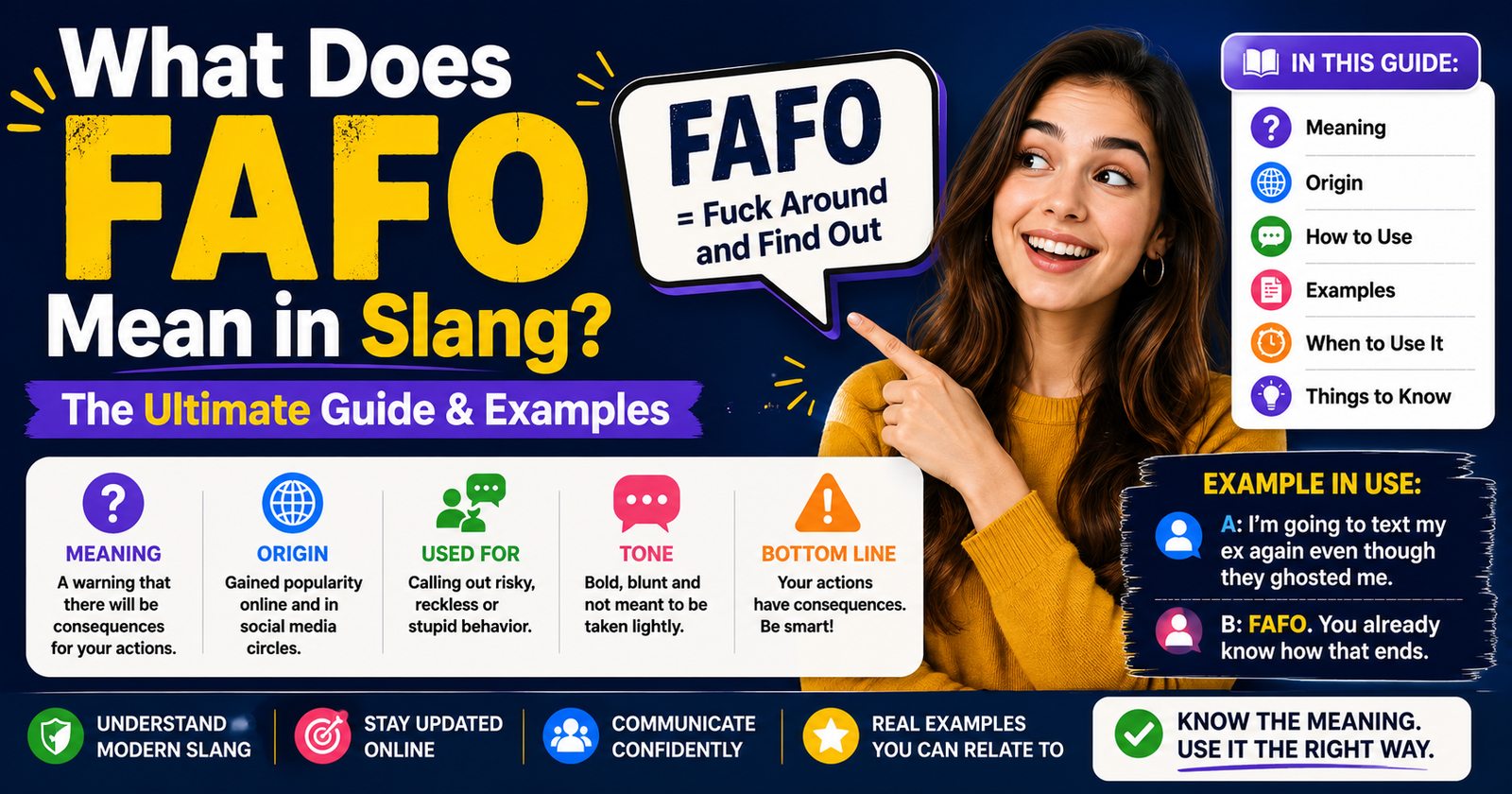
So, what does FAFO mean in slang? It stands for “F*** Around and Find Out.” People use it as a warning. It means if you keep pushing your luck, you’ll face the consequences. Below, you’ll find the full meaning, real examples, and how to use it the right way.
The Full Meaning
Breaking it into its two halves makes it easier to remember:
- “F* Around”** — to mess with someone, break a rule, ignore a warning, or act recklessly.
- “Find Out” — to experience the consequences of that behavior, usually painful, embarrassing, or costly ones.
Put together, FAFO is shorthand for “keep testing me and you’ll regret it” or, more generally, “actions have consequences.”
Is FAFO an Acronym, Abbreviation, or Slang?
Technically, FAFO is an acronym — each letter stands for a word in the phrase, and it’s pronounced as a word-like unit (“fah-foh”) rather than spelled out letter by letter, though people do spell it out too (as Pete Hegseth famously did — more on that below). It also functions as slang, since its meaning is informal, tone-dependent, and understood mainly through cultural context rather than a dictionary definition.
What Confusion Does Knowing FAFO Solve?
If you’ve seen “FAFO” in a comment section, a text from a friend, or a political headline and had no idea what it meant, you’re not alone. Knowing the term solves a few specific confusions:
- Why people reply “FAFO” to someone bragging about doing something risky or dumb.
- Why a threatening headline about a politician or military official might just contain four letters.
- Why “FAFO” shows up as a caption under memes of people getting hurt, arrested, or embarrassed.
- Why the tone can range from joking-among-friends to genuinely threatening, depending on who’s saying it.
FAFO Meaning in Text, Chat, and on Social Media
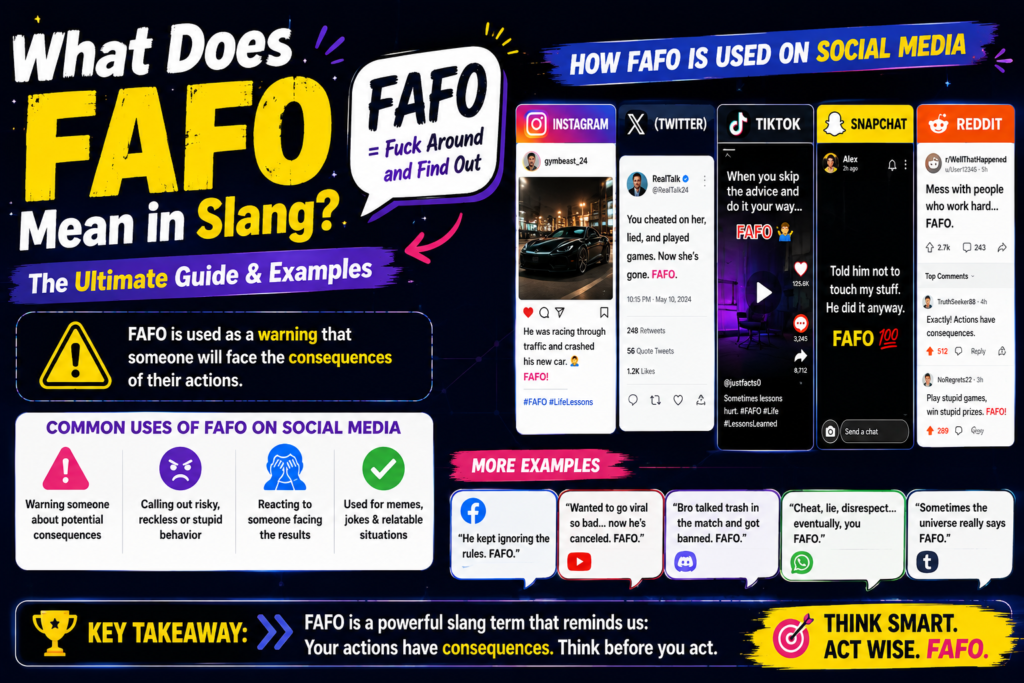
The core meaning of FAFO doesn’t change across platforms, but the tone and use case shift depending on where you see it.
FAFO Meaning in Text Messages
In one-on-one texting, FAFO is usually short for a playful warning between friends. Example: your friend says they’re going to confront their landlord without reading the lease first. You text back “FAFO 😂” — meaning “go ahead, but you’re going to learn something the hard way.”
FAFO Meaning on TikTok
On TikTok, FAFO is often attached to videos where someone does something reckless — jumping off something too high, mouthing off to the wrong person, ignoring a safety warning — and then faces immediate, visible consequences. It’s become a genre tag almost like “instant karma.”
FAFO Meaning on Instagram
On Instagram, especially in comments and captions, FAFO is used similarly to TikTok: a caption on a video or photo showing someone’s risky decision backfiring. It also appears in comment sections warning someone not to repeat a mistake.
FAFO Meaning on Snapchat and WhatsApp
In private chats on Snapchat or WhatsApp, FAFO tends to stay closer to its casual, joking use — a quick reply to a friend’s risky plan, minus the public “gotcha” element you see on TikTok or Instagram.
FAFO Meaning on X (Twitter)
On X, FAFO shows up constantly in political and social commentary. It’s used both sincerely, as a genuine threat or warning (including by public officials, as covered below), and sarcastically, mocking someone who is currently facing the consequences they were warned about.
Where Did FAFO Come From? The Real Origin
Roots in AAVE and Street Culture
Like many widely used slang terms, FAFO has roots in African American Vernacular English (AAVE) and street culture, where “f*** around” has long meant to mess with someone or something recklessly, and “find out” implied discovering the consequences. The phrase circulated informally for years before it became an internet acronym.
Software Developers and Tech Culture
Interestingly, FAFO also has documented use in a very different world: the U.S. military and later tech and engineering circles, where it functioned as blunt shorthand for “test the system carelessly and it will break.”
Wikipedia’s list of military slang terms confirms FAFO’s long-standing use in military contexts to describe, doing something usually ill-advised or stupid and discovering the consequences of that action, in some cases involving serious injury or even fatality.
The 2022 Viral Moment
FAFO exploded into mainstream internet slang around 2022, spreading through memes, sports commentary, and reaction videos where someone’s reckless choice led to an immediate and often funny consequence. This is when the acronym crossed over from niche subcultures into everyday internet vocabulary.
2025–2026: FAFO Goes Political and Institutional
FAFO took on a new, much more public life in 2025 and 2026 when it started appearing in official and political contexts in the United States.
- In January 2025, Donald Trump used “FAFO” in an AI-generated image posted online amid a diplomatic standoff with Colombia over deportations.
- On September 30, 2025, then–Defense Secretary Pete Hegseth used the term during a mandatory in-person address to hundreds of top U.S. military commanders. Speaking to the country’s top military commanders, Hegseth said, “To our enemies: FAFO,” using the acronym as a warning. He reportedly spelled it out letter by letter — “F-A-F-O” — while looking into the camera.
- The moment was widely covered by outlets including NPR, which noted Hegseth used the vulgar military slang to describe what would happen if U.S. adversaries tested the country.
This is the origin of two of the most searched variations of the term: “FAFO military meaning” and “FAFO Hegseth meaning.” In both cases, the meaning is identical to the general definition — “test us and face consequences” — but the context (a sitting Defense Secretary addressing military leadership) gave it institutional weight it hadn’t had before.
FAFO Meaning in Politics
In political commentary, what does FAFO mean in politics usually comes down to one of two uses:
- As a warning issued by officials or political figures to adversaries, critics, or foreign governments — as seen in the Hegseth and Trump examples above.
- As commentary from the public or media, often used sarcastically to describe a politician, official, or voter base now facing the consequences of a policy or decision they supported or dismissed warnings about.
Because of this dual use, FAFO in political contexts can either be a genuine threat from someone in power, or a pointed criticism aimed at someone in power. Context — who is saying it, and to whom — matters more here than in almost any other use case.
FAFO Meaning in Law
FAFO is not a legal term and has no formal legal definition or standing in statutes, contracts, or court proceedings. When people search “FAFO meaning in law,” they’re usually looking for one of these:
- Informal commentary from legal commentators or social media users describing someone who broke a law or violated a court order and is now facing consequences (“they FAFO’d and got sentenced”).
- General curiosity about whether the phrase has any formal legal use (it doesn’t).
If you see FAFO used near legal news, it’s almost always colloquial commentary, not a courtroom term.
FAFO Meaning in WWE
In professional wrestling commentary and fan culture, FAFO is used the way it’s used elsewhere: a wrestler who disrespects, provokes, or underestimates an opponent and then loses the match or gets injured “FAFO’d.” Fans and commentators use it to describe an in-ring storyline moment where bravado is punished on screen — it’s part of wrestling’s long tradition of trash talk paying off (or backfiring) dramatically.
Tone and Context Variations
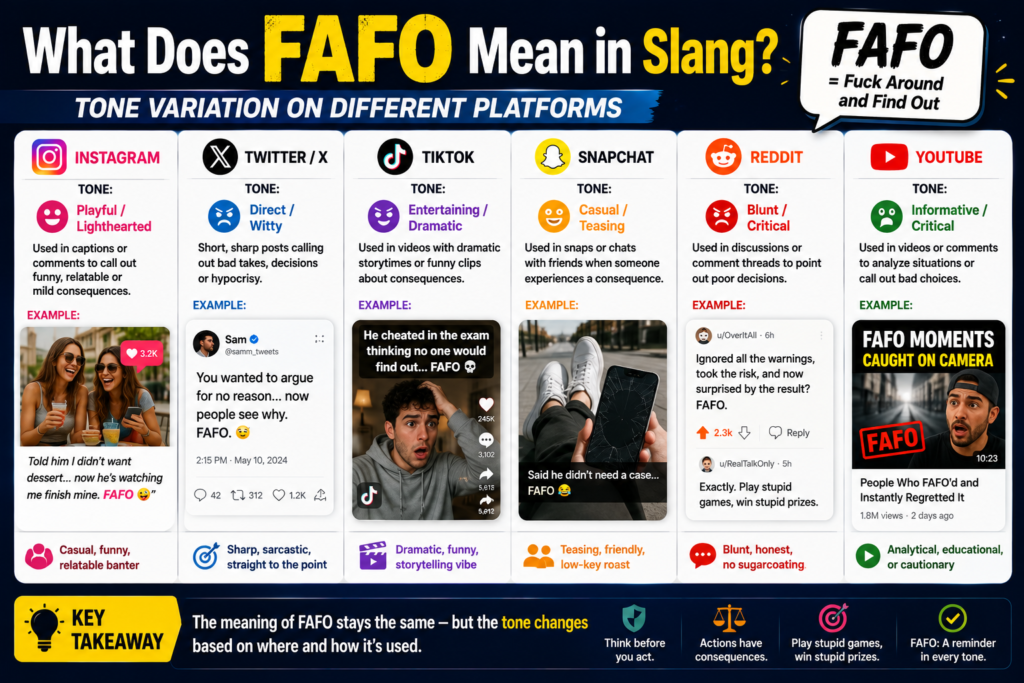
FAFO changes meaning slightly depending on tone. Here’s how to read it:
Playful / Funny Tone
Used between friends about low-stakes decisions. “You’re eating gas station sushi? FAFO.” No real threat — just teasing.
Sarcastic Tone
Used after someone’s prediction comes true. “They said the plan would fail, and… FAFO.” Often paired with a laughing or eye-roll emoji.
Serious / Confrontational Tone
Used as a genuine warning, often in arguments, workplace disputes (rare, but happens informally), or political statements. This is the tone Hegseth used.
Self-Aware / Ironic Tone
Used by someone about their own mistake. “I ignored the check-engine light for six months. FAFO.” Shows self-deprecating humor.
Angry Tone
Used as a hostile threat in arguments or confrontations, sometimes escalating a conflict rather than joking about one.
Real Chat Conversation Examples
Playful:
A: “I’m gonna skip my dentist appointment again lol” B: “brooo FAFO, don’t come crying to me”
Sarcastic:
A: “He didn’t back up his laptop and now the hard drive died” B: “FAFO 💀”
Serious warning:
A: “If you post that without asking me first, we’re done.” B: “Do it anyway and FAFO.”
Self-aware:
A: “Went for a run in new shoes with zero break-in. Blisters everywhere. FAFO tbh.”
Grammar and Language Role of FAFO
Part of Speech
FAFO functions primarily as an interjection — a standalone exclamation, similar to “watch out” or “you’ll see.” It can also work as a noun (“that was a full FAFO moment”) or informally as a verb (“they FAFO’d hard”), though the verb form is less common and more playful.
Does It Replace a Full Sentence?
Yes. FAFO is almost always used to replace an entire warning sentence like “keep doing that and you’ll regret it” or “you’re about to find out the hard way.” That’s part of its appeal — it compresses a whole idea into one punchy word.
Formal vs Informal
FAFO is strictly informal. It originates from a phrase containing profanity, and even in its “cleaned up” version (“Fool Around and Find Out”), it reads as casual slang. It does not belong in formal writing, professional emails, academic work, or official communication — its use by a cabinet official in 2025 was itself newsworthy precisely because it broke that norm.
How to Reply When Someone Says FAFO to You
If It Is a Playful Warning from a Friend
Lean into the joke: “Noted, I’ll report back with the damage” or a simple laughing reaction works fine.
If It Is a Serious Warning
Take stock of the situation. If someone is genuinely warning you about real consequences (legal, financial, physical), it’s worth pausing and reconsidering your next move rather than escalating.
If Someone Says FAFO After You Made a Mistake
A little humility goes a long way: “Yeah… I should’ve listened” defuses the moment better than getting defensive.
Funny Reply
“Already found out. Would not recommend. 0/10.”
Confident / Unbothered Reply
“Found out. Doing it again anyway.”
Comparison Table: FAFO vs Similar Slang Terms
| Term | Meaning | Tone | Common Platform |
| FAFO | Test your luck and face consequences | Playful to serious | TikTok, X, texting |
| YOLO | You only live once — do it anyway | Encouraging, reckless | Instagram, general |
| IYKYK | If you know, you know | Inside-joke, exclusive | Instagram, TikTok |
| Shoot your shot | Take a risk, usually romantic | Encouraging | Texting, Instagram |
| Watch and learn | I’ll show you how it’s done | Confident | General chat |
| Don’t test me | Direct warning, no joking | Serious | Texting, in person |
The key difference: YOLO encourages risk-taking without focusing on outcome, while FAFO centers on the outcome — specifically, a bad one.
Who Uses FAFO?
Age Groups
FAFO is most common among Gen Z and younger Millennials, though its 2025 political moment pulled it into much broader, older audiences who encountered it through news coverage rather than internet culture.
Gen Z vs Millennials
Gen Z tends to use FAFO casually and constantly, often as a reaction to everyday videos and posts. Millennials are more likely to use it sparingly, often ironically referencing its meme status.
Regional Usage
FAFO is used throughout the U.S. without strong regional concentration, though its AAVE origins and continued popularity in Black internet culture and hip-hop-adjacent commentary remain a strong thread in how the phrase is used and understood.
Platforms Where It Is Most Common
TikTok and X (Twitter) see the heaviest use, followed by Instagram comments and everyday texting.
Is FAFO Rude? Safety and Appropriateness
Does It Contain Profanity?
Yes. The full phrase behind the acronym contains profanity (“f***”), even though the acronym itself doesn’t spell out the word. This is worth knowing before using it around people who might be offended by profanity, even in abbreviated form.
Is It a Slur or Hate Speech?
No. FAFO is not a slur and is not targeted at any protected group. It’s a general warning phrase, not hate speech.
Is It Rude?
It can come across as rude or aggressive depending on tone and context, especially in serious or angry use. Among friends joking around, it’s generally not considered offensive.
Should You Use It at School?
Casually with peers, it’s common and generally low-risk. Saying it to a teacher or authority figure, or in a way that sounds like a threat, could get you in trouble — treat it the way you would any mild swear-adjacent phrase.
Should You Use It at Work?
Avoid it in professional communication. Even informally with coworkers, it carries the underlying profanity and a confrontational edge that doesn’t fit most workplace norms.
Who Should Be Careful?
Public figures, professionals in customer-facing roles, and anyone communicating with someone who doesn’t share the same cultural context should be cautious — as the 2025 Hegseth example shows, using it in an official capacity can generate significant public attention and criticism.
Real-World Observation: How People Actually Use FAFO
Scrolling through comment sections and video captions shows a consistent pattern: FAFO shows up most often as a reaction rather than an opener. People rarely start a conversation with it — instead, it appears after the “find out” part has already happened, functioning almost like a punchline confirming that a warning was correct all along.
Summary, Usage Tips, and When to Avoid It
Summary
FAFO stands for “F*** Around and Find Out” — a slang warning meaning that reckless behavior leads to consequences. It ranges from a joking exchange between friends to a serious, even institutional, warning, as seen in its high-profile use by U.S. political and military figures in 2025.
Usage Tips
- Match your tone to your relationship with the person you’re talking to.
- Remember it contains implied profanity, even abbreviated.
- Use it in casual, informal settings only.
Common Mistakes to Avoid
- Using it in professional or formal writing.
- Assuming everyone knows what it means — older or less online audiences may not.
- Using it as a genuine threat without meaning to; tone doesn’t always translate over text.
When to Use It
Casual conversations, memes, reactions to videos, joking warnings among friends.
When to Avoid It
Formal writing, professional communication, conversations with people who may be offended by implied profanity, or any situation where it could be read as a genuine threat.
Conclusion
Now you know the answer to what does FAFO mean in slang. It’s short for “F*** Around and Find Out.” People use it as a warning. It tells someone their risky choice will have real consequences.
FAFO shows up everywhere now. You’ll see it in texts, memes, and even the news. Use it with friends, keep it casual, and skip it in formal settings. Now you can spot it, understand it, and use it the right way.
Frequently Asked Questions
Is FAFO always aggressive?
No. It ranges from lighthearted teasing between friends to a genuine, serious threat, depending on tone and relationship.
Is FAFO a gen z slang term?
Not originally, but Gen Z made it mainstream. It’s used most by Gen Z and younger Millennials today.
What does FA mean in Gen Z slang?
“FA” just means “F*** Around” — the first half of FAFO. It means acting recklessly or testing your luck.
Is FAFO considered vulgar?
Mildly. The full phrase contains profanity, even though the acronym itself doesn’t spell it out.
What does FAFO mean in slang, according to Urban Dictionary?
Urban Dictionary defines it the same way: a warning that reckless behavior leads to bad consequences. Wording varies by entry, but the meaning stays consistent.
Did Pete Hegseth invent FAFO?
No. FAFO existed for years before him, with roots in AAVE and military slang. He just brought it into a major political moment in 2025.
Can FAFO be used positively?
Rarely, but yes — in self-aware or confident contexts, someone might use it almost proudly, implying they took a risk and are fine with whatever comes of it.
Is FAFO the same as a threat?
Sometimes. Whether it counts as a genuine threat depends entirely on context, tone, and who is saying it to whom.
1 thought on “What Does FAFO Mean in Slang? The Ultimate Guide & Examples”