
Ever seen “NSFW” pop up before a photo, video, or link and wondered what it actually means?
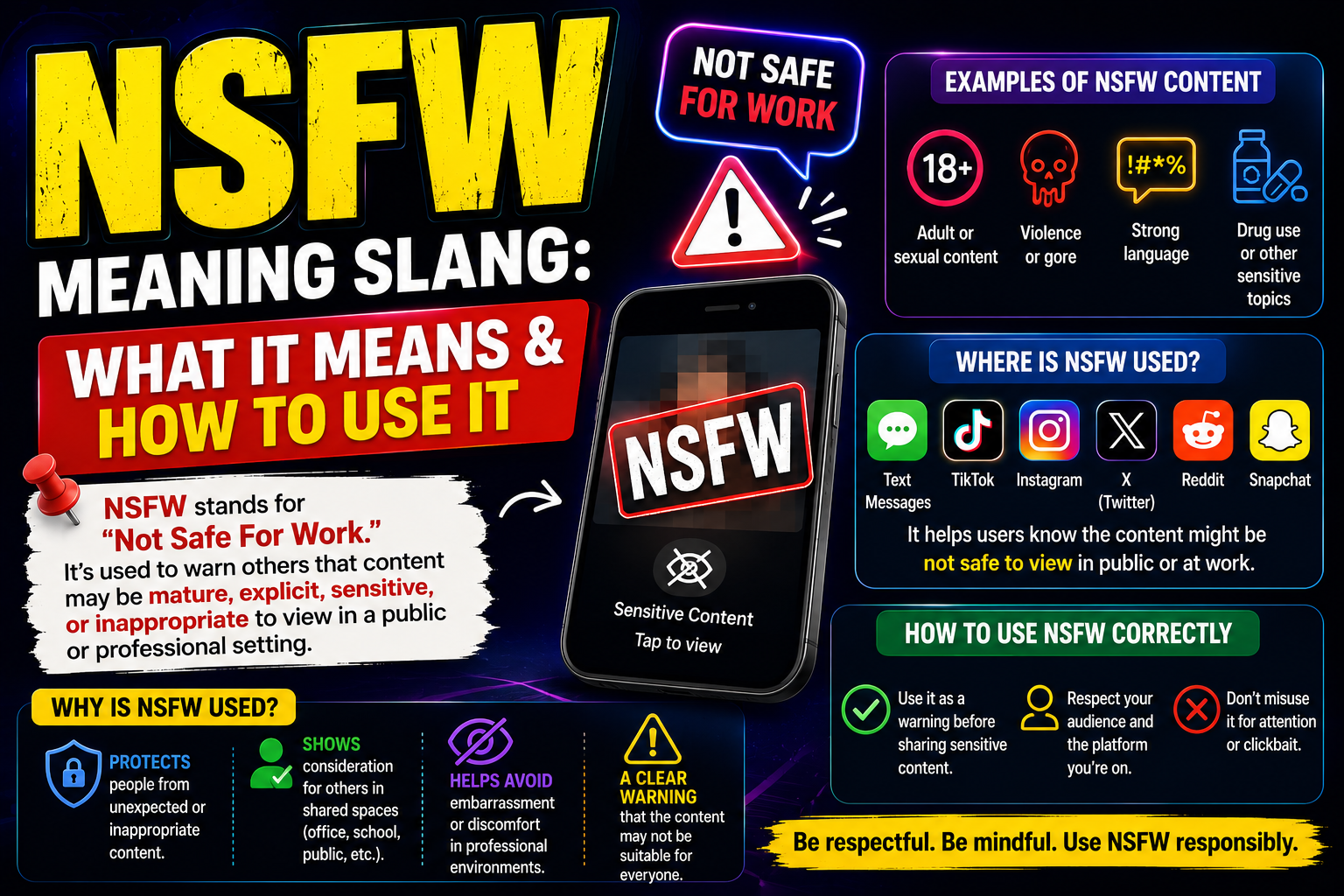
If you’re searching for the NSFW meaning slang definition, here it is: NSFW stands for “Not Safe For Work.” It’s a quick warning label people use online to flag content that shouldn’t be opened in public, at school, or in front of coworkers.
You’ll spot it everywhere — Snapchat, Discord, Reddit, group texts. Sometimes it’s a genuine heads-up before something explicit or graphic. Other times, it’s just a joke between friends about something mildly embarrassing.
The tricky part? The meaning shifts depending on where you see it and who’s using it. A tag that means “seriously explicit” on Reddit might just mean “kind of funny” on TikTok.
This guide breaks down exactly what NSFW means, how it’s used across different platforms and age groups, and how to reply when someone sends it your way.
Is NSFW an Acronym, Short Form, or Slang?
NSFW is technically an initialism (each letter is pronounced separately, not blended into a word), but in everyday use it functions as internet slang. It started as a practical content-warning label on forums and image boards in the early 2000s, then spread to mainstream platforms like Reddit, Twitter/X, Discord, and Tumblr as those sites grew.
Unlike pure acronyms that get spoken aloud (like “NASA”), NSFW is almost always read letter-by-letter or simply recognized visually as a tag. It’s rarely said out loud in conversation — you’re more likely to type it than say it.
NSFW Meaning in Text Messages
In texting, NSFW is a heads-up. Someone sends it right before or alongside content to warn you that what follows is graphic, explicit, sexual, violent, or otherwise inappropriate for a work or public setting.
Common ways it shows up in texts:
- “NSFW ⚠️” followed by a photo or video
- “Don’t open this at work, NSFW”
- “lol this meme is NSFW” (used loosely for anything crude, not necessarily sexual)
In texting, NSFW isn’t always about explicit sexual content. It’s also used for things that are just crude, gory, violent, or embarrassing to be caught looking at — a bloody injury photo, a graphic news clip, or an off-color joke can all get tagged NSFW.
What Does NSFW Mean in Chat?
In live chat apps and group chats (Discord, Slack, Telegram), NSFW works the same way but often comes with an actual system feature attached. Discord, for example, lets server admins mark entire channels as “NSFW channels,” which hides them from view until a user manually confirms they’re 18 or older and opts in.
So in chat platforms, NSFW isn’t just a word people type — it’s sometimes a built-in content filter setting. Understanding this distinction matters: typing “NSFW” in a message is a personal warning, while an NSFW-tagged channel is a platform-level restriction.
NSFW Meaning on Snapchat
On Snapchat, NSFW usually appears as a caption or a warning before someone sends a Snap. Because Snaps disappear after viewing, people use NSFW as a courtesy alert so the recipient can choose when (and where) to open it — not in a crowded room, not with a screen visible to others nearby.
It’s also common in Snapchat usernames or bios shared on other platforms, where “NSFW Snap” signals that the account posts adult content and is intended for an 18+ audience.
NSFW Meaning on Instagram
Instagram’s community guidelines restrict overtly sexual content, so “NSFW” on Instagram is used more cautiously. You’ll typically see it:
- In bios linking to other platforms (“NSFW content on my Fansly/Reddit — link in bio”)
- As a joke tag on borderline-suggestive but technically allowed posts
- In comments warning others about a linked post or story
Because Instagram enforces stricter content rules than sites like Reddit or Twitter/X, NSFW there often functions as a redirect signal rather than a warning about content on the platform itself.
NSFW Meaning on TikTok
TikTok also restricts explicit content, so NSFW rarely labels actual sexual material on the app. Instead, it’s used more casually — almost as a joke or exaggeration:
- “This dance is NSFW 😂” meaning it’s just a little suggestive or spicy, not literally explicit
- Warning captions before a gross-out, gory, or cringe-inducing clip
- Referring users to a creator’s other platform for uncensored content
On TikTok, NSFW has drifted toward hyperbole. People use it for comedic emphasis far more often than as a literal content warning, since the platform’s moderation makes truly explicit NSFW content rare.
NSFW Meaning on WhatsApp
WhatsApp has no content-tagging system, so NSFW here is purely a personal, typed warning between individuals or in group chats. Since WhatsApp is widely used for family and work communication, people are especially careful to flag NSFW content before sending it, given the higher chance of it being opened on a shared or visible device.
Tone & Context Variations
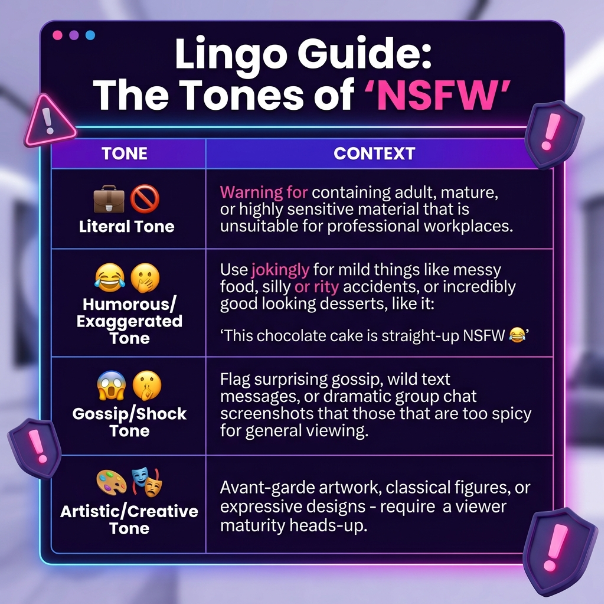
The words “NSFW” don’t change, but the tone around them shifts the meaning quite a bit.
Funny Tone
Used as a joke about something mildly embarrassing, not actually explicit. “NSFW, my desk is an absolute disaster 💀”
Sarcastic Tone
Deliberately exaggerating something harmless to make it sound scandalous. “NSFW alert: I just ate an entire pizza alone.”
Romantic Tone
Genuinely flirtatious or suggestive, often between partners. “Sent you something… NSFW 😏”
Angry Tone
Rare, but used to warn that a message contains harsh language or a graphic rant. “NSFW, I need to vent about my coworker.”
Playful Tone
Teasing without being explicit — building anticipation. “Got a NSFW thought I can’t stop thinking about lol”
Real Chat Examples
- A: “Sending you a pic, NSFW btw” B: “Noted, opening it later 👀”
- A: “This article is wild” B: “Warning, kinda NSFW language in it”
- A: “check ur email” B: “is it NSFW? I’m at work lol”
- A: “NSFW meme incoming” B: “lmaooo why do you do this to me”
- A: “New pics up on my page, NSFW” B: “🔥🔥 saved”
- A: “this show has some NSFW scenes fyi” B: “good, I need drama”
- A: “bro this thread is NSFW” B: “reddit never disappoints”
- A: “NSFW rant about my ex, you ready?” B: “always ready lol go off”
- A: “sent u something 😏 nsfw” B: “oh?? give me a sec to find headphones”
- A: “careful, that video’s NSFW” B: “too late, already at the office 😭”
- A: “this joke is a lil NSFW lol” B: “say less”
- A: “posted new content, tagged NSFW for the algorithm” B: “smart move”
- A: “warning: nsfw language, I’m heated rn” B: “what happened??”
- A: “this channel got marked NSFW on discord” B: “makes sense honestly”
- A: “nsfw ish photo, don’t open around your mom 😂” B: “noted lmao”
Grammar & Language Role
Part of Speech
NSFW mainly functions as an adjective (“this is NSFW content”) but is also frequently used as a standalone interjection or warning tag on its own line, similar to how “spoiler alert” works.
Sentence Position
It usually appears at the start of a message as a heads-up, or at the end as an afterthought clarification. Mid-sentence use is less common but does happen: “the video is kind of NSFW, just so you know.”
Does It Replace a Full Sentence?
Often, yes. On its own — just “NSFW” with nothing else — it communicates a complete warning without needing a full sentence. This is typical of internet shorthand, where efficiency matters more than grammar.
Tone Impact
Capitalization doesn’t usually change meaning (nsfw vs NSFW), but punctuation does. “NSFW.” reads as a flat, serious warning. “NSFW 😏” or “NSFW lol” softens it into something playful or flirtatious.
Formal vs Informal Usage
NSFW is inherently informal internet slang. It has no place in formal writing, business emails, or academic contexts — even when referencing graphic content, professional writing uses phrases like “graphic content warning” or “content advisory” instead.
How to Reply When Someone Says NSFW
Funny Replies
- “Say less 😂”
- “My curiosity is now uncontrollable”
- “Bold of you to warn me”
Serious Replies
- “Got it, I’ll check it later when I’m free.”
- “Thanks for the heads-up.”
- “I’d rather not, but appreciate the warning.”
Flirty Replies
- “Oh really? 👀”
- “Now I have to see it”
- “You have my full attention”
Neutral Replies
- “Noted.”
- “Okay, thanks.”
- “Will open it later.”
Comparison Table: NSFW vs Similar Internet Slang
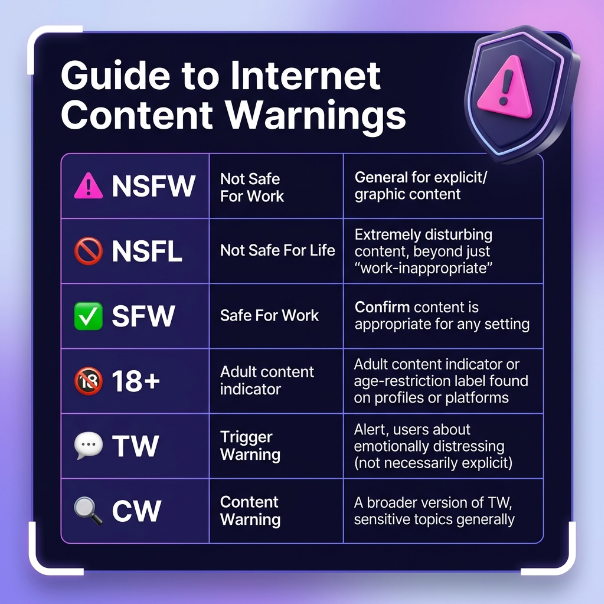
| Term | Meaning | Typical Use Case |
| NSFW | Not Safe For Work | General warning for explicit/graphic content |
| NSFL | Not Safe For Life | Extremely disturbing content, beyond just “work-inappropriate” |
| SFW | Safe For Work | Confirms content is appropriate for any setting |
| 18+ | Adult content indicator | Age-restriction label, often on profiles or platforms |
| TW | Trigger Warning | Alerts about emotionally distressing content (not necessarily explicit) |
| CW | Content Warning | Broader version of TW, covers sensitive topics generally |
Key Insight
NSFW is specifically about setting (is this okay to view where you are right now?), while TW and CW are about emotional impact regardless of location. NSFL is a more extreme version of NSFW, and SFW is its direct opposite — confirming content is safe rather than warning against it.
Who Uses This Term?
Age Groups
NSFW is used across a wide age range now, but it’s most frequently typed by people roughly 16–40, since that group grew up alongside forums, Reddit, and Discord culture.
Gen Z vs Millennials
Millennials tend to use NSFW closer to its original, literal meaning — a genuine warning before sharing something explicit. Gen Z uses it more loosely and often ironically, applying it to mildly embarrassing or exaggerated situations that aren’t explicit at all.
Regional Usage
The term originated in English-language internet culture and remains most common in the US, UK, Canada, and Australia, but it’s now widely understood internationally, including among non-native English speakers active on global platforms like Discord and Reddit.
Common Platforms
Reddit, Discord, Twitter/X, Tumblr, and Snapchat see the heaviest NSFW usage. Reddit in particular has a platform-wide NSFW tagging system that blurs thumbnails and requires users to opt in to view marked content.
Origin & Internet Culture Insight
NSFW traces back to early-2000s internet forums and image-sharing boards, where users needed a quick way to flag content that shouldn’t be opened on an office or shared computer — a real concern in an era before smartphones, when most internet browsing happened on work or shared PCs. The term caught on because it solved a genuine, common problem: nobody wanted to accidentally open something explicit in front of coworkers.
Why People Say NSFW on TikTok
Since TikTok actively moderates and removes explicit content, using “NSFW” there has become more of a stylistic exaggeration — a way to add a little mystery or comedic tension to a video that’s actually tame. It borrows the feeling of the warning (something forbidden or exciting) without the literal content behind it.
Is NSFW Rude?
No — NSFW itself isn’t rude. It’s a courtesy tag, and using it correctly is actually considerate: it lets the recipient decide when and where to view something instead of being caught off guard. What matters is context. Sending NSFW content unprompted to someone who hasn’t consented to receive it is the actual problem, not the label itself.
Is NSFW a Bad Word?
No. NSFW is not profanity and isn’t considered offensive language. It’s a neutral warning label. The content it’s attached to might be explicit, but the term itself is simply descriptive — similar to a rating label on a movie.
Should You Use NSFW in School or the Office?
You can reference the term itself (saying “this is NSFW” to warn a friend not to open something) in most casual settings, but you should never actually open or share NSFW-tagged content on school or work devices, networks, or during work hours.
Many workplaces and schools monitor network activity, and opening flagged content on shared or monitored systems can lead to serious consequences, including disciplinary action.
Experience-Based Insight
People who spend time in online communities — Reddit threads, Discord servers, group chats — quickly learn that NSFW tags exist for a practical reason: shared and public devices make privacy unreliable. A tag takes two seconds to add and prevents an awkward, sometimes serious situation.
Communities that enforce NSFW tagging (like Reddit’s system) tend to have fewer complaints about unexpected explicit content, which is part of why the norm has stuck around for two decades.
Conclusion
NSFW simply means “Not Safe For Work.” It’s a warning, not an insult. Use it before sending anything explicit or graphic. This small habit shows respect for the person on the other end.
The meaning shifts a little depending on where you use it. On Discord, it might be a real content filter. On TikTok, it’s often just a joke. Either way, now you know exactly what it means and how to use it well.
Usage Tips
- Add it before sharing content, not after, so the recipient has a real choice
- Match the tone to your relationship with the recipient — playful with friends, straightforward with new acquaintances
- Never assume someone wants NSFW content just because you tagged it
Common Mistakes
- Using NSFW for content that’s simply embarrassing, not actually inappropriate for work (confusing but not incorrect if the tone is clearly joking)
- Sending NSFW-tagged content without consent
- Opening NSFW-tagged content on school, work, or shared devices
When to Use It
Use NSFW whenever you’re sharing something explicit, graphic, or otherwise inappropriate for a public or professional setting — it’s a quick, widely understood way to give someone a heads-up.
When to Avoid It
Avoid it in formal or professional writing, and never rely on it as a substitute for asking consent before sending explicit content to someone.
FAQ
What does NSFW mean?
NSFW stands for “Not Safe For Work.” It’s a warning label for content that shouldn’t be opened in public or professional settings.
What does NSFW mean in texting?
It means the photo, video, or link being shared is explicit or graphic, so the recipient should open it privately, not around others.
Is NSFW a bad word?
No. NSFW isn’t offensive language. It’s a neutral warning tag, similar to a content rating.
What does NSFW mean on Snapchat?
On Snapchat, NSFW warns the recipient that a Snap contains explicit or adult content before they open it.
What does NSFW mean in Gen Z?
Gen Z often uses NSFW loosely and jokingly, tagging anything mildly embarrassing or exaggerated, not just truly explicit content.
What does NSFW mean in love?
In romantic chats, NSFW usually signals something flirtatious or suggestive sent between partners, often with a playful tone.
What does NSFW mean in dirty terms?
In this context, NSFW warns that the content is sexually explicit and not appropriate to open in public or professional settings.
What is the difference between NSFW and NSFL?
NSFW means content is inappropriate for work, while NSFL (“Not Safe For Life”) is a stronger warning for disturbing or graphic content.
5 thoughts on “NSFW Meaning Slang: What It Means & How to Use It”