
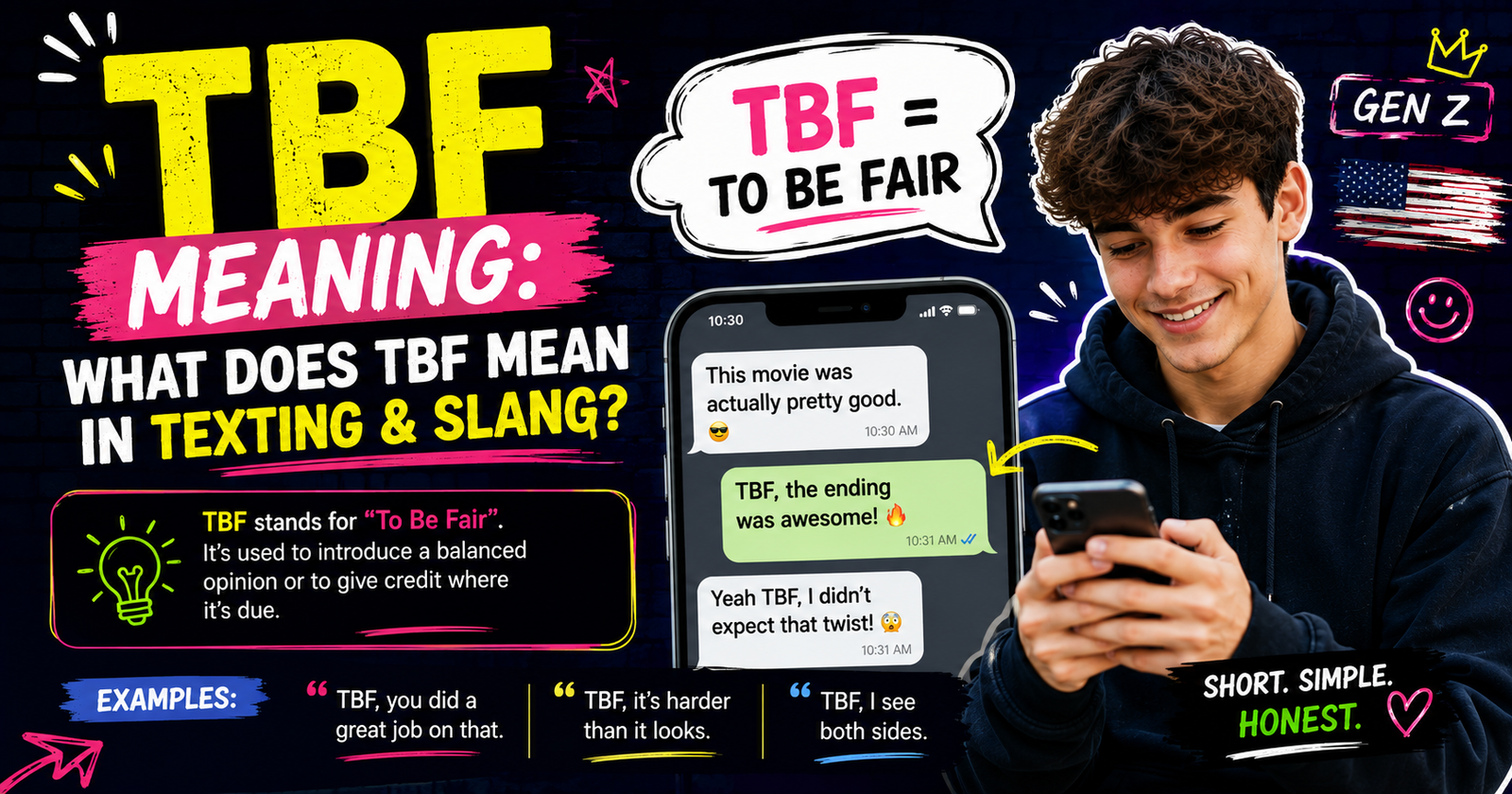
You’ve probably seen “TBF” pop up in a text or comment and wondered what it actually means. It’s simple, short, quick, and used everywhere online. The TBF meaning is simple once you know it: “To Be Fair.” People use it to soften an opinion or add balance before making a point.
This guide breaks down the TBF meaning across texting, social media, and even sports and business contexts. You’ll learn how tone changes its impact, see real examples, and find out when to use it — and when to skip it. By the end, you won’t just know what TBF stands for. You’ll know exactly how to use it right.
Quick answer: TBF = To Be Fair. It’s used to introduce a fair or balanced point, usually before agreeing partly with someone or admitting something is true, even if you don’t fully agree with the bigger picture.
Related slang terms you’ll often see alongside TBF:
- TBH – To Be Honest
- NGL – Not Gonna Lie
- IMO / IMHO – In My Opinion / In My Humble Opinion
- FWIW – For What It’s Worth
Example: “TBF, he did apologize first.” / “NGL, that’s a fair point.”
What Does TBF Mean?
TBF stands for “To Be Fair.” People use it right before making a point that balances out something negative or one-sided they just said.
Example:
“The movie was too long. TBF, the ending made up for it.”
It works like a small pause button. You say something, then TBF signals you’re about to add fairness or context.
Why People Search for TBF Meaning
Most people search for TBF meaning because they saw it in a text, a comment, or a caption and had no context. Texting slang moves fast, and abbreviations like this spread across platforms before dictionaries catch up.
Some search it out of curiosity. Others search it because a coworker, a partner, or a friend used it and they didn’t want to ask directly. Either way, the confusion is common — TBF is short, but it carries a specific tone that’s easy to miss if you’re new to it.
TBF Meaning in Text
In texting, TBF meaning stays the same: “To Be Fair.” But the tone shifts depending on who’s texting and why.
In a text conversation, TBF usually softens a disagreement or adds a fair counterpoint.
“You were late again.” “TBF, traffic was insane today.”
It’s rarely used to start a conversation. It almost always responds to something.
TBF Slang Meaning
As slang, TBF meaning goes beyond the literal definition. It’s become a conversational habit, almost a verbal shrug.
People use it to:
- Admit a fair point without fully agreeing
- Soften criticism
- Add balance to an opinion
- Sound less harsh when disagreeing
“That was a bad take. TBF, everyone has bad days.”
The slang version keeps the original meaning but adds a casual, low-effort tone that fits fast typing culture.
YOU MAY ALSO WANT TO KNOW ABOUT EMO MEANS ONLINE
What Does TBF Mean in Chat?
In group chats, DMs, and messaging apps, TBF meaning is almost always “To Be Fair.” It’s used constantly because chats move quickly and full sentences slow things down.
“That plan was messy.” “TBF, we had zero time to prepare.”
In chat, TBF often works as a mini rebuttal. It doesn’t fully disagree — it just adds missing context.
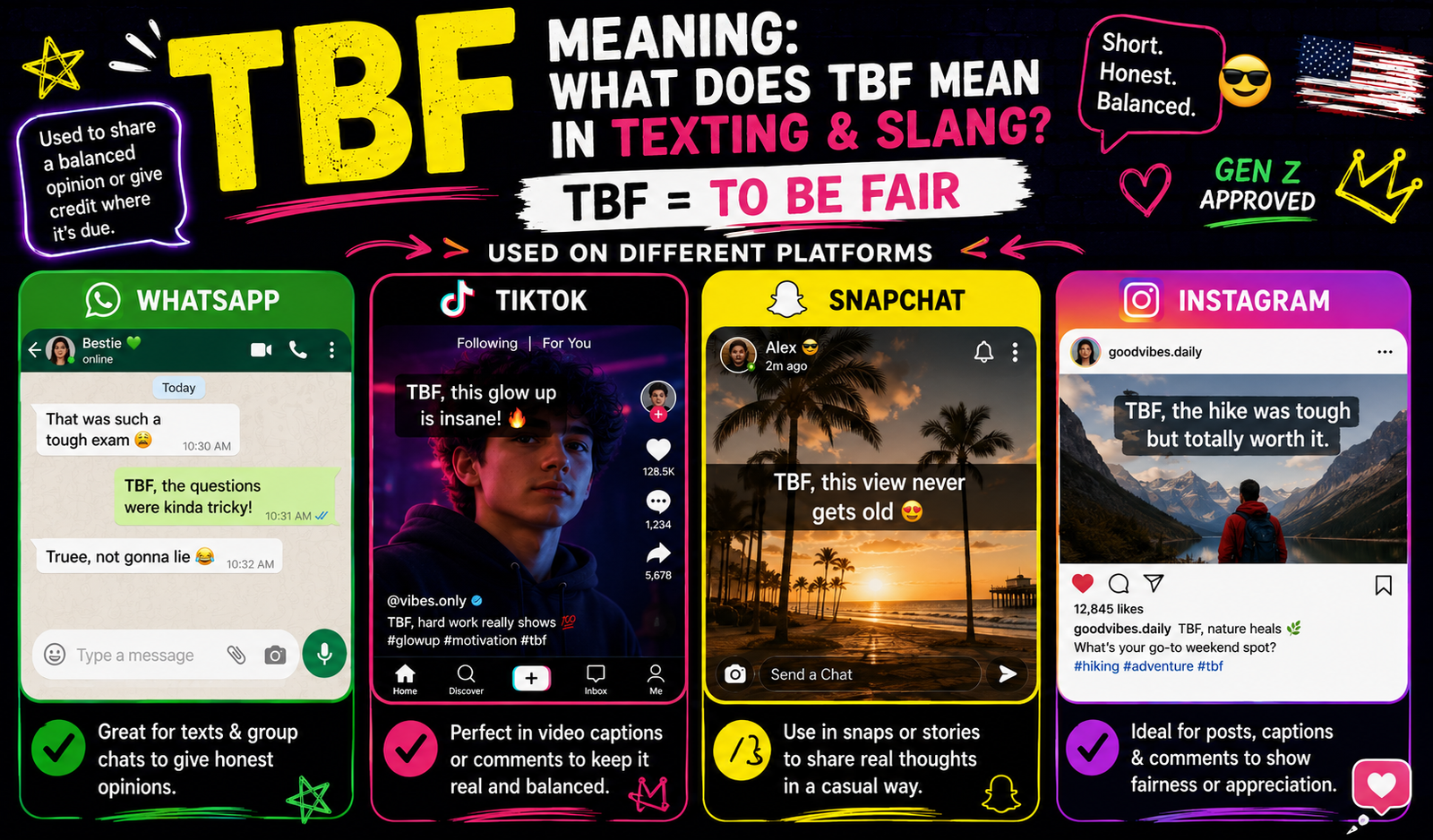
TBF Meaning on Snapchat
On Snapchat, TBF keeps its standard meaning, but it shows up mostly in chat replies and story comments rather than snaps themselves.
“You ignored my snap for 3 hours.” “TBF, I was in class.”
Snapchat conversations move fast and stay casual, so TBF fits naturally without needing explanation.
TBF Meaning on Instagram, TikTok, and WhatsApp
TBF Meaning on Instagram
TBF meaning on Instagram usually appears in comments. People use it to respond to a post or another comment with a fair, balanced take.
Comment: “This outfit is a bit much.” Reply: “TBF, it’s for a themed party.”
TBF Meaning on TikTok
On TikTok, TBF often shows up in comment sections under opinion-based videos or debates.
“TBF, the original recipe was better.”
It’s also common in captions when someone wants to acknowledge a counterpoint before making their own.
TBF Meaning on WhatsApp
On WhatsApp, TBF meaning stays close to texting. It’s used in personal chats, family groups, and work groups to soften disagreement or add fairness to a statement.
“You should’ve told me sooner.” “TBF, I didn’t know myself until today.”
Is TBF an Acronym, Short Form, or Slang?
Is TBF an Acronym?
Yes. TBF is a true acronym. Each letter stands for a specific word: To Be Fair. It’s read letter by letter in formal contexts, though in casual chat, people usually just say “tee-bee-eff” as one quick phrase or skip saying it aloud entirely.
Is TBF a Short Form?
It also functions as a short form of the full phrase “to be fair.” Unlike some internet slang, TBF didn’t start as a joke or meme — it’s a direct shortening of a common English phrase.
Is TBF a Phonetic Spelling?
No. TBF is not phonetic. It doesn’t try to sound like the words it represents. It’s a straightforward initialism.
Is TBF a Typo Turned Slang?
No. TBF wasn’t born from a typo, unlike some internet terms. It came from natural texting shorthand, where people shortened common phrases to save time.
How TBF Changes Depending on Tone
The TBF meaning stays fixed, but the emotional weight shifts a lot depending on tone.
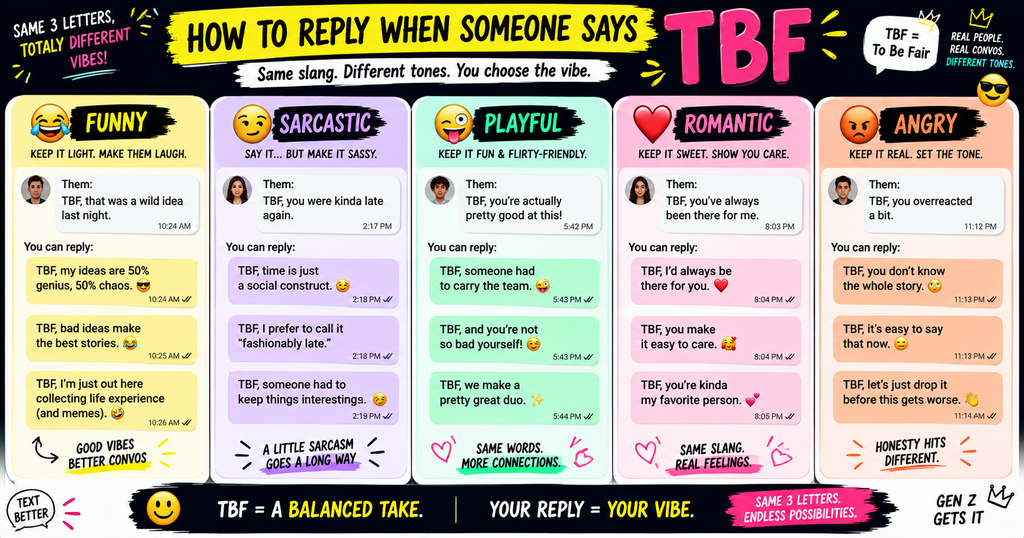
Funny Tone
“You just fell off your chair.” “TBF, the chair moved first.”
Sarcastic Tone
“You’re ‘so busy’ huh.” “TBF, Netflix doesn’t watch itself.”
Romantic Tone
“You never text first.” “TBF, I get nervous.”
Angry Tone
“You never listen to me.” “TBF, you talk over me too.”
Playful Tone
“You cheated at that game.” “TBF, you left your side open.”
Real Chat Examples Using TBF
Example 1
“TBF, I’d have done the same thing.”
Example 2
“That test was hard. TBF, we barely studied.”
Example 3
“He’s annoying. TBF, he’s stressed lately.”
Example 4
“TBF, the coffee shop closes early on Sundays.”
Example 5
“You lost the game. TBF, the rules were confusing.”
Example 6
“TBF, everyone was late, not just you.”
ANOTHER COMMON TEXTING ABBREVIATION IS SMB
Example 7
“She snapped at me. TBF, I did interrupt her.”
Example 8
“TBF, the app has been glitchy all week.”
Example 9
“That joke was rough. TBF, timing was bad.”
Example 10
“TBF, I didn’t read the group message either.”
Example 11
“He missed the deadline. TBF, the brief changed twice.”
Example 12
“TBF, you did warn me about this.”
Grammar and Language Role of TBF
Part of Speech
TBF functions as an interjection or a discourse marker. It doesn’t act as a noun, verb, or adjective. Its job is to introduce a shift in tone, not to describe anything directly.
Sentence Position
TBF almost always sits at the start of a sentence. Placing it mid-sentence or at the end is rare and can feel awkward.
Correct: “TBF, the flight was delayed.” Unusual: “The flight was delayed, TBF.”
Can TBF Replace a Full Sentence?
Sometimes, yes. In casual chat, “TBF” alone can stand as a complete reply.
“You’re not wrong.” “TBF.”
Tone Impact
TBF softens statements. It signals you’re being reasonable, not combative, even while disagreeing.
Formal vs Informal Use
TBF is informal. It doesn’t belong in reports, emails to clients, or academic writing. It fits casual chats, social media, and relaxed workplace conversations.
How to Reply When Someone Says TBF
Funny Replies
“TBF is doing a lot of work in that sentence.”
Serious Replies
“That’s a fair point, actually.”
Flirty Replies
“TBF, you’re pretty convincing.”
Neutral Replies
“Yeah, makes sense.”
Comparison Table
| Term | Full Meaning | Common Use |
| TBF | To Be Fair | Adding balance or a fair point |
| TBH | To Be Honest | Sharing an honest opinion |
| NGL | Not Gonna Lie | Admitting something bluntly |
| IMO | In My Opinion | Stating a personal view |
| FWIW | For What It’s Worth | Adding a low-stakes opinion |
SEE OUR GUIDE OF MFW FOR A STRONGER EXPRESSION
Contrasting Term
TBH focuses on honesty. TBF focuses on fairness. You can be honest without being fair, and fair without full honesty — that’s the core difference.
“TBH, I didn’t like the plan.” “TBF, it wasn’t a bad idea, just bad timing.”
Who Uses TBF?
Age Groups
TBF is most common among teens and young adults, roughly ages 13 to 35. Older users understand it too, but use it less often.
Gen Z vs Millennials
Gen Z uses TBF constantly, often multiple times in one conversation. Millennials use it more selectively, usually when making a genuine point rather than out of habit.
Regional Usage
TBF is especially common in British and Irish English, where “to be fair” is a everyday spoken phrase. It has since spread widely into American texting culture through social media.
Platforms Where TBF Is Common
TBF shows up most on Instagram, TikTok, Twitter/X, Snapchat, and WhatsApp. It’s less common on formal platforms like LinkedIn.
Origin and Internet Culture Insight
Why People Say TBF on TikTok
TikTok comment sections thrive on quick opinions. TBF lets users add nuance in a few characters, which fits the platform’s fast-scroll culture.
Meme Culture and TBF
TBF isn’t a meme itself, but it often appears in meme captions and reaction posts, usually to acknowledge a joke has some truth to it.
“TBF, this meme is too accurate.”
Fast Typing Culture
Abbreviations like TBF grew out of a need for speed. Full phrases take longer to type, especially on mobile keyboards. Shortened forms let people keep conversations moving.
Is TBF Rude?
No. TBF is not rude on its own. It’s actually the opposite — it’s often used to sound more reasonable and less confrontational when disagreeing with someone.
Is TBF a Bad Word?
No. TBF is not offensive or inappropriate. It’s safe for work, safe for school, and safe in most casual conversations.
Should You Use TBF in School?
TBF is fine in casual conversations with classmates or friends. It’s not appropriate in essays, formal presentations, or written assignments.
Should You Use TBF at Work?
TBF meaning in business settings depends heavily on context. It can work in casual Slack messages or informal team chats.
“TBF, the client did change the brief last minute.”
It should be avoided in formal emails, client communication, reports, or anything official. In those cases, write out “to be fair” fully, or better, restructure the sentence to sound professional.
Experience-Based Insight
People who use TBF regularly usually reach for it in one specific moment: right after they’ve said something slightly negative or critical, and they want to add balance before it sounds one-sided. It’s less about grammar and more about social tone — a small verbal cushion that keeps conversations feeling fair rather than one-sided.
Final Thoughts
The TBF meaning is easy to remember once you see the pattern: it always introduces fairness, balance, or a fair counterpoint. It’s casual, safe to use, and understood across most texting platforms.
Conclusion
Now you know the TBF meaning inside and out. It stands for “To Be Fair,” and it’s used to add balance or soften a point during a conversation. Whether it’s a text, a comment, or a casual work chat, TBF helps you sound reasonable, not harsh.
Keep it casual though. Save TBF for texts and social media, not emails or formal writing. Once you get a feel for the tone, using it becomes second nature. It’s a small phrase, but it says a lot in just three letters.
Usage Tips
- Use TBF to soften disagreement, not to start a conversation
- Pair it with a genuine fair point, not a random comment
- Keep it casual — avoid it in formal writing
Common Mistakes
- Using TBF to sound dismissive instead of fair
- Overusing it in every sentence, which weakens its impact
- Using it in formal emails or professional documents
When to Use TBF
Use it in texts, DMs, social comments, and casual chats when you want to add a fair or balanced point.
When to Avoid TBF
Avoid it in essays, official emails, resumes, or any formal written communication.
FAQ
What does TBF mean in slang text?
TBF means “To Be Fair.” It’s used to add a balanced or fair point, often right before agreeing partly with something.
Is TBF to be frank?
No. TBF stands for “To Be Fair,” not “To Be Frank.” The two are easy to confuse but carry different meanings — fairness vs. bluntness.
What does TBH and TBF mean?
TBH means “To Be Honest” and TBF means “To Be Fair.” TBH shares an honest opinion; TBF adds balance or context to a statement.
How is “TBF” used on social media?
On platforms like Instagram, TikTok, and Twitter/X, TBF usually appears in comments to offer a fair counterpoint or acknowledge a valid point during a discussion.
What does TBF mean in baseball?
TBF stands for “Total Batters Faced,” a stat tracking how many batters a pitcher has faced in a game or season.
What does TBF mean in football?
Football doesn’t have a standard TBF stat like baseball. It’s mostly used informally in fan discussions to mean “To Be Fair.”
What does TBF mean in business?
In casual workplace chats, TBF still means “To Be Fair,” used to acknowledge a valid point during informal discussions.
Can TBF be used sarcastically?
Yes. Depending on tone and context, TBF can carry sarcasm, especially when paired with an exaggerated or ironic statement.