
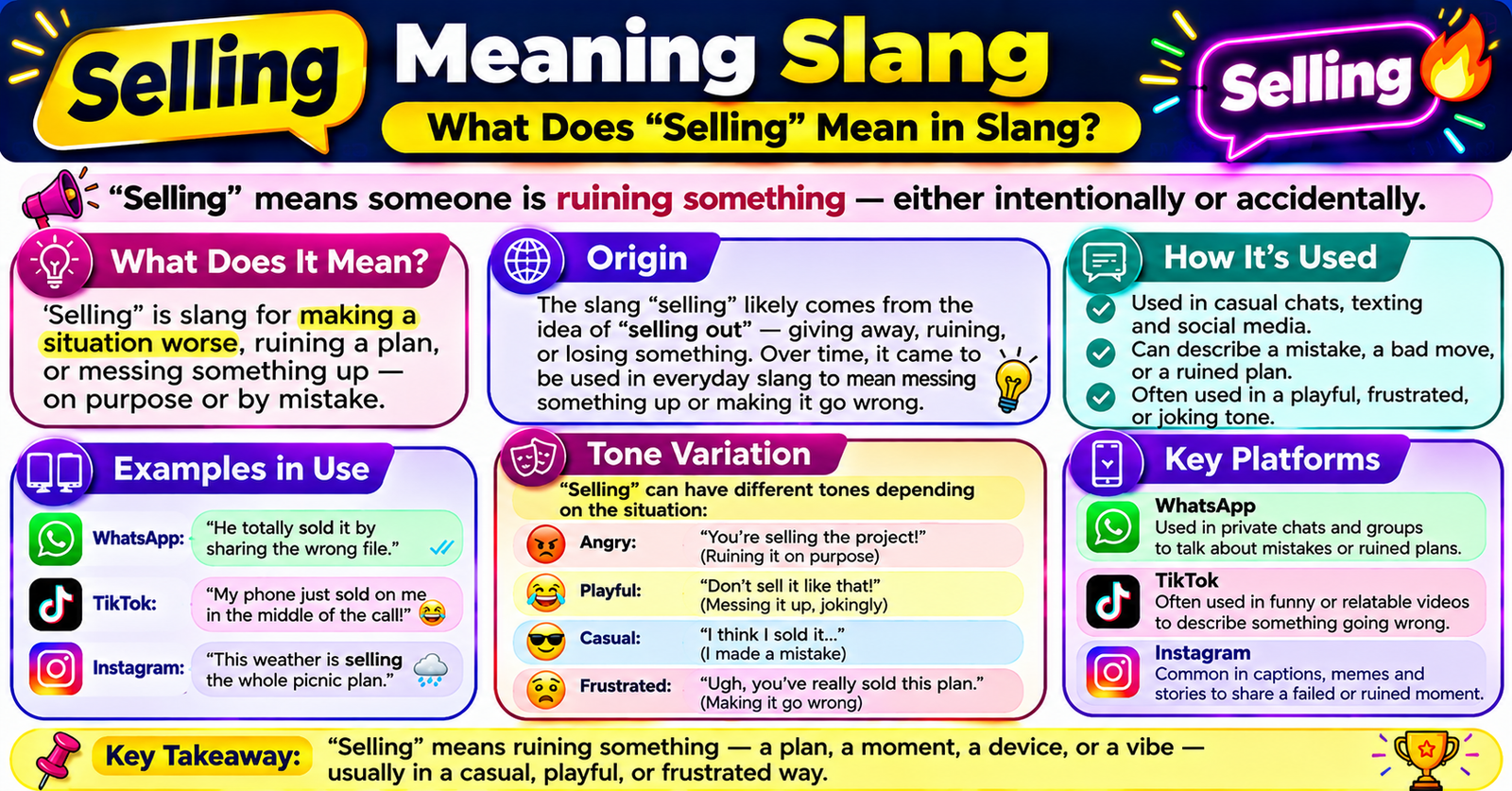
Quick answer: In slang, “selling” means ruining something — either on purpose or by accident. The selling meaning slang is common in gaming and everyday chat, used when someone messes up a play, a moment, or an opportunity for themselves or others.
Seen someone get called out for “selling” in a group chat or gaming clip? The selling meaning slang means ruining something — a game, a plan, or a moment — either on accident or on purpose. It’s common in gaming culture, where one bad play can “sell” the whole match for a team.
This guide breaks down the selling meaning slang in simple terms. You’ll learn where it comes from, how gamers and Gen Z use it, and how to respond if someone says you sold it. By the end, you’ll know exactly what it means and when it applies.
Meaning & Explanation
At its core, the selling meaning slang describes ruining something, whether it’s a game, a plan, or a moment. It can apply to a single careless mistake or a deliberate act that wrecks things for others. Either way, “selling” always points to something going wrong because of someone’s actions.
What Does “Selling” Mean in Text?
In texts, “selling” usually means messing something up. Example: “You sold the surprise party by texting her too early.”
Selling Slang Meaning
The slang meaning stays consistent: ruining something, whether accidentally or on purpose. It can describe a small slip-up (“you sold that joke”) or a bigger failure (“he sold the whole plan”).
What Does “Selling” Mean in Chat?
In chat, it’s often used to call someone out for messing something up. A friend might type “bro why’d you sell it” after a mistake ruins something for the group.
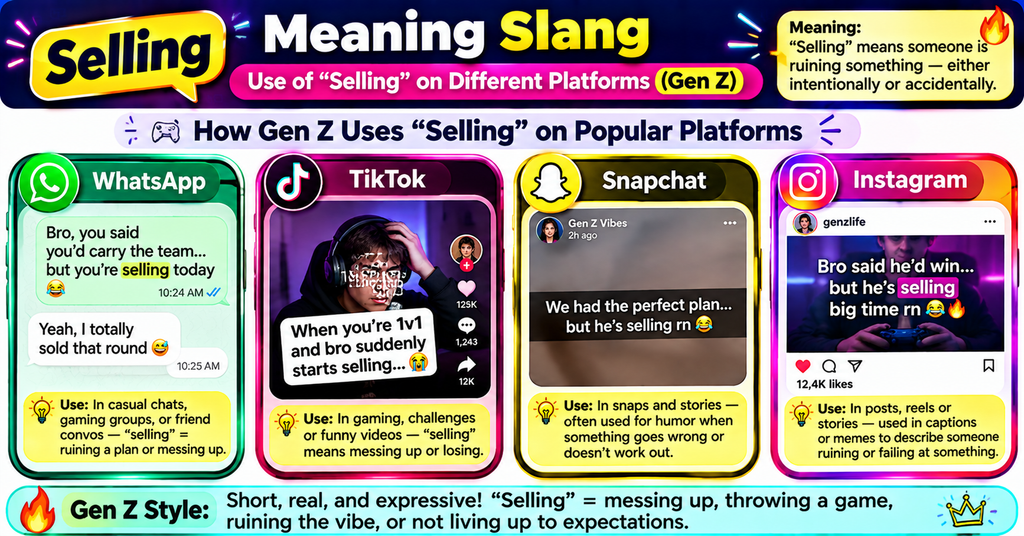
Selling Meaning on Snapchat
On Snapchat, it shows up in captions or replies when something goes wrong on camera — like a prank or moment getting ruined by bad timing.
Selling Meaning on Instagram, TikTok, WhatsApp
On Instagram and TikTok, “selling” often appears in comments under gaming clips or fail videos, calling out the moment someone ruined a play. On WhatsApp, it’s used more casually between friends about everyday mistakes, like ruining a surprise or a plan.
Is “Selling” an Acronym or Abbreviation?
No. It’s a regular English word used with an extended, informal meaning — not an acronym or shortened form.
Real Chat Examples
- “He sold the game with that last mistake.”
- “You sold the surprise, she already knows.”
- “I sold my own plan by forgetting the tickets.”
- “They sold the lead in the final five minutes.”
- “Don’t sell it this time, we need this win.”
- “She sold the joke by laughing too early.”
- “The whole squad sold that round with bad positioning.”
ANOTHER COMMON TEXTING ABBREVIATION IS NPC
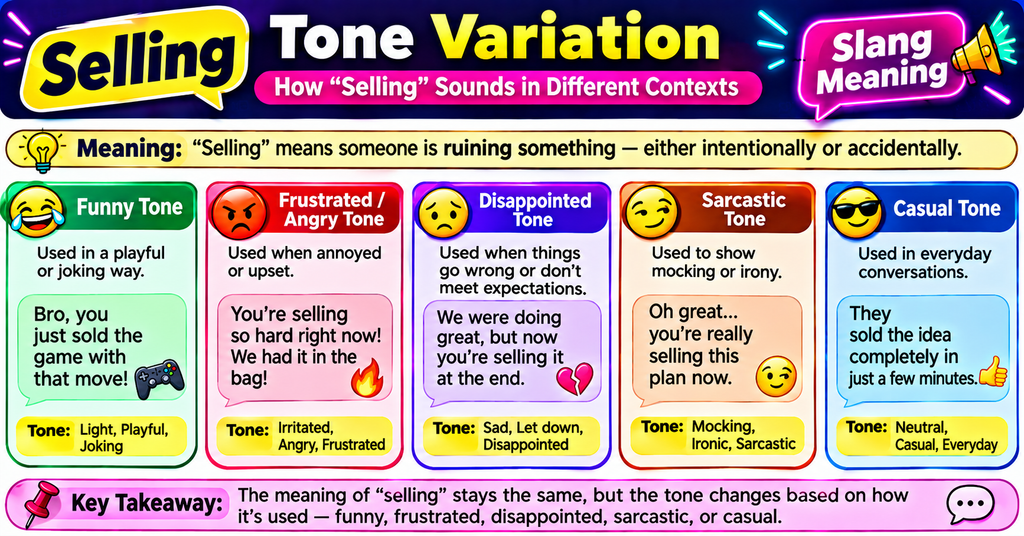
Tone & Context Variations
Funny Tone
Used to laugh at a harmless mistake: “bro sold that goal, how do you miss an open net.”
Sarcastic Tone
Points out an obvious blunder: “oh nice, really sold that one for the team.”
Romantic Tone
Occasionally used teasingly, like joking that someone “sold” a romantic moment by saying something awkward.
Angry Tone
Used seriously when a mistake caused real consequences: “you sold us the game, that was careless.”
Playful Tone
Common among friends, light and joking, without real blame behind it.
Grammar & Language Role
Part of Speech
Used as a verb (“he sold it”) or a short phrase (“that was a sell,” though this form is less common).
Sentence Position
Typically follows a subject and verb: “you sold it,” “they sold the game,” “don’t sell this.”
Does It Replace a Full Sentence?
Not usually on its own — it needs context (“you sold it” or “don’t sell this”) to make sense.
Tone Impact
The word itself is neutral; tone comes from surrounding words, not “selling” alone.
Formal vs Informal Use
Strictly informal. It doesn’t appear in formal writing, academic contexts, or professional communication.
How to Reply When Someone Says “Selling”
Funny Reply
“Yeah, I panicked, my bad.”
Serious Reply
“That was an honest mistake, not intentional.”
Flirty Reply
“Guess you’ll have to keep an eye on me next time.”
Neutral Reply
“Fair, that one’s on me.”
Comparison Table: Selling vs Throwing vs Choking vs Griefing
| Term | Meaning | Intent |
| Selling | Ruining something, on purpose or by accident | Can be either |
| Throwing | Intentionally losing a game | Always intentional |
| Choking | Failing under pressure, unintentionally | Unintentional |
| Griefing | Deliberately annoying or sabotaging teammates | Intentional, disruptive |
The key difference: “selling” covers both accidental and intentional ruin, while “throwing” and “griefing” are always intentional, and “choking” is always accidental.
Who Uses This Term?
Age Group
Most common among teens and young adults, roughly ages 14–28, especially gamers and social media users.
Region
No strong regional pattern in the U.S. — usage spreads mainly through gaming communities and short-form video, not geography.
Platforms
Most common on TikTok, Twitch, YouTube gaming comments, and group chats among gamers.
YOU MAY ALSO WANT TO KNOW ABOUT W MEANS ONLINE
Origin & Internet Culture Insight
Original Meaning
The term likely grew out of gaming culture, where “selling” a match or a play meant giving away an advantage through a costly mistake — similar to “selling out” a teammate.
Meme Culture Role
Gaming and sports clips use “selling” to caption moments where a mistake clearly wrecked an outcome, often paired with slow-motion replays or reaction memes.
Fast Typing Culture
Because it’s a short, real word repurposed for slang, it fits naturally into fast typing without needing abbreviation.
Why People Say “Selling” on TikTok
TikTok’s fail-clip and gaming-highlight culture leans on quick callouts, making “selling” a natural, frequently used comment under videos of costly mistakes.
Safety & Appropriateness
Is “Selling” Rude?
Not inherently. It’s usually a lighthearted callout, though it can feel harsh if used to blame someone for a genuine accident.
Is It a Bad Word?
No. It’s informal slang, not offensive language.
Should You Use It in School or Office?
It’s fine in casual settings but not appropriate for formal writing, reports, or professional communication.
Experience-Based Insight
Gaming communities and sports commentary sections show this pattern often: “selling” gets used the moment a single mistake changes the outcome of a match, whether that’s a missed shot, bad timing, or a careless call. That instant, outcome-focused usage is part of why the term spread so quickly through gaming and sports clips.
Summary
The selling meaning slang centers on one idea: ruining something, whether by accident or on purpose. It’s common in gaming and everyday chat, used to call out mistakes that cost something — a game, a surprise, or a plan.
Usage Tips
- Use it to point out a mistake in a lighthearted, non-serious way.
- Avoid using it to harshly blame someone for a genuine accident.
- Add context so the meaning is clear (“sold the game” vs. just “selling”).
Common Mistakes
- Using “selling” to mean literally selling a product, which confuses the slang meaning.
- Assuming it always implies intent — often it’s accidental.
- Using it in professional writing, where it reads as unclear or too casual.
When to Use
Use it in casual chats, gaming commentary, sports discussions, or social media comments about costly mistakes.
When to Avoid
Avoid it in formal writing, professional settings, or situations where blame could feel unfair or hurtful, especially over genuine accidents.
Conclusion
The selling meaning slang comes down to one thing: ruining something, whether by accident or on purpose. It’s most common in gaming, where a single mistake can “sell” the whole match. From there, it spread into everyday chat and social media.
Now that you know what it means, spotting it in a comment or clip is easy. Whether someone’s joking about a missed shot or calling out a genuine mistake, the meaning stays the same: something got wrecked, and “selling” is how people describe it.
Frequently Asked Questions
What does “selling” mean in Gen Z slang?
It means ruining something — a moment, a plan, or an opportunity — either accidentally or on purpose.
What does “selling” mean in gaming slang?
In gaming, “selling” usually means making a costly mistake that ruins a play or loses the match for your team.
What does “selling me” mean in slang?
It means someone thinks you ruined something for them, whether through a mistake or a deliberate action.
What does it mean if someone says you’re selling?
It means they think you’re messing something up, whether that’s a game, a plan, or a moment.
What’s the origin of “selling” as slang?
It likely comes from gaming culture, where “selling” a match meant giving away an advantage through a costly mistake.
Is “selling” the same as “throwing” in gaming?
They’re closely related. “Throwing” always implies intent to lose, while “selling” can be either accidental or intentional.
I am Qatar