
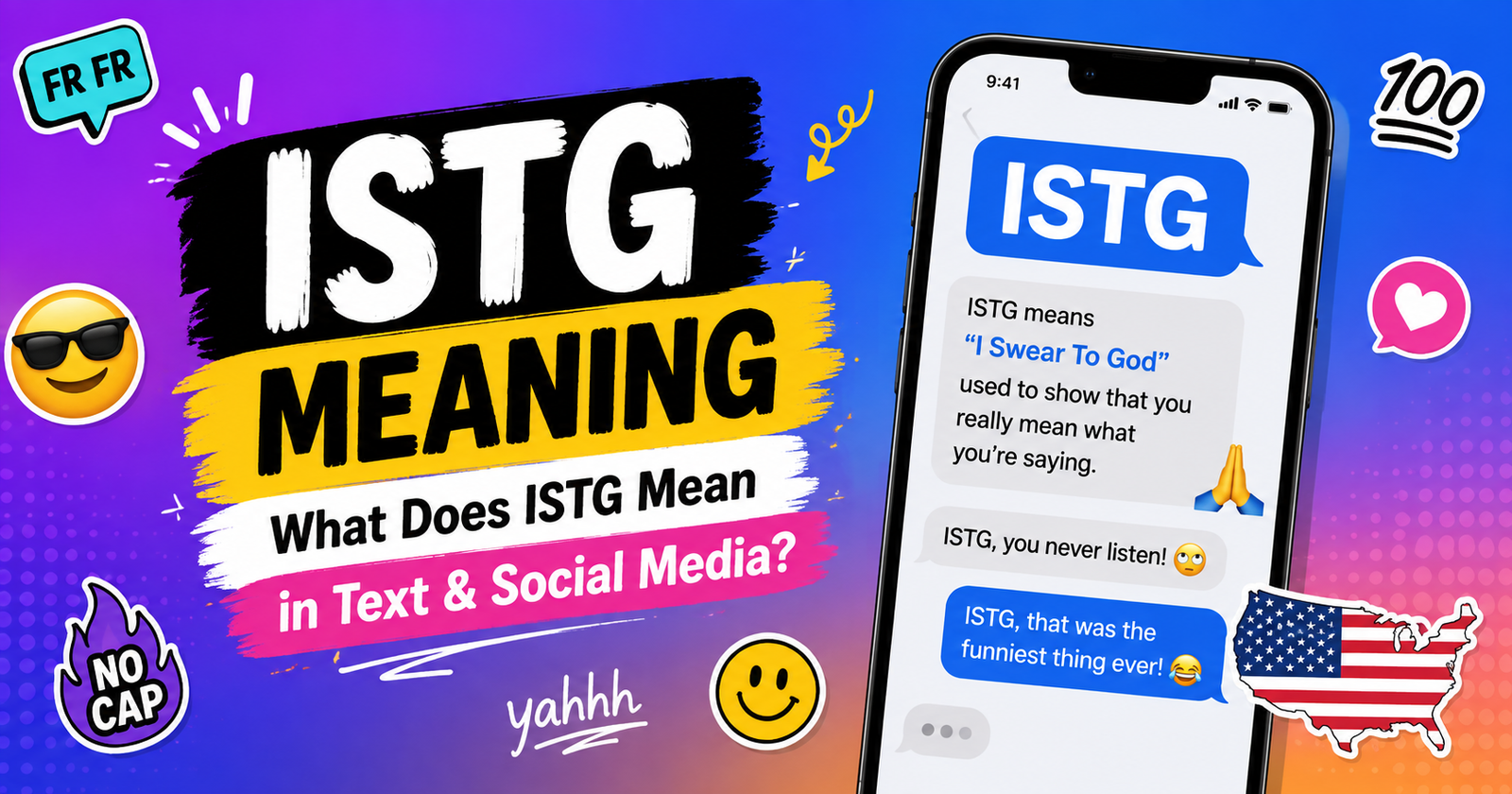
ISTG meaning in simple is “I Swear To God.” It’s a text and social media abbreviation people use to emphasize that they’re being completely honest, or to show strong emotion — frustration, excitement, disbelief, or a warning.
What Does ISTG Mean?
ISTG stands for “I Swear To God.” It’s a popular texting and social media abbreviation used to emphasize honesty, add emotional weight, or stress that someone is being completely serious.
People use ISTG across texts, Instagram, TikTok, Snapchat, and group chats to react to something surprising, make a casual promise, or vent frustration. The tone can shift ISTG meaning depending on context — it might sound playful, sarcastic, excited, or dead serious, but the core meaning stays the same: emphasis and sincerity, not a literal religious statement.
Example: “ISTG I finished the assignment last night, check your email.”
Things You Should Know
- ISTG = “I Swear To God.” That’s the core meaning across every platform.
- It’s used to add emphasis, not to make a literal religious statement.
- Tone changes everything — ISTG can sound playful, annoyed, sarcastic, or dead serious depending on context.
- It’s common in texting, Instagram, TikTok, Snapchat, and group chats, especially among teens and young adults.
- Related terms include IPB (I promise bro), ISTFG (I swear to freaking god), and IPS (I promise to God).
Quick examples:
- Casual: “ISTG this show is so good, you need to watch it.”
- Warning/serious: “ISTG if you touch my food one more time.”
- Sarcastic: “ISTG you’re the funniest person alive 🙄”
- Excited: “ISTG I just met my favorite celebrity!!”
- Safe for work: “ISTG I finished the report, check your email.”
ISTG Meaning and Origin
The ISTG meaning is simple: it’s shorthand for “I swear to God,” a phrase people have said out loud for generations to stress that they’re telling the truth or feel strongly about something.
The abbreviation itself grew out of early 2000s and 2010s texting culture, when character limits and fast typing pushed people to shorten common phrases. As texting gave way to Instagram comments, Twitter (now X), and group chats, ISTG carried over naturally. It didn’t originate on any single platform — it spread the same way most internet slang does, through everyday conversation moving online.
Today, the ISTG meaning in English stays consistent across contexts. What changes is the emotion behind it.
ISTG Usage Online and in Text
ISTG works as a stand-alone reaction or as part of a longer sentence. It’s flexible, which is part of why it’s stuck around.
How to Use ISTG
There’s no complicated grammar rule here. ISTG usually sits at the start of a sentence, like a spoken exclamation:
- “ISTG, that was the scariest movie I’ve seen.”
- “ISTG I’m going to fall asleep in class.”
- “ISTG she said that to my face.”
It can also stand alone as a full reaction to something someone else said.
Use of ISTG on different platforms:
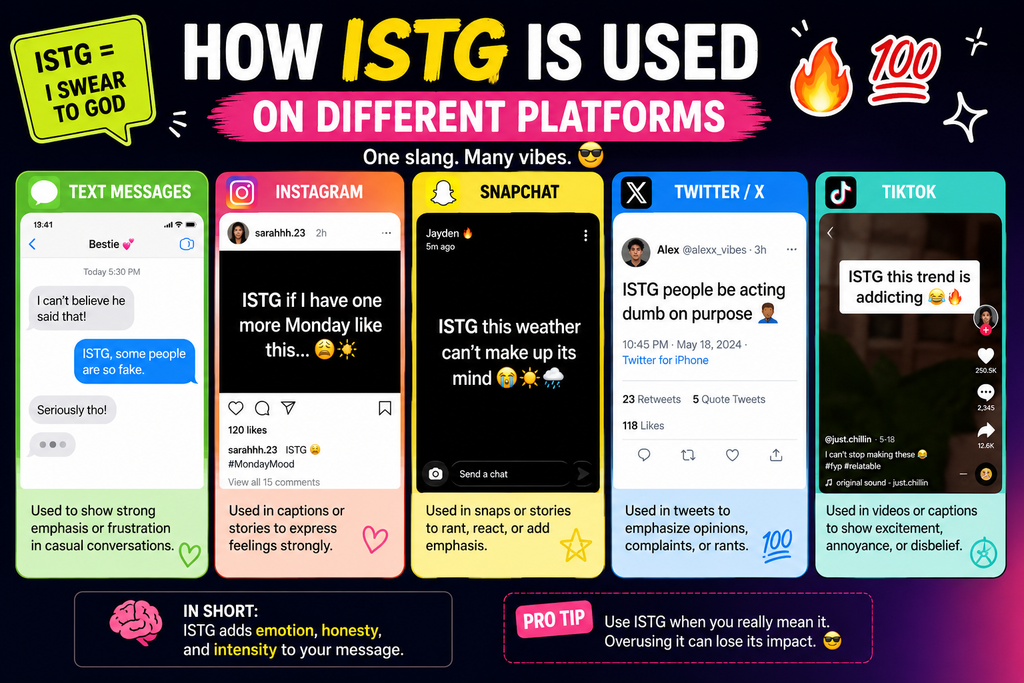
| Platform | Typical Use |
| Texting (iMessage/SMS) | Personal, emotional emphasis with friends or family |
| Instagram (comments/DMs) | Reacting to posts, reels, or messages with strong feeling |
| TikTok | Comment sections, often paired with humor or shock |
| Snapchat | Quick, casual reactions in chat |
| Twitter/X | Short, punchy reactions to news, memes, or opinions |
| Group chats | Common in back-and-forth banter or venting |
The ISTG meaning in chat doesn’t change platform to platform — only the tone and audience shift slightly.
YOU MAY ALSO WANT TO KNOW ABOUT NGL MEANS ONLINE
Real Chat Conversation Examples
Example 1 — Casual Friend 1: “Did you actually finish the whole pizza?” Friend 2: “ISTG I did, I don’t even feel bad.”
Example 2 — Serious/Warning Sibling 1: “Stop going through my phone.” Sibling 2: “ISTG I wasn’t, I was just charging it.”
Example 3 — Excited “ISTG I just got the internship!! I can’t believe it.”
Example 4 — Sarcastic “ISTG you’re SO helpful” (after someone gives bad directions).
Example 5 — Safe for work “ISTG the client meeting got moved to 3pm, just a heads up.”
Why is ISTG Slang Popular with Children?
Kids and teens use ISTG because it does a lot of emotional work in very few letters. Texting and social media favor speed, and abbreviations like ISTG let young people express intensity — anger, excitement, disbelief — without typing a full sentence.
It also fits naturally into peer culture. Teens often mirror how their friends text, and once slang like ISTG becomes common in a friend group or school, it spreads fast through group chats, comments, and shared memes.
Importantly, most uses of ISTG among kids are harmless. It’s rarely used with actual religious intent — it functions more like “I promise” or “for real.”
How Kids These Days are Using “ISTG”: Examples of Usage
The ISTG meaning from a girl or ISTG meaning from a boy in a text is generally the same — the phrase itself isn’t gendered. What differs is context: it might show up in a flirty exchange, a friendship dispute, a joke, or a genuine promise, regardless of who’s sending it.
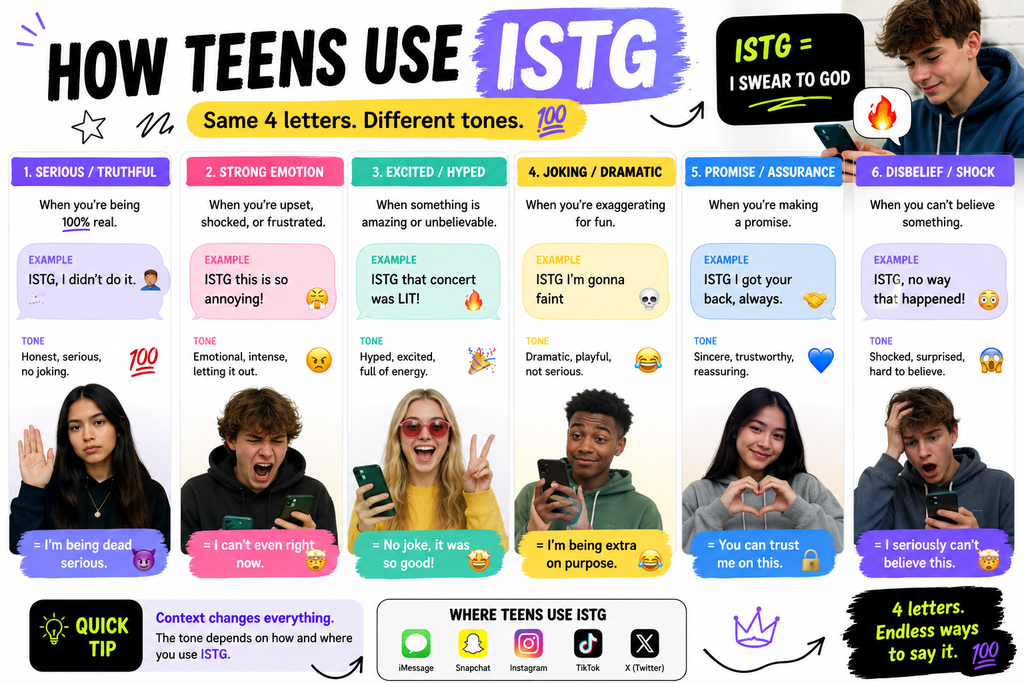
Tone and Context Variation of “ISTG”
Normal “ISTG traffic today was insane.”
Playful / Funny Tone “ISTG if you send me one more cat video I’m blocking you 😂”
Sarcastic Tone “ISTG this is the BEST homework ever” (clearly not).
Serious / Confrontational Tone “ISTG we need to talk about what happened yesterday.”
Replying to ISTG
You don’t need a complicated response. Common replies include:
- “Okay, I believe you.”
- “lol prove it”
- “ISTG too” (if agreeing or matching the energy)
- A simple “😂” or “💀” if it’s clearly a joke
Reading the tone of the original message matters more than the reply itself. A sarcastic ISTG deserves a joke back, while a serious one deserves a real response.
My Child Uses ISTG: How Can I Talk to My Child About Slang?
If you’ve noticed ISTG in your child’s messages, it’s rarely a red flag on its own. It’s one of the most common phrases in youth texting, right alongside terms like “fr fr” or “no cap.”
A few tips for talking about slang without making it awkward:
- Ask openly what a term means instead of assuming the worst.
- Avoid overreacting to mild slang — it can shut down future conversations.
- Focus on tone and context, not just the abbreviation itself.
- Use it as a natural opening to talk about respectful communication online.
Kids are more likely to be honest about their online activity when they don’t feel judged for normal texting habits.
SEE OUR GUIDE OF TS FOR A STRONGER EXPRESSION
Parental Control of Kids’ Messengers: Pros and Cons
Many parents consider monitoring apps or built-in phone controls once they start noticing unfamiliar slang. It’s worth weighing both sides.
Pros:
- Helps spot genuinely concerning conversations, not just slang
- Can filter contact from strangers
- Gives visibility into screen time and app usage
- Useful for younger children still learning online safety
Cons:
- Can feel like a privacy invasion to teens
- May damage trust if used without any conversation
- Doesn’t replace open communication
- Kids may simply switch to apps parents don’t monitor
The most effective approach usually combines light oversight with honest conversation, rather than relying on monitoring alone.
Related Slang Words
- IPB – I promise bro
- ISTFG – I swear to freaking god
- IPS – I promise to God
- Fr fr – for real, for real
- No cap – not lying
More Slang Acronyms to Know
- NGL – not gonna lie
- IMO / IMHO – in my opinion / in my humble opinion
- TBH – to be honest
- SMH – shaking my head
- IYKYK – if you know, you know
Summary, Usage Tips, and When to Avoid It
Usage Tips
- Use ISTG when you want to add emphasis, not as a literal statement.
- Pair it with emojis or punctuation to make tone clearer over text.
- Keep it casual — it fits best in informal conversations.
Common Mistakes to Avoid
- Using it in formal emails or professional messages.
- Assuming it always means the sender is upset — context matters.
- Overusing it, which can water down its emphasis.
When to Use It
- Texting friends or family
- Reacting to something surprising or funny
- Making a casual promise or emphasizing honesty
When to Avoid It
- Professional or academic writing
- Formal communication with teachers, employers, or clients
- Situations where religious sensitivity matters — some readers may prefer alternatives like “I promise” or “fr”
Conclusion
So that’s the ISTG meaning in a nutshell: “I swear to God.” It’s used to add weight to a message, whether that’s excitement, frustration, or a genuine promise. The tone always depends on context, not the letters themselves.
You don’t need to memorize every slang term out there. Just watch how people use it and match their energy. Next time ISTG shows up in your texts or on Instagram, you’ll know exactly what it means and how to respond.
FAQ
What does ISTG mean in Gen Z slang?
It means “I Swear To God” — used to add emphasis or show you’re being real about something.
What is ISTG FR FR?
It combines “I swear to God” with “for real, for real,” doubling down to show you’re completely serious.
What should I reply to ISTG?
A simple “okay, I believe you,” “lol prove it,” or a matching “ISTG too” works fine, depending on the tone.
Is ISTG rude or offensive?
Not inherently. It can sound intense depending on tone, but it’s generally casual slang, not an insult.
Is ISTG appropriate for work or school messages?
No. It’s informal slang best kept for casual texting, not professional communication.
What’s the difference between ISTG and ISTFG?
ISTFG (“I swear to freaking God”) is a slightly stronger, more expressive version of the same phrase.
Where did ISTG come from?
It comes from the spoken phrase “I swear to God,” shortened for faster texting as digital communication grew.