
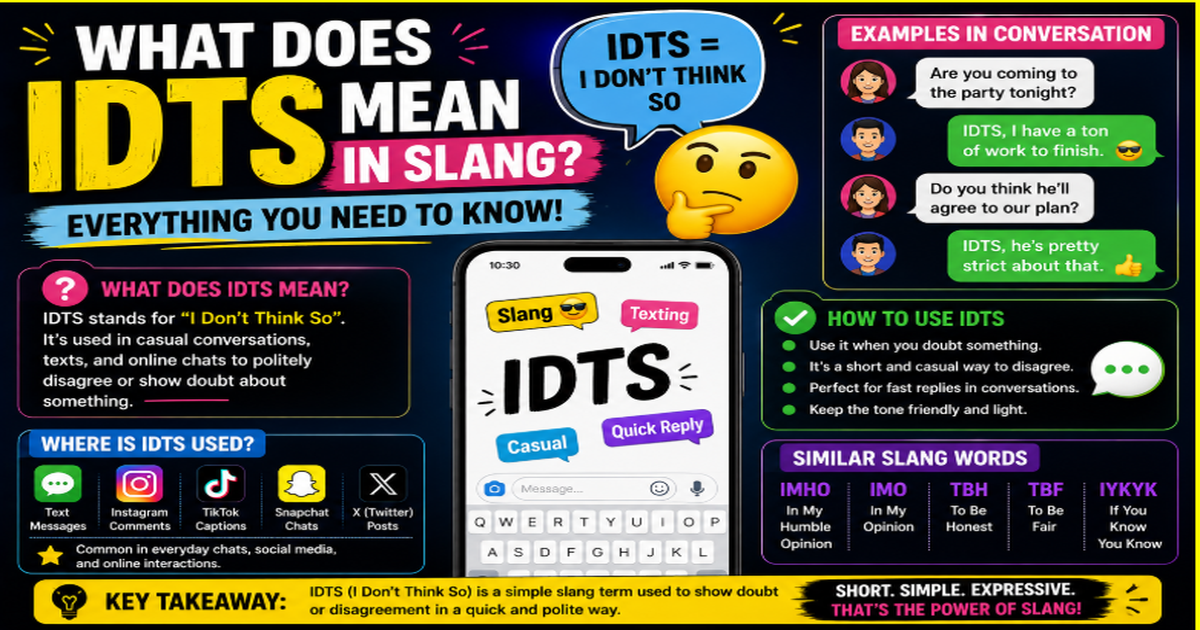
Have you seen “IDTS” in a text or comment and wondered what it means? It’s a common piece of internet slang. People use it to react quickly in chats and on social media. Once you know it, you’ll spot it everywhere.
IDTS stands for “I Don’t Think So”. People use it to show doubt or disagreement. It’s short, casual, and easy to type. This guide breaks down exactly how and when to use it.
What Does IDTS Mean?
IDTS = “I Don’t Think So.”
It’s used when someone wants to express disagreement, skepticism, or mild disbelief, but in a shorter, more casual way than typing the full sentence. It carries the same meaning as saying “nah, I doubt it” or “probably not.”
Example:
Sam: Do you think it’ll rain tomorrow? Jess: IDTS, the forecast looked clear.
What Does IDTS Mean in Text?
In texting, IDTS works the same way it does anywhere else — it’s a fast, informal way to say “I don’t think so” while keeping the conversation moving. Texting culture favors abbreviations like this because they save time and fit naturally into quick back-and-forth conversations.
You’ll typically see it as a standalone reply or tacked onto the end of a sentence, similar to how people use “IDK” (I don’t know) or “IMO” (in my opinion).
IDTS Meaning in Chat
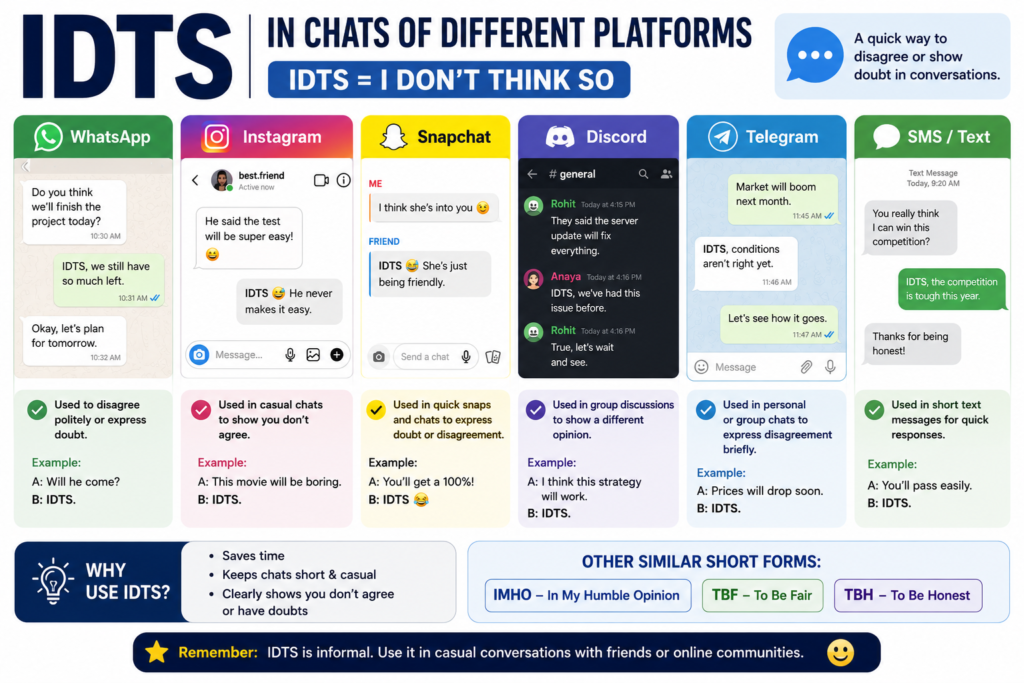
Across messaging apps — iMessage, WhatsApp, Discord, group chats — IDTS means the same thing: a short way to express doubt or disagreement. Chat culture in general leans heavily on abbreviations like this, especially in fast-paced group conversations where typing out full sentences slows things down.
IDTS Meaning on Snapchat
On Snapchat, IDTS is often used in chat replies or captions where someone is reacting to a friend’s plan, story, or claim. Because Snapchat conversations tend to be brief and rapid-fire, short forms like IDTS fit naturally.
IDTS Meaning on Instagram
On Instagram, you’ll mostly see IDTS in comments or DMs — someone disagreeing with a caption, a take, or a friend’s comment thread. It keeps replies quick and casual, matching the tone of the platform.
IDTS Meaning on TikTok
TikTok comment sections move fast, and IDTS is a common way to disagree with a video’s claim or another commenter’s opinion without writing a paragraph. It’s especially common in debate-style comment threads or reaction videos.
IDTS Meaning on WhatsApp
WhatsApp usage mirrors general texting — IDTS shows up in personal chats and group threads as a quick disagreement or expression of doubt, often followed by a reason.
ANOTHER COMMON TEXTING ABBREVIATION IS BMF
Is IDTS an Acronym?
Yes. IDTS is an initialism (a type of acronym) formed from the first letters of “I Don’t Think So.” It’s not pronounced as a word — you say the phrase it stands for, not the letters — which technically makes it an initialism rather than a true acronym, though most people use the terms interchangeably in casual speech.
Is IDTS a Short Form?
Yes. It’s a short form (abbreviation) of a common spoken phrase, created for faster typing. It belongs to the same family of texting shorthand as IDK, TBH, NGL, and IMO.
Is IDTS a Phonetic Spelling?
No. Unlike slang terms such as “gr8” or “cuz,” IDTS isn’t a phonetic spelling of a word. It’s a letter-based abbreviation, where each letter represents the first letter of a word in the phrase.
Is IDTS a Typo Turned Slang?
No, IDTS isn’t a typo that accidentally became slang (unlike some internet terms with murky origins). It was intentionally shortened from “I don’t think so” for convenience, following the same pattern as dozens of other common text abbreviations.
How the Tone of IDTS Changes
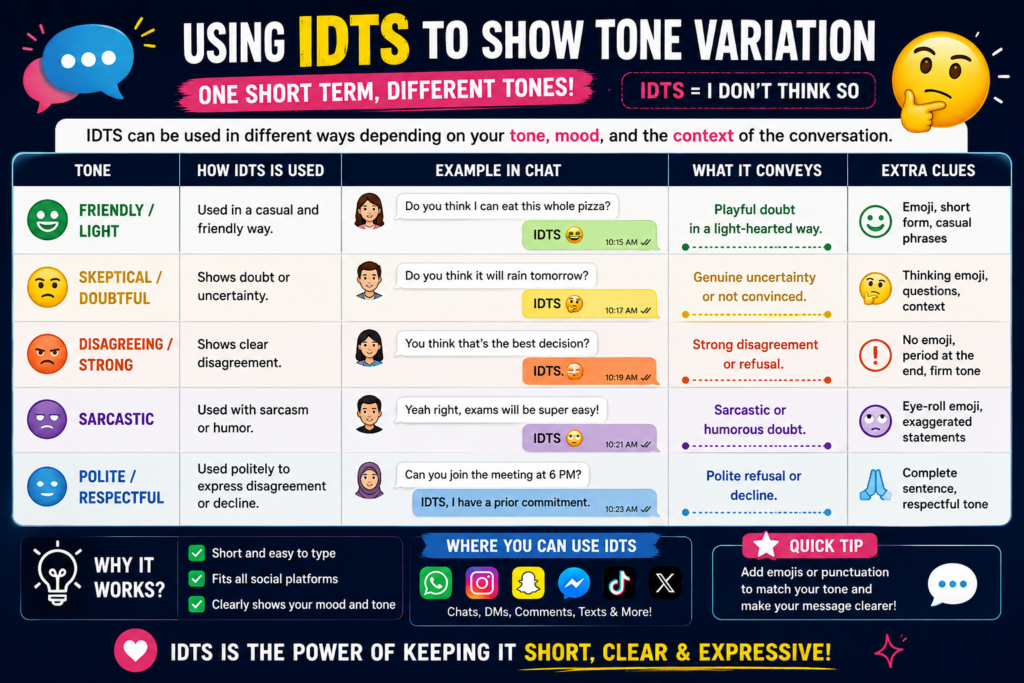
One of the trickiest things about IDTS is that its meaning stays the same, but its tone shifts a lot depending on context, punctuation, and who’s saying it.
Funny Tone
“Can I borrow your charger for the fifth time this week?” “IDTS 😂”
Sarcastic Tone
“I’m definitely going to wake up at 6am tomorrow.” “IDTS lol”
Romantic Tone
“Do you think we’ll ever get tired of each other?” “IDTS ❤️”
Angry Tone
“You said you’d be here an hour ago.” “IDTS you’re actually going to show up at this point.”
Playful Tone
“Bet I can beat you in this game.” “IDTS but go ahead and try 😏”
Punctuation and emojis do a lot of the emotional work here. “IDTS.” can read as blunt or annoyed, while “IDTS lol” or “IDTS 😂” softens it into something lighthearted.
Mini Conversation Examples
Example 1
“Think the store’s still open?” “IDTS, it’s already 9pm.”
Example 2
“He’s going to apologize first, watch.” “IDTS, he never does.”
Example 3
“Should I text him back right now?” “IDTS, give it a day.”
Example 4
“This diet is definitely going to work fast.” “IDTS, those things rarely do.”
Example 5
“I could probably run a marathon with zero training.” “IDTS 😂 maybe start with a 5k.”
Grammar and Language Role of IDTS
Part of Speech
IDTS functions as an interjection or a stand-in for a full independent clause. It isn’t a noun, verb, or adjective on its own — it replaces an entire sentence (“I don’t think so”).
Sentence Position
It can appear:
- Alone, as a complete reply
- At the start of a sentence (“IDTS that’s a good idea”)
- At the end of a sentence (“That’s not happening, IDTS”)
Does IDTS Replace a Full Sentence?
Yes. Because it stands in for a complete thought (“I don’t think so”), it can function as a full reply on its own without needing additional words.
Tone Impact
As shown above, the surrounding words, punctuation, and emojis shape whether IDTS reads as neutral, sarcastic, playful, or annoyed. On its own, with a period, it can come across as flat or dismissive; softened with “lol,” “haha,” or an emoji, it feels lighter.
Formal vs. Informal Use
IDTS is strictly informal. It belongs in texting, social media, and casual conversation — not in emails, reports, or professional documents (more on this below).
15 Real Chat Examples Using IDTS
- “Is the party still happening?” — “IDTS, I haven’t heard anything.”
- “You think she’s mad at me?” — “IDTS, she seemed fine earlier.”
- “Can we finish this project in one night?” — “IDTS, it’s way too much work.”
- “Is he coming to the wedding?” — “IDTS, he never RSVP’d.”
- “Will this shirt still fit after washing?” — “IDTS, it’s already tight.”
- “Do you think they’ll notice we left early?” — “IDTS lol, everyone was distracted.”
- “You think it’s a good idea to text him now?” — “IDTS, wait till tomorrow.”
- “Is the test going to be easy?” — “IDTS, the last one was brutal.”
- “Should I trust this online seller?” — “IDTS, check the reviews first.”
- “Do you think she’ll say yes?” — “IDTS, but it’s worth asking.”
- “Is this recipe actually quick?” — “IDTS, 30 minutes prep alone.”
- “You think our flight will be on time?” — “IDTS, it’s already delayed once.”
- “Will he remember my birthday?” — “IDTS, he forgot last year too.”
- “Do you think this trend will last?” — “IDTS, most fade fast.”
- “Is this a good time to ask for a raise?” — “IDTS, wait till after the review.”
YOU MAY ALSO WANT TO KNOW ABOUT WNL MEANS ONLINE
How to Reply When Someone Says IDTS
Funny Replies
- “Rude, but okay 😂”
- “Wow, no faith in me at all.”
Serious Replies
- “Why not?”
- “What makes you say that?”
Flirty Replies
- “Prove me wrong then 😏”
- “Guess I’ll have to convince you.”
Neutral Replies
- “Fair enough.”
- “Okay, noted.”
Comparison Table
| Abbreviation | Full Meaning | Typical Use |
| IDTS | I Don’t Think So | Expressing doubt or disagreement |
| IDK | I Don’t Know | Expressing uncertainty |
| IMO | In My Opinion | Sharing a personal view |
| NGL | Not Gonna Lie | Prefacing an honest opinion |
| TBH | To Be Honest | Prefacing a candid statement |
| IDC | I Don’t Care | Expressing indifference |
Who Uses IDTS?
Age Group
IDTS is most common among teens and young adults, roughly ages 13–30, who grew up texting and messaging as a primary form of communication.
Gen Z vs. Millennials
Both generations use IDTS, but Gen Z tends to use it more frequently and casually across social platforms (TikTok, Snapchat, Instagram comments), while Millennials use it more in direct texting and messaging apps.
Regional Popularity
IDTS is widely understood across English-speaking countries, including the US, UK, Canada, and Australia, though usage frequency varies by platform and age group rather than by region specifically.
Platforms Where IDTS Is Most Common
It shows up most in:
- Text messages
- Group chats (iMessage, WhatsApp, Discord)
- Social media comments (TikTok, Instagram)
- DMs on social platforms
Origin of IDTS and Its Place in Internet Culture
Like many texting abbreviations, IDTS emerged from the broader shift toward faster, keyboard-based communication in the 2000s and 2010s, as instant messaging and later smartphone texting made short forms practical. There’s no single documented origin point or creator; it developed alongside similar abbreviations like IDK, IMO, and NGL as part of everyday internet shorthand.
Why People Say IDTS on TikTok
TikTok comment culture rewards quick, punchy responses. IDTS lets users register disagreement in a debate or reaction thread without slowing down the scroll — it’s efficient and immediately understood by most viewers.
Meme Culture and the Popularity of IDTS
IDTS occasionally appears in meme captions or reaction images, often paired with humor to express disbelief at something absurd or unlikely, reinforcing its casual, lighthearted use.
Fast Typing Culture
At its core, IDTS exists because typing “I don’t think so” repeatedly in fast conversations is inefficient. Shorthand like this reflects how digital communication prioritizes speed without losing meaning.
SEE OUR GUIDE OF WYLL FOR A STRONGER EXPRESSION
Is IDTS Rude?
Not inherently. IDTS is neutral by default — it simply expresses doubt or disagreement. Whether it comes across as rude depends entirely on context, tone, and what follows it. “IDTS, but let’s see” reads very differently from “IDTS.” with no explanation.
Is IDTS a Bad Word?
No. IDTS isn’t offensive or inappropriate language. It’s simply informal shorthand and carries no vulgar or harmful meaning.
Should You Use IDTS at School or Work?
Appropriate Situations
- Casual texts with friends or classmates
- Informal group chats
- Social media comments among peers
Situations to Avoid
- Emails to teachers, professors, or supervisors
- Formal reports or professional documents
- Client-facing communication
Experience-Based Insight
As a general rule, if you wouldn’t say “I don’t think so” out loud in that setting because it feels too casual, you probably shouldn’t type IDTS there either. It’s best reserved for peer-to-peer, informal communication.
Other Meanings of IDTS (Outside Slang)
While “I Don’t Think So” is by far the most common meaning, the same letters can stand for different things depending on context:
- IDT meaning: Often refers to “Integrated DNA Technologies” (a biotech company) or is used as shorthand for “identity” in some technical contexts. It’s a different abbreviation from IDTS and isn’t interchangeable with it.
- IDTS in business: In some niche business or organizational contexts, IDTS has been used as an internal acronym or company name abbreviation — this varies by organization and isn’t a standardized industry term.
- IDTS meaning medical: IDTS isn’t a standard, widely recognized medical abbreviation. If you’ve seen it in a medical context, it’s likely specific to a particular institution, document, or specialty, so it’s worth confirming with the source rather than assuming a universal meaning.
- IDTS company: Some businesses use “IDTS” as part of their name or branding (as an initialism of their own company name), unrelated to the slang meaning.
If you’re researching IDTS outside of a texting or social media context, always check the surrounding material — the same letters can mean very different things depending on the field.
Conclusion
Now you know what IDTS means. It’s just a quick way to say “I don’t think so.” People use it in texts, chats, and comments every day. It’s casual, easy to use, and simple to understand.
Keep it for informal chats with friends. Skip it in emails or work messages. Pay attention to tone, since punctuation and emojis change how it feels. Once you get the hang of it, IDTS becomes second nature.
Quick Summary
IDTS stands for “I Don’t Think So” and is a common, informal way to express doubt or disagreement in texting, chat apps, and social media comments. It’s neutral by default, with tone shaped entirely by context, punctuation, and emojis.
Common Mistakes to Avoid
- Using IDTS in formal emails or professional settings
- Assuming it always means the same thing outside slang contexts (business, medical, or company names may use it differently)
- Confusing it with similar-looking abbreviations like IDTG, which aren’t standardized the same way
When to Use IDTS
Use it in casual, informal conversations — texts, group chats, and social media — when you want a quick, natural way to express doubt or disagreement without typing a full sentence.
Frequently Asked Questions
Is IDTS used the same way in 2024 as it was in 2022?
Yes. The meaning and usage of IDTS have stayed consistent — it hasn’t shifted the way some slang terms do over a couple of years.
Can IDTS be used in professional writing?
No, it should be avoided in formal or professional communication. Use the full phrase “I don’t think so” instead.
Does IDTS always mean disagreement?
Mostly, yes — it expresses doubt and disagreement. The intensity depends on tone and context, but the core meaning stays the same.
What does IDTS mean in chat?
IDTS means “I Don’t Think So.” People use it to show doubt or disagreement in a text or chat.
Is IDTS a good or bad word?
No, IDTS isn’t a bad word. It’s just casual slang for expressing doubt.
How do you use IDTS in a sentence?
You use IDTS to reply when you disagree or doubt something, like “IDTS, that’s not happening.”
What does IDTS mean on TikTok or Instagram?
On TikTok and Instagram, IDTS means “I Don’t Think So.” People use it in comments to disagree quickly.
What is IDT slang?
IDT usually means “I Don’t Think” — a shorter version used before finishing a thought, like “IDT that’s true.”
2 thoughts on “What Does IDTS Mean in Slang? Everything You Need to Know”